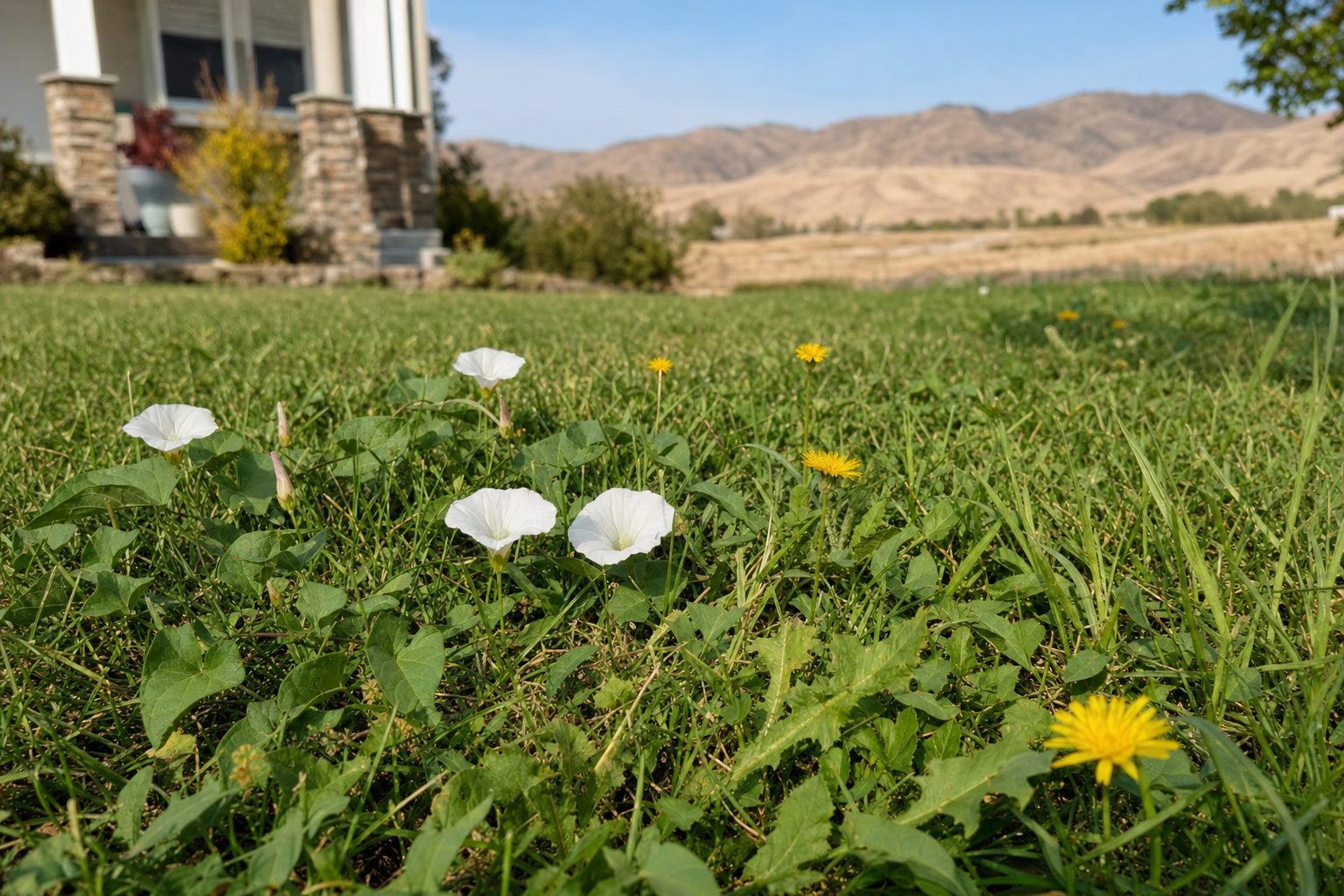
August is peak weed season in the Treasure Valley. The heat stresses your lawn, irrigation struggles to keep up, and weeds exploit every bare patch and stressed blade of grass. This guide identifies the 12 most common weeds in Ada and Canyon County yards — and gives you practical, season-by-season strategies to control them.
Why weeds thrive in the Treasure Valley
Our climate creates a perfect storm for weeds. Boise averages just 12 inches of rain per year, concentrated in winter and spring. By July and August, lawns go dormant or survive only with heavy irrigation. Weeds — especially deep-rooted perennials like field bindweed and Canada thistle — tap moisture far below where turfgrass roots reach. Our alkaline, compacted soils (particularly in new subdivisions from Nampa to Kuna) favor pioneer species: plants evolved to colonize disturbed ground.
The key to weed control in the Treasure Valley is understanding that weeds are a symptom, not just a problem. Bare soil, thin turf, overwatering, underwatering, and compacted ground all invite weeds. The most effective long-term strategy is to grow healthy, dense turf or planting beds that leave no room for invaders. Herbicides and hand-pulling are tools, but soil health, proper mowing height, and smart irrigation are the real solutions.
Idaho noxious weed law: Idaho state law designates 64 species as noxious weeds. Property owners are legally responsible for controlling them. The Ada County Noxious Weed Control program (208-577-4646) offers consultations and treats noxious weeds on private property at no cost. They do not treat nuisance (non-noxious) weeds like dandelions or crabgrass — those are the homeowner's responsibility.
The 12 most common Treasure Valley yard weeds
These are the weeds you're most likely to encounter from Boise to Caldwell, organized by type: grassy weeds, broadleaf weeds, and noxious weeds that require legal control.
Grassy weeds
1. Crabgrass (Digitaria sanguinalis, Digitaria ischaemum)
What it looks like: Low, spreading grass with flat, yellow-green blades. Grows in a prostrate star pattern from a central point. Seed heads branch like fingers radiating from the stem. Turns purplish-red in fall before dying.
Life cycle: Summer annual. Germinates when soil temperatures reach 55°F for 3+ consecutive days (typically late April to May in the Treasure Valley). Dies at first hard frost (early October). Each plant produces up to 150,000 seeds.
Where you'll find it: Thin or bare lawn areas, along sidewalks and driveways where heat reflects, edges of lawns near curbs. Thrives in the heat that stresses Kentucky bluegrass and tall fescue.
Control: Apply a pre-emergent herbicide in early to mid-April (when soil temps hit 50°F) to prevent germination. Once emerged, spot-treat with a post-emergent containing quinclorac or fenoxaprop. Raise your mowing height to 3–4 inches to shade the soil and prevent seed germination. Overseed bare patches in September with cool-season grass seed to deny crabgrass space the following spring.
2. Quackgrass (Elymus repens)
What it looks like: Tall, coarse grass with flat blades and clasping auricles (small claws that wrap around the stem). White, creeping rhizomes spread underground. Often confused with tall fescue, but quackgrass has a prominent midrib on the leaf blade and grows in patches rather than individual clumps.
Life cycle: Perennial. Spreads aggressively via rhizomes that can extend 6 feet or more in a single season. Any rhizome fragment left in the soil can start a new plant.
Where you'll find it: Garden beds, lawn edges, areas where topsoil was brought in. Very common in new Treasure Valley subdivisions where disturbed soil and imported fill create ideal conditions.
Control: Non-selective glyphosate is the most effective option — it translocates to the rhizomes. Multiple treatments are needed. Digging can work for small patches but every rhizome fragment must be removed. In lawns, there is no selective herbicide that kills quackgrass without killing desirable turf — the best approach is to kill the patch, then reseed in fall.
3. Cheatgrass (Bromus tectorum)
What it looks like: Bright green in early spring, turning purple-red then straw-colored by June. Drooping seed heads with long awns (bristles). Grows 4–30 inches tall.
Life cycle: Winter annual. Germinates in fall, grows through winter, seeds out and dies by early summer. Extremely flammable when dry.
Where you'll find it: Undeveloped lots, Boise Foothills properties, areas adjacent to open land, poorly maintained lawns. One of the most significant invasive grasses in Idaho — it increases wildfire risk and outcompetes native bunchgrasses.
Control: Pre-emergent herbicide in early fall (September) before germination. Mow before seed heads form in spring to reduce the seed bank. For Foothills properties, see our Firewise Landscaping guide for cheatgrass removal strategies in the defensible space zones.
Broadleaf weeds
4. Field bindweed / Morning glory (Convolvulus arvensis)
What it looks like: Trailing vine with arrowhead-shaped leaves and white-to-pink trumpet flowers that look like miniature morning glories. Twines around anything vertical — fence posts, shrubs, other plants. Forms dense mats that smother lawns and garden beds.
Life cycle: Perennial. Roots extend 8–20 feet deep — deeper than any other common yard weed. Spreads by seed, root fragments, and creeping rhizomes. A single plant can occupy 20 square feet in one season.
Where you'll find it: Everywhere in the Treasure Valley. Particularly aggressive in dry, well-drained soils on south- and west-facing slopes. The #1 most-requested noxious weed for Ada County Weed Control.
Control: The most frustrating weed in the Treasure Valley. Hand-pulling only works for very young plants — established bindweed regrows from any root fragment. Herbicide with 2,4-D plus a surfactant (to penetrate the waxy leaf surface) is most effective, applied in fall before dormancy when the plant pulls the chemical down into its deep roots. Expect 3–5 years of persistent treatment. Never let it go to seed — each flower produces seeds viable for 20+ years.
Bindweed reality check: If you have a severe bindweed infestation, you will not eliminate it in one season. The goal is suppression, not eradication. Consistent fall herbicide treatment + preventing seed production + maintaining dense turf to outcompete new shoots is the proven approach. Patience is essential.
5. Dandelion (Taraxacum officinale)
What it looks like: Rosette of jagged, lance-shaped leaves. Bright yellow flowers on hollow stems. White puffball seed heads. Taproot is thick and fleshy, 6–18 inches deep.
Life cycle: Perennial. Blooms spring through fall, with a peak in April–May and a second flush in September. Each flower head produces 50–170 seeds that travel on the wind.
Where you'll find it: Lawns, garden beds, sidewalk cracks, anywhere with thin turf or bare soil.
Control: Hand-dig with a dandelion fork, removing at least 4–6 inches of taproot (any remaining root will regrow). Broadleaf herbicides containing 2,4-D, MCPP, or dicamba are effective. Fall treatment is most effective — the plant is moving nutrients to its roots for winter, taking the herbicide with it. Maintain a thick, healthy lawn at 3–4 inch mowing height to prevent dandelion establishment.
6. White clover (Trifolium repens)
What it looks like: Low-growing with three rounded leaflets (occasionally the lucky four). White, ball-shaped flowers. Creeping stems root at nodes, allowing it to spread.
Life cycle: Perennial. Fixates nitrogen from the air, which allows it to thrive in nitrogen-poor soils where turf struggles.
Where you'll find it: Lawns with low nitrogen. Clover is often a sign that your lawn needs fertilizer. It handles drought and foot traffic better than most turf grasses.
Control: The simplest fix: fertilize your lawn. Clover thrives in low-nitrogen soil, so applying a balanced fertilizer (3–4 lbs nitrogen per 1,000 sq ft per year) naturally suppresses it. If you prefer herbicide, broadleaf weed killers with 2,4-D + dicamba + MCPP (often sold as "weed and feed") are effective. Or embrace it — clover is increasingly used as a lawn alternative because it stays green without fertilizer, tolerates drought, and supports pollinators. See our lawn alternatives guide for more on clover lawns.
7. Puncturevine / Goatheads (Tribulus terrestris)
What it looks like: Flat, prostrate plant spreading from a central taproot in a wheel pattern up to 6 feet across. Tiny yellow flowers with five petals. Leaves resemble narrow fir needles. Produces hard, spiny seed pods that look like goat heads (or caltrops) — the bane of bicyclists and bare feet across the Treasure Valley.
Life cycle: Summer annual. Germinates May–June, flowers and seeds through summer until frost. Seeds remain viable for up to 30 years.
Where you'll find it: Bare soil, gravel, sidewalk cracks, driveway edges, and along bike paths. Loves the compacted, sandy soils common in Meridian and Kuna. Designated noxious in Ada County.
Control: Pre-emergent herbicide in March and again in June (before germination). Hand-pull before seeds form — grasp just below the root crown and pull the entire plant. Bag and trash any plants with seeds; never compost them. Check shoes, tires, and pet paws after walking through infested areas. This is the weed that causes the most calls to Ada County Noxious Weed Control.
8. Prostrate spurge (Euphorbia prostrata)
What it looks like: Flat, mat-forming plant with reddish stems radiating from a center point. Small, oval dark green leaves often with a maroon spot in the middle. Tiny pink flowers. Exudes a milky sap when broken. Often confused with puncturevine, but spurge has no spines.
Life cycle: Summer annual. Germinates in late spring, grows rapidly in summer heat.
Where you'll find it: Sidewalk cracks, driveway edges, thin or drought-stressed lawn areas. Loves the hot, dry conditions of July and August.
Control: Pull by hand, cutting below the root crown. Pre-emergent in spring prevents germination. Maintain thick turf — spurge cannot compete with healthy grass. Post-emergent broadleaf herbicides containing 2,4-D are effective on young plants.
9. Purslane (Portulaca oleracea)
What it looks like: Low, fleshy plant with succulent, paddle-shaped leaves and reddish stems. Small yellow flowers. Spreads flat along the ground in a radiating pattern up to 3 feet.
Life cycle: Summer annual. Produces over 100,000 seeds per plant, viable for 40+ years. Can also regrow from stem fragments left on the soil surface.
Where you'll find it: Vegetable gardens, bare ground, newly landscaped areas, drought-stressed lawns. Particularly common in raised beds and containers.
Control: Hand-pull before flowering — but do NOT till or chop the plant, as stem fragments will root and create more plants. Bag and remove pulled plants. Pre-emergent herbicide in spring. Mulch garden beds heavily (2–3 inches) to prevent germination. Interestingly, purslane is edible and nutritious — high in omega-3 fatty acids — but most Treasure Valley gardeners want it out of their beds.
10. Kochia (Bassia scoparia)
What it looks like: Upright, bushy plant growing 3–7 feet tall. Narrow, gray-green leaves on many branching stems. Turns bright red in fall. When mature, breaks off at the base and tumbles across the landscape as a tumbleweed, scattering seeds.
Life cycle: Summer annual. Germinates early (March–April). Each plant produces over 14,000 seeds.
Where you'll find it: Vacant lots, roadside ditches, fence lines, new construction sites. Extremely common across the Treasure Valley, especially in developing areas of Meridian, Kuna, and Star.
Control: Pull or hoe seedlings in spring when small (under 6 inches). Pre-emergent in March. Mow or cut before seed set in summer. Do not let plants mature into tumbleweeds — a single plant rolling across your property can seed thousands of square feet. Herbicide with 2,4-D or glyphosate is effective on young plants.
Noxious weeds (legally required to control)
11. Canada thistle (Cirsium arvense)
What it looks like: Erect plant 3–6 feet tall with spiny, wavy-edged bright green leaves. Purple urn-shaped flowers about ½ inch in diameter. Spreads in patches connected by underground rhizomes.
Life cycle: Perennial. Extensive rhizome system can reach 15 feet horizontally. Each plant produces 1,500–3,000 seeds with a 95% germination rate, viable for 20+ years.
Where you'll find it: Pastures, fence lines, garden borders, and anywhere with disturbed soil. Designated noxious in Idaho — property owners are legally required to control it.
Control: Herbicide is the most effective method — 2,4-D or clopyralid (the gold standard for thistles) translocates into the roots. Apply in spring at emergence, during bud formation (before flowering), and in fall before frost to push chemical into roots. Mechanical pulling is NOT recommended — it breaks rhizomes into fragments, each of which regrows. Expect 3–5 years of treatment for full control.
12. Whitetop / Hoary cress (Lepidium draba)
What it looks like: Plant growing 1–2 feet tall with blue-gray, hairy, lance-shaped leaves. Flat clusters of small white flowers with four petals at the top of the stalk. Blooming whitetop looks like a white-topped carpet across a field.
Life cycle: Perennial. Spreads by seed and rhizomes. Toxic to livestock.
Where you'll find it: Disturbed areas, pastures, roadsides, and open lots. Common in rural areas of Canyon County and the agricultural edges of Nampa and Caldwell.
Control: Similar to Canada thistle — herbicide with 2,4-D before flowering, repeated treatments. Do not mow after flowering as it spreads seeds. Cultural control with weed barrier fabric can suppress new growth. Designated noxious in Idaho.
Quick identification table
| Weed | Type | Life cycle | Noxious? | Best control window |
|---|---|---|---|---|
| Crabgrass | Grassy | Summer annual | No | Pre-emergent: April. Post-emergent: May–July |
| Quackgrass | Grassy | Perennial | No | Spring or fall (glyphosate) |
| Cheatgrass | Grassy | Winter annual | No | Pre-emergent: September. Mow: April–May |
| Field bindweed | Broadleaf | Perennial | Yes | Fall (before dormancy) — 3–5 yr program |
| Dandelion | Broadleaf | Perennial | No | Fall (herbicide translocates to roots) |
| White clover | Broadleaf | Perennial | No | Spring–fall (fertilize lawn first) |
| Puncturevine | Broadleaf | Summer annual | Yes | Pre-emergent: March + June. Pull: May–Sept |
| Prostrate spurge | Broadleaf | Summer annual | No | Spring pre-emergent; pull young plants |
| Purslane | Broadleaf | Summer annual | No | Pre-emergent: spring. Hand-pull (no tilling) |
| Kochia | Broadleaf | Summer annual | No | Pre-emergent: March. Pull/hoe: April–June |
| Canada thistle | Broadleaf | Perennial | Yes | Spring + fall (clopyralid or 2,4-D) |
| Whitetop | Broadleaf | Perennial | Yes | Spring before flowering (2,4-D) |
Control strategies: choosing your approach
Organic and cultural methods
The most sustainable weed control doesn't come in a bottle. A thick, healthy lawn is the best weed suppressor available — weeds are opportunists that exploit bare soil, thin grass, and stressed turf.
- Mow high (3–4 inches): Taller grass shades the soil, preventing weed seed germination. Mowing too short is the #1 cause of crabgrass and spurge in Treasure Valley lawns.
- Deep, infrequent watering: Daily shallow watering encourages shallow roots and weed germination at the surface. Water 2–3 times per week, 30–45 minutes per zone, to encourage deep turf roots. See our irrigation guide for Treasure Valley-specific schedules.
- Fertilize properly: Clover and dandelions thrive in under-fertilized lawns. Apply 3–4 lbs of nitrogen per 1,000 sq ft per year, split across September, November, and April applications.
- Aerate annually: Core aeration in September relieves compaction, improves water infiltration, and creates space for grass roots to spread — reducing the bare, compacted spots where weeds establish.
- Mulch garden beds: A 2–3 inch layer of bark mulch, compost, or gravel prevents weed germination by blocking light. Replenish annually.
- Hand-pull regularly: A weekly walk through the yard with a weed fork catches weeds when they're small and easy to remove. Ten minutes a week is more effective than one exhausting weekend per year.
- Overseed thin lawns: Each September, overseed bare and thin patches with a quality Kentucky bluegrass or tall fescue blend. Dense turf leaves no room for weeds.
Herbicide strategies
When cultural methods aren't enough, herbicides are a valuable tool. The key is using the right product at the right time — not blanket-spraying your entire yard.
Pre-emergent herbicides
Pre-emergents prevent weed seeds from germinating. They create a chemical barrier in the soil that stops root development. Timing is critical — apply before germination, not after.
- Crabgrass pre-emergent: Apply in early to mid-April, when soil temperatures reach 50°F. Products containing prodiamine (Barricade) or dithiopyr (Dimension) provide 3–4 months of control. Do not overseed within 8 weeks of applying pre-emergent — it will prevent grass seed from germinating too.
- Puncturevine pre-emergent: Apply in March and again in June. Puncturevine germinates later than crabgrass (May–June), so a second application extends the barrier.
- Cheatgrass pre-emergent: Apply in September before fall germination. This is the opposite timing from crabgrass — cheatgrass is a winter annual, not a summer annual.
Post-emergent herbicides
Post-emergents kill weeds that have already emerged. They fall into two categories:
- Selective (broadleaf weed killers): Products containing 2,4-D, MCPP (mecoprop), and dicamba kill broadleaf weeds (dandelions, clover, thistle, bindweed) without harming grass. Best applied in fall when weeds are pulling nutrients (and herbicide) into their roots. Available at Edwards Greenhouse, Zamzows, and Home Depot in the Treasure Valley. Cost: $15–$30 for a ready-to-use spray bottle, $40–$80 for concentrate.
- Non-selective (glyphosate): Kills everything it touches. Use for spot treatment in driveways, sidewalk cracks, and garden borders where you don't want any vegetation. Avoid on windy days — drift will damage desirable plants. Cost: $20–$50 depending on concentration.
Always read the label. Herbicide labels are legal documents. Follow application rates, timing, and safety precautions exactly. Wear gloves, long sleeves, and eye protection. Keep children and pets off treated areas until the product has dried completely (typically 24 hours). Do not apply before rain or irrigation — runoff carries herbicides into storm drains and the Boise River.
Seasonal weed control calendar for the Treasure Valley
March
Apply pre-emergent for puncturevine and kochia. Hand-pull winter rosettes (dandelion, thistle, mullein) while soil is soft and roots are shallow. Spot-treat bindweed with 2,4-D as it emerges.
April
Apply crabgrass pre-emergent when soil reaches 50°F. Fertilize lawn to suppress clover. Begin weekly hand-pulling rounds. Hoe kochia seedlings while small.
May–June
Second pre-emergent for puncturevine. Spot-treat emerged crabgrass. Mow lawn at 3–4 inches. Pull puncturevine before seeds form. Check for Canada thistle buds — spray before flowers open.
July–August
Peak weed season. Hand-pull spurge and purslane from garden beds (do not till purslane). Keep bindweed from flowering — clip vines weekly. Bag and trash any weeds with seeds. Maintain irrigation to keep turf competitive.
September
The most important month for weed control. Apply fall broadleaf herbicide (2,4-D) for dandelions, bindweed, thistle — plants are pulling nutrients to roots, taking herbicide with them. Aerate and overseed thin lawns. Apply cheatgrass pre-emergent.
October–November
Late fall herbicide treatment for perennial weeds (bindweed, thistle, whitetop) before ground freezes. Clean up all weed debris to reduce next year's seed bank. Final fertilizer application to strengthen turf for winter.
Local resources for weed control in the Treasure Valley
Professional help
- Ada County Noxious Weed Control — (208) 577-4646. Free consultations and noxious weed treatment for Ada County properties. They will identify weeds and provide management recommendations. adacounty.id.gov
- University of Idaho Extension, Ada County — (208) 287-5900. Plant identification, soil testing, and research-based weed management advice. Bring a sample for free identification.
- Canyon County Extension — (208) 459-6003. Same services for Nampa, Caldwell, and surrounding areas.
Where to buy herbicides and tools
- Zamzows — Multiple Treasure Valley locations. Locally owned, carries selective and pre-emergent herbicides suited to Idaho conditions, plus organic options. Staff are knowledgeable about local weeds.
- Edwards Greenhouse — 4106 Sand Creek St, Boise. Garden-focused, carries organic weed control products and high-quality tools for hand-weeding.
- Home Depot / Lowe's — Boise, Meridian, Nampa locations. Broad selection of branded herbicides (Spectracide, Roundup, Ortho) and pre-emergent products. Best for bulk purchases.
- Northwest Horticultural Supply — 8535 W State St, Boise. Professional-grade herbicides and equipment for larger properties.
Free identification
If you can't identify a weed, bring a sample (including roots, leaves, and flowers if present) to the University of Idaho Extension office in your county. They'll identify it for free and recommend control strategies specific to your location. The Ada County Noxious Weed Guide also has detailed photo guides for every noxious and nuisance weed in the area.
When to call a professional
For most yard weeds, a homeowner with a hand fork and a bottle of broadleaf herbicide can handle the job. But some situations call for professional help:
- Severe bindweed infestations — If bindweed covers more than 25% of your yard, a professional lawn care service with commercial-grade products and multi-year treatment plans will save you years of frustration.
- Noxious weeds on large properties — If you have Canada thistle, whitetop, or Scotch thistle on an acre-plus property, Ada County Noxious Weed Control will treat them at no cost. For large nuisance weed infestations, a professional spray service is more cost-effective than buying hundreds of dollars of retail herbicide.
- Lawn renovation — If weeds make up more than 50% of your lawn, it's time for a full renovation: kill everything, amend the soil, reseed in September. A landscape contractor can handle this efficiently. See our contractor selection guide for how to choose the right one.
For routine weed prevention — proper mowing, fertilizing, and irrigation — see our Treasure Valley lawn care guide and late summer lawn recovery guide.