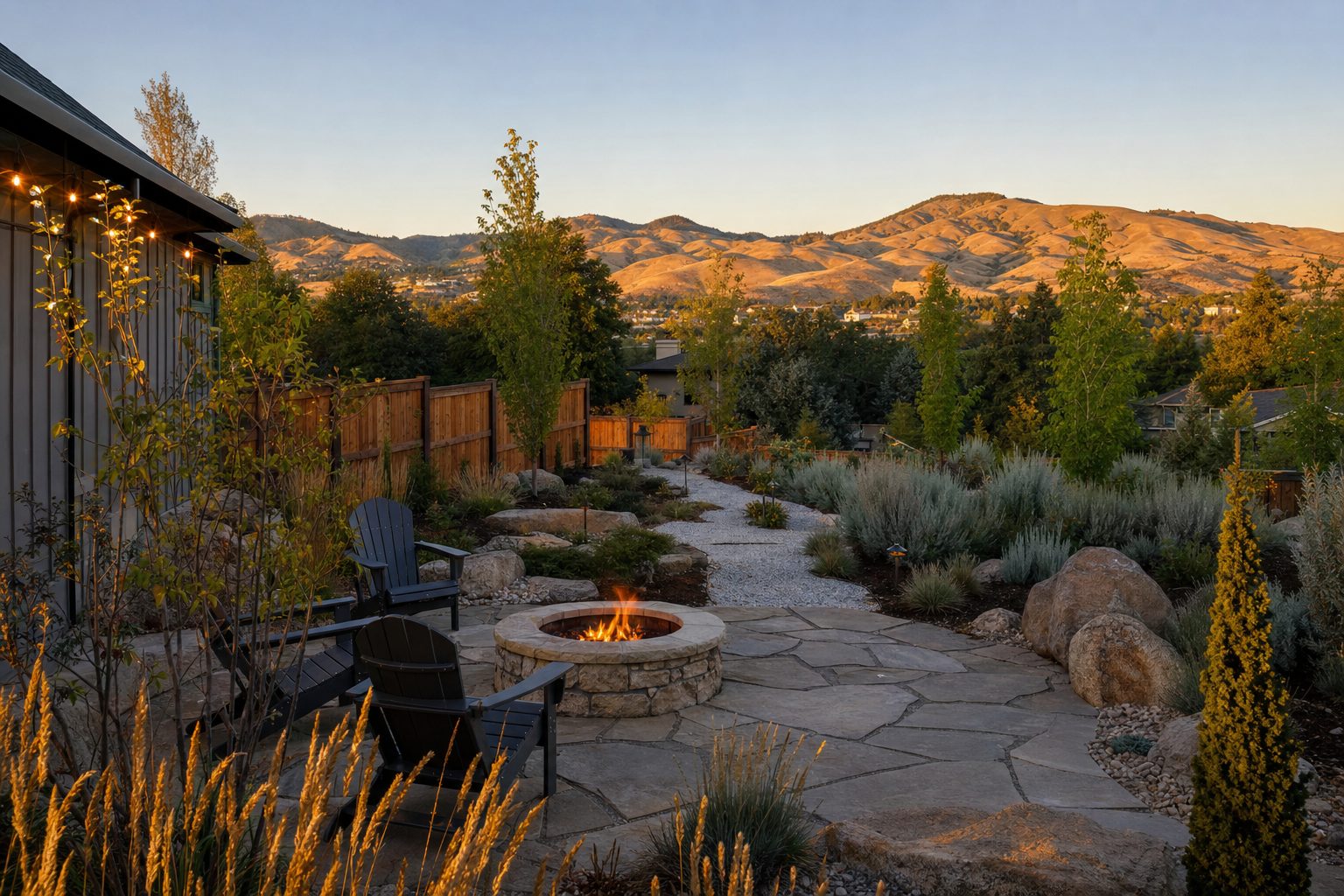
Before & After: Treasure Valley Landscaping Transformations
Every Treasure Valley yard has a "before" — the patchy lawn, the bare dirt from new construction, the overgrown shrubs the previous owner planted 25 years ago. This guide walks through six real transformation concepts you can see across Boise, Meridian, Nampa, and the surrounding valley, with honest cost ranges, realistic timelines, and the decisions that separate a good result from a great one.
Landscaping is the one home improvement that literally grows in value over time. National research from Opendoor and the American Society of Landscape Architects (ASLA) shows that well-executed landscaping can increase a home's value by 5–15%. In the Treasure Valley's hot housing market — where median home prices in Ada County hover around $525,000 (Boise Regional Realtors, 2025) — a 5% value bump from quality landscaping represents over $26,000. Even a modest front yard refresh of $5,000–$8,000 can pay for itself at sale time, while delivering years of enjoyment before that day comes.
The six Treasure Valley yard types
Most yards in the Treasure Valley fall into one of six recognizable categories. Identifying which one you have is the first step toward planning the right transformation.
| Yard type | What it looks like | Typical location | Best transformation |
|---|---|---|---|
| The New Construction Blank Slate | Compacted clay subsoil, builder-installed front lawn, bare backyard, no trees | Meridian, Kuna, Star, S. Boise | Full landscape installation with irrigation, hardscape, and planting |
| The Thirsty Front Lawn | Large Kentucky bluegrass lawn, spray irrigation, high summer water bills | Boise North End, Meridian, Nampa | Front yard xeriscape conversion with drip irrigation |
| The Overgrown 1990s Yard | Overgrown junipers and Photinia, cracked concrete walkway, sparse lawn | Boise North End, SE Boise, Caldwell | Full removal and redesign with modern plants and hardscape |
| The Bare Backyard | Dirt or weeds, no patio, no shade, no privacy | Newer subdivisions across the valley | Patio + fire pit + pergola + privacy planting |
| The Sloped Foothills Lot | Steep slope, rocky soil, native sagebrush, erosion issues | Boise Foothills, Harris Ranch, Eagle Foothills | Terraced retaining walls, native plant preservation, hardscape |
| The Small Courtyard | Tiny yard, patio home or zero-lot, limited space | Downtown Boise, Meridian town center | Container garden, vertical greenery, compact hardscape |
Project 1: The Front Yard Xeriscape Conversion
Before: A 1,200-square-foot Kentucky bluegrass front lawn in a Meridian subdivision, installed by the builder in 2019. The lawn requires 30+ inches of irrigation water per summer, and July water bills run $80–$120/month. The yard has no visual interest — flat, green, identical to every house on the street.
After: The lawn is removed and replaced with a designed xeriscape: curved decomposed granite paths, groupings of drought-tolerant shrubs and ornamental grasses, a mature shade tree (Hackberry or Burr Oak), drip irrigation throughout, and landscape boulders for structure. Summer water bills drop to $15–$25/month. The yard has four-season interest and stands out on the block — in a good way.
What the transformation involves
- Lawn removal: Sod cutter rental ($75/day), remove sod and dispose at a local compost facility. Alternatively, solarize with clear plastic for 6–8 weeks (free but slow). Chemical kill with glyphosate is not recommended — it kills soil biology.
- Soil preparation: Add 2–3 inches of compost, till into existing soil. Treasure Valley soils are typically alkaline (pH 7.5–8.5) with caliche layers — see our soil amendment guide for amendment details.
- Hardscape: Install decomposed granite paths ($3–$6 per sq ft) and landscape boulders ($150–$400 each, delivered and placed). Define planting beds with steel edging ($4–$8 per linear foot).
- Planting: Drought-tolerant shrubs (Apache Plume Fallugia paradoxa, Threeleaf Sumac Rhus trilobata), ornamental grasses (Blue Grama Bouteloua gracilis, Switchgrass Panicum virgatum), perennials (Penstemon Penstemon spp., Yarrow Achillea millefolium), and one shade tree. See our native plants guide for the full list.
- Irrigation conversion: Remove spray heads, install drip irrigation with pressure compensating emitters. Add a smart controller (Hunter Hydrawise or Rain Bird ESP-Me) for weather-based scheduling. Budget $800–$1,500.
- Mulch: 3-inch layer of bark mulch ($4–$7 per sq ft) or decomposed granite ($3–$6 per sq ft). Mulch reduces weeds, retains moisture, and moderates soil temperature.
Cost breakdown
| Component | DIY cost | Professional cost |
|---|---|---|
| Lawn removal (1,200 sq ft) | $200–$400 (rental + disposal) | $800–$1,500 |
| Soil amendment (compost + till) | $300–$500 | $600–$1,000 |
| Drip irrigation + smart controller | $500–$900 | $1,200–$2,000 |
| Plants (40–60 shrubs, grasses, perennials + 1 tree) | $800–$1,500 | $1,500–$3,000 |
| Hardscape (paths, boulders, edging) | $400–$800 | $1,200–$2,500 |
| Mulch (3 cu yd) | $250–$400 | $500–$800 |
| Total | $2,450–$4,500 | $5,800–$10,800 |
Nampa residents: get paid to do this. The City of Nampa's "Nampa In Bloom" waterwise rebate program offers up to $5,000 in rebates for replacing turf with water-efficient landscaping. The average rebate covers about 40% of project costs and has averaged over $3,200 per participant. The program is funded by a Bureau of Reclamation WaterSMART grant. Homeowners must apply before starting the project and use approved plant lists. Visit cityofnampa.us for details and application. If you live in Nampa, this rebate can cut your out-of-pocket cost for a front yard xeriscape conversion nearly in half.
Water savings
A Kentucky bluegrass lawn in the Treasure Valley needs 25–35 inches of irrigation water per growing season (April–October). A well-designed xeriscape with drip irrigation uses 7–12 inches — a 60–70% reduction. On a typical 1,200 sq ft front lawn, that saves roughly 18,000–25,000 gallons of water per year. At Nampa's water rates (~$3.50 per 1,000 gallons in 2025), that is $63–$88 in annual water savings — and water rates are rising every year.
Project 2: The Backyard Living Space
Before: A bare 50 × 30 foot backyard in a Kuna subdivision. Compacted clay, weeds, no patio, no shade, and a view of the neighbor's fence. The space is unused from May through September because there is no shade and nowhere to sit.
After: A 400-square-foot paver patio with a stone fire pit, a cedar pergola for shade, string lights overhead, and a privacy screen of ornamental grasses. The yard becomes the most-used room of the house from April through October.
The transformation plan
- Patio installation: 20 × 20 foot paver patio on a compacted 3/4-inch minus base with polymeric sand joints. Belgard or Pavestone pavers in a neutral color. Expect $12–$25 per sq ft installed. See our fire pit & outdoor living guide for full details.
- Fire pit: Gas fire pit with stone surround, connected to a natural gas line run during patio construction. $3,000–$7,000 installed. If gas is not available, a wood-burning stone fire pit kit runs $800–$2,500.
- Pergola: 10 × 12 foot cedar pergola, freestanding on the patio. $3,000–$8,000 installed. Climbing hops or grape vines for living shade.
- Privacy planting: A row of Switchgrass (Panicum virgatum) or Maiden Grass (Miscanthus sinensis) along the fence line creates a 5–6 foot translucent screen that catches afternoon light beautifully. $300–$600 for plants.
- Lighting: Edison string lights between pergola posts, plus low-voltage path lights. $300–$800 for a DIY install.
- Irrigation: Drip lines to the privacy planting and any additional beds. $300–$600.
Cost summary
| Component | Cost range | Notes |
|---|---|---|
| Paver patio (400 sq ft) | $4,800–$10,000 | Largest cost variable — base prep quality matters |
| Gas fire pit | $3,000–$7,000 | Includes gas line run; cheaper if run during patio construction |
| Cedar pergola | $3,000–$8,000 | Kit installs cheaper; custom costs more |
| Privacy planting (grasses) | $300–$600 | DIY; grows to full height in 2 seasons |
| Lighting | $300–$800 | DIY string lights + path lights |
| Irrigation (drip) | $300–$600 | DIY; add to existing system or new zone |
| Total | $11,700–$27,000 | Professional install of all components |
Timeline
Patio + fire pit + pergola: 2–4 weeks of construction, typically scheduled May–June for summer use. Planting is best done in spring (April–May) or early fall (September–October) to allow root establishment before extreme heat or cold.
Project 3: The Overgrown Yard Reclamation
Before: A 1990s-era home in Boise's North End or SE Boise. The front yard is dominated by overgrown juniper bushes that have swallowed the front window, a Photinia hedge that blocks the walkway, and a patchy lawn riddled with bare spots from shade competition. The concrete walkway is cracked and settled. The whole yard feels dated and unloved.
After: The overgrown shrubs are gone. A clean, modern landscape replaces them: a flagstone walkway to the front door, a small patio with seating, architectural plants with year-round structure, and a reduced lawn area or lawn alternative. The house looks 20 years younger.
Step-by-step reclamation
- Removal and clearing: Cut and remove all overgrown shrubs. Stump grinding for larger root systems ($75–$150 per stump). Haul away debris ($200–$400 for a small dumpster). This is the hardest physical work of the project but essential — you cannot build a new landscape on top of old overgrowth.
- Assess what stays: Mature trees (if healthy), established perennials (if not invasive), and the lawn (if still viable) can stay. Get a tree assessment from a certified arborist if you have large trees — they are your most valuable landscape asset and should not be removed casually.
- Hardscape replacement: Replace the cracked concrete walkway with flagstone ($18–$30 per sq ft) or pavers ($12–$25 per sq ft). Consider widening the walkway to 4–5 feet for a more welcoming entry.
- New planting plan: Focus on structure first — evergreens for winter interest (Manzanita Arctostaphylos spp., Dwarf Conifers), then flowering shrubs (Ceanothus Ceanothus spp., Curl-leaf Mountain Mahogany Cercocarpus ledifolius), then perennials and grasses for seasonal color.
- Lawn renovation: If keeping a small lawn area, reseed with a drought-tolerant blend (Tall Fescue) or convert to a lawn alternative like Blue Grama or Buffalo Grass. See our lawn alternatives guide for options and costs.
- Edging and mulch: Steel or aluminum edging between lawn and beds, fresh mulch throughout. These finishing details make the biggest visual impact for the least money.
Cost breakdown
| Component | DIY cost | Professional cost |
|---|---|---|
| Shrub removal + disposal | $400–$800 | $1,000–$2,500 |
| Walkway replacement (120 sq ft) | $1,000–$2,000 | $2,200–$3,600 |
| New plants (20–30 shrubs + perennials) | $500–$1,200 | $1,200–$2,500 |
| Irrigation adjustments | $200–$500 | $500–$1,200 |
| Mulch + edging | $300–$600 | $600–$1,200 |
| Total | $2,400–$5,100 | $5,500–$11,000 |
Project 4: The New Construction Blank Slate
Before: A brand-new home in Meridian or Star, with a builder-installed front lawn and nothing else. The backyard is compacted clay subsoil from construction, graded but unplanted. No trees, no irrigation (except front spray heads), no hardscape. The property looks bare and exposed.
After: A complete landscape plan executed in phases: Phase 1 (immediate) — trees, front yard finishing, backyard irrigation rough-in; Phase 2 (year 2–3) — backyard patio and planting; Phase 3 (year 3–5) — outdoor living amenities (fire pit, pergola, lighting). The phased approach spreads cost over time and lets you live in the space before committing to the final plan.
Phase 1: The essentials ($8,000–$18,000)
- Trees: 2–3 shade trees in the backyard (Hackberry Celtis occidentalis, Burr Oak Quercus macrocarpa, or London Plane Tree Platanus × acerifolia). Buy the largest caliper you can afford — 2-inch caliper trees ($250–$400 each) give immediate impact. Plant in fall or early spring.
- Backyard irrigation mainline: Run irrigation pipe to planned zones even if you are not planting yet. Trenching later costs 3× more. $500–$1,000 for the mainline and manifolds.
- Front yard planting beds: Add beds around the house foundation (3–5 feet wide), planted with hardy shrubs and perennials. $1,500–$4,000.
- Fencing: Cedar or vinyl privacy fence for the backyard. $25–$45 per linear foot installed. A typical 200-foot lot line fence: $5,000–$9,000.
Phase 2: Backyard patio and planting ($12,000–$30,000)
- Patio: 300–500 sq ft paver patio. $3,600–$12,500.
- Planting beds: Perimeter beds with shrubs, ornamental grasses, and perennials. $2,000–$5,000.
- Lawn area: Sod installation for a reduced lawn area (300–600 sq ft). $1,200–$2,400.
- Drip irrigation: Complete the irrigation system for all backyard zones. $1,500–$3,000.
Phase 3: Outdoor living ($15,000–$35,000)
- Fire pit + pergola: See Project 2 above.
- Lighting: $500–$1,500.
- Privacy planting: Ornamental grasses and tall perennials along fence lines.
Plant trees on day one. Trees are the only landscape element that appreciates in value over time. A $300 Hackberry planted in year one will be a $3,000 mature tree in year ten. Every year you delay planting trees, you lose a year of growth that cannot be recovered. Even if you cannot afford the full landscape plan, plant your trees immediately after moving in. Dig the hole twice as wide as the root ball, plant at the same depth as the nursery container, water deeply once a week for the first growing season, and stake only if the tree is top-heavy in wind.
Project 5: The Foothills Hillside Transformation
Before: A steep slope in the Boise Foothills — perhaps in Harris Ranch or along the Ridge to Valley corridor. Native sagebrush and rabbitbrush, rocky basalt soil, erosion channels from storm runoff, and fire risk from adjacent wildland vegetation. The slope makes the space unusable for recreation or even gardening.
After: Terraced retaining walls create level usable space — a patio terrace, a planting terrace, and a natural slope preserved with native plants above. Walls are built with segmental block or basalt boulders, drainage is engineered behind each wall, and native plants are preserved or replanted above the terraces. The yard gains usable living space without losing its foothills character.
What makes foothills projects different
- Soil and rock: Foothills soils are rocky, shallow, and underlain by basalt. Excavation for wall footings may require a rock breaker or hoe-ram — add 30–50% to wall costs compared to valley-floor projects.
- Drainage: Hillside drainage is critical. Every retaining wall needs a gravel drainage column behind it and a perforated pipe at the base to daylight. Without drainage, hydrostatic pressure will push the wall over within a few years.
- Fire safety: In the Wildland-Urban Interface (WUI), create defensible space: 30 feet of low-fuel zone around the house, avoid planting flammable shrubs near the foundation, keep trees limbed up 6–10 feet. See our fire pit guide for WUI regulations.
- Native plant preservation: Sagebrush (Artemisia tridentata) and rabbitbrush (Ericameria nauseosa) are ecologically valuable and beautiful. Work around existing healthy native plants rather than clearing everything.
- Irrigation challenges: Foothills lots may not have pressurized irrigation — you are on domestic water, which is more expensive. Drip irrigation is essential. Many foothills homeowners capture rainwater from roofs in cisterns for landscape use (check Ada County regulations — rainwater harvesting is legal in Idaho with minimal restrictions).
Cost ranges
| Component | Cost range | Notes |
|---|---|---|
| Terraced retaining walls (80 linear ft, 3–4 ft height) | $8,000–$20,000 | Segmental block; basalt boulder walls cost less but need equipment access |
| Drainage system (gravel + pipe per wall) | $1,000–$3,000 | Non-negotiable — walls without drainage will fail |
| Patio terrace (200 sq ft) | $3,000–$6,500 | On the terrace created by the wall |
| Planting (native + adapted shrubs and grasses) | $1,500–$4,000 | Preserve existing natives; plant in fall |
| Drip irrigation | $800–$2,000 | On domestic water; use pressure regulator |
| Total | $14,300–$35,500 | Professional installation |
Project 6: The Small Courtyard Garden
Before: A patio home or zero-lot-line house in downtown Boise or Meridian's town center. The "yard" is a 15 × 20 foot courtyard bounded by the house on two sides and a fence on the other two. It is currently a patch of struggling lawn or bare dirt with a narrow concrete strip.
After: A private outdoor room — a compact flagstone or paver patio, a container garden with vertical growing on the fence, a small water feature for sound (masking street noise), and a cafe table with two chairs. The courtyard becomes a morning coffee spot and an evening cocktail terrace.
Design principles for small spaces
- Pave most of it: In a 15 × 20 foot space (300 sq ft), leave only 20–30% for planting beds. The rest is patio. A usable surface is more valuable than a tiny lawn you cannot use.
- Go vertical: Mount trellises on the fence and grow climbing plants — clematis, climbing roses, or even beans in summer. This multiplies your planting area without consuming floor space.
- Choose multi-season plants: Every plant must earn its spot. Pick shrubs with year-round interest — evergreens (Boxwood Buxus, Dwarf Alberta Spruce Picea glauca 'Conica'), or plants with notable bark (Red Twig Dogwood Cornus sericea).
- Add water: A small wall fountain ($150–$500) or a self-contained fountain ($80–$300) adds the sound of moving water, which makes the space feel larger by masking street noise and creating a focal point.
- Light it: String lights, a lantern on the table, and a low-voltage uplight on the trellis. Lighting transforms the courtyard into an evening destination.
Cost summary
| Component | DIY cost | Professional cost |
|---|---|---|
| Paver or flagstone patio (200 sq ft) | $1,200–$2,400 | $2,400–$6,000 |
| Trellises + climbing plants | $150–$400 | $400–$800 |
| Container plants (6–10 pots) | $200–$600 | $400–$1,000 |
| Water feature | $80–$500 | $200–$800 |
| Lighting | $100–$300 | $300–$600 |
| Bistro set + cushions | $200–$500 | — |
| Total | $1,930–$4,700 | $3,700–$9,200 |
ROI: Which projects pay back?
Not all landscaping projects offer the same return on investment. Based on national real estate data (Opendoor, ASLA, National Association of Realtors) applied to Treasure Valley home values:
| Project | Typical cost | Est. value added | ROI | Best for |
|---|---|---|---|---|
| Front yard xeriscape conversion | $5,000–$10,000 | $8,000–$15,000 | 80–150% | Resale value + water savings |
| Mature tree planting | $500–$1,500 | $2,000–$5,000 | 200–300% | Highest ROI of any landscape investment |
| Paver patio | $5,000–$12,000 | $6,000–$14,000 | 70–120% | Usable outdoor living space |
| Lawn removal + low-water landscape | $3,000–$8,000 | $5,000–$12,000 | 80–150% | Water bill reduction + resale |
| Outdoor kitchen | $15,000–$50,000 | $8,000–$20,000 | 40–60% | Personal enjoyment; low resale ROI |
| Pergola | $3,000–$8,000 | $3,000–$6,000 | 50–80% | Shade + defined outdoor room |
| Retaining walls (needed for slope) | $8,000–$20,000 | $8,000–$18,000 | 50–90% | Creating usable space; erosion control |
The front yard matters more for resale. Buyers form their first impression in 8 seconds of seeing a property from the street. A clean, well-designed front yard with mature trees, defined beds, and a quality walkway signals that the home has been cared for. The backyard matters more for your daily enjoyment — invest there for yourself, and invest in the front for both yourself and your future buyer.
Seasonal timing for transformations
The Treasure Valley has specific windows when each phase of a landscape project should happen. Working with the calendar — not against it — saves money and produces better results.
January–February
Planning season. Design on paper, get bids from contractors, order materials. Dormant season is the best time to transplant existing shrubs or trees. Hard landscape construction is difficult when ground is frozen.
March–April
Hardscape construction begins. Soil is workable, temperatures are moderate, and contractors are available before their busy season. Plant trees and shrubs as soon as soil is workable. Start lawn seeding or sodding.
May–June
Peak planting and construction season. All landscape work can proceed. Irrigation systems should be activated and tested. Plant perennials and warm-season grasses. This is the best window for patio and fire pit installation.
July–August
Hot season — limit planting to container plants that can be watered daily. Hardscape construction continues but crews need early morning starts. Focus on irrigation maintenance and deep watering. Fall planting season preparation begins.
September–October
The best planting window of the year. Cooler temperatures and natural rainfall help plants establish roots before winter. Plant trees, shrubs, and perennials. Install new lawns by seed or sod. Complete hardscape projects before ground freezes.
November–December
Winterization: blow out irrigation systems, mulch tender plants, wrap young tree trunks. Plan next year's projects. Late fall is also a good time for hardscape construction — contractors are available and ground may not freeze until December.
Hiring a professional vs. DIY
Most landscape transformations benefit from a hybrid approach — some work done professionally, some done yourself. Here is how to decide:
| Task | DIY-friendly? | When to hire |
|---|---|---|
| Design / planning | Yes, with research | Complex slopes, drainage issues, or high-end projects |
| Lawn removal | Yes | Large lawns (over 1,500 sq ft) — rent a sod cutter |
| Planting shrubs and perennials | Yes | Large trees (2+ inch caliper) — use a nursery's planting service |
| Drip irrigation | Yes, with a kit | Complex multi-zone systems or connecting to pressurized irrigation |
| Paver patio | Yes for small (under 200 sq ft) | Large patios, slopes, or when proper base compaction requires heavy equipment |
| Retaining walls (under 3 ft) | Yes with block kits | Walls over 3 feet (engineering required), or on slopes |
| Gas fire pit | No | Always hire — gas line work requires licensing |
| Pergola | Yes for kits | Custom designs, attached to house, or requiring footings below frost line |
| Lighting | Yes (low-voltage) | Complex multi-zone systems or tree-mounted fixtures |
For a curated list of local professionals who design and build these types of transformations, see our Landscapers of the Treasure Valley directory. For specific project types, Terravita Landscape & Gardening (Boise) has completed foothills renovations, SE Boise beautification projects, and patio stone renovations across the valley.
Financing your transformation
Large landscape projects are often phased over multiple years, but several financing options can help if you want to do it all at once:
- HELOC (Home Equity Line of Credit): If you have equity in your home, a HELOC offers the lowest interest rates (typically prime + 0.5–1%). A $20,000 landscape project financed at 8% over 5 years costs about $405/month.
- Contractor financing: Some local landscape companies offer financing through third-party lenders (GreenSky, Synchrony). Rates vary from 0% promotional APR for 12–18 months to 15–25% standard rates.
- Nampa In Bloom rebate: Up to $5,000 for water-efficient landscaping in Nampa — effectively a grant, not a loan.
- Phase the work: The most cost-effective approach for most homeowners. Phase 1 (trees + front yard) in year one, Phase 2 (backyard patio + planting) in year two, Phase 3 (fire pit + pergola) in year three. Each phase is paid as you go.
- DIY the planting: Hardscape and irrigation are worth hiring out (base prep, drainage, and gas work require expertise), but planting is where you can save the most money. Buy plants in smaller sizes (1-gallon vs. 5-gallon) and let them grow — you save 50–70% per plant and they catch up within 2–3 seasons.
Before you dig
Before any excavation — even for a fence post or a tree hole — call 811 (Idaho One Call) at least two business days before digging. This free service marks underground utility lines so you do not hit a gas line, water main, or electrical conduit. Hitting an unmarked utility line can cost thousands in repairs and is dangerous. The service is free; not calling is expensive.
Putting it all together
A landscape transformation is not a single weekend project — it is a process that unfolds over months or years. The homeowners who get the best results share three habits:
- They start with a plan. Even a rough sketch on paper prevents the "one plant at a time" approach that produces a cluttered, incoherent yard. Know where the patio goes, where the trees go, and where the beds are before you buy anything.
- They invest in the invisible work. Soil preparation, drainage, irrigation infrastructure, and base compaction are not visible in the finished project — but they determine whether the landscape lasts 5 years or 50 years. Do not cut corners underground.
- They plant for the future, not the delivery day. A 1-gallon shrub looks small next to a new patio, but it will be 4 feet across in three years. Space plants for their mature size, fill the gaps with mulch and annuals, and let the landscape grow into itself.
Whether you are converting a thirsty front lawn in Meridian, building a backyard living space in Kuna, or reclaiming an overgrown 1990s yard in Boise's North End, the principles are the same: understand your yard type, work with the Treasure Valley's climate and soil, phase the work to fit your budget, and plant trees on day one. The transformation you can see in your mind today will be the reality you walk through in five years.