Browse all six Treasure Valley city guides →
Nampa is Idaho's third-largest city and the most populous in Canyon County, with a population of 120,384 in the U.S. Census Bureau's July 1, 2025 estimate — an increase of 19.9% from the April 1, 2020 estimates base. Located about 20 miles west of Boise along I-84, Nampa has transformed from a railroad and agricultural town into a rapidly growing residential city with a mix of historic neighborhoods, master-planned communities, and rural-residential estates near Lake Lowell. For homeowners, landscaping in Nampa means working with deep agricultural soils, two irrigation districts, a slightly shorter growing season than Boise, and a real range of lot sizes — from 0.12-acre subdivision lots to 2-acre estate properties.
This guide covers Nampa's climate and growing season, soil types, pressurized irrigation systems, landscaping strategies by neighborhood, recommended plants for Nampa yards, cost expectations, and local resources for getting projects done.
Nampa's climate and growing season
Nampa sits at approximately 2,474 feet elevation on the flat valley floor of the western Snake River Plain, about 130 feet lower than Boise. The 2023 USDA Plant Hardiness Zone Map places Nampa in Zone 7a (0°F to 5°F average minimum), the same zone as Boise and Meridian. However, Nampa's slightly lower elevation and open agricultural surroundings create a microclimate that runs 2–4 degrees cooler on clear nights, particularly in spring and fall.
Key climate facts for Nampa:
- Average last spring frost: May 1–5 (30% probability; some sources cite as late as May 17 for tender plantings)
- Average first fall frost: October 3–7 (some sources cite September 12 for air frost at 32°F)
- Growing season: ~150–160 days (slightly shorter than Boise's 166 days)
- Annual precipitation: ~11.6 inches, mostly November through May
- Annual snowfall: ~19 inches
- July average high: 93°F; record highs exceeding 110°F
- January average low: 27°F
- Elevation: ~2,474 feet (754 m)
- USDA Zone: 7a (0°F to 5°F average minimum)
Nampa's flat, open terrain means fewer microclimates than foothills communities. The surrounding agricultural land creates a heat-sink effect on summer nights — temperatures can stay warm late into the evening during July and August. Conversely, cold air drainage into low-lying areas near Lake Lowell and the Boise River corridor can produce early frost pockets. Plan for a slightly later spring planting date and slightly earlier fall harvest date than Boise, especially for tender vegetables and warm-season annuals.
Soil types in Nampa
Nampa's soils are shaped by its location on the broad alluvial plain of the western Snake River Plain and its long agricultural history. Decades of flood irrigation farming have built up organic matter in many areas, while newer subdivisions have compacted soils from construction. Here is what you will encounter:
- Central/Downtown Nampa (Old Nampa Historic District, near 12th Avenue and 1st Street): Silty to silty-clay loam with deep organic accumulation from a century of lawns, gardens, and street trees. These older neighborhoods have some of the most fertile and workable soil in the Treasure Valley. Drainage can be slow in pockets of heavier clay, but overall fertility is excellent.
- North Nampa (Maple Leaf, Reflections Edge, near Garrity Blvd and I-84): Sandy loam over a compacted clay sublayer, typically 12–24 inches below the surface. Newer construction has left the topsoil thin and the subsoil compacted. Plan to amend heavily with compost and core-aerate new lawns annually for the first three years.
- South Nampa (near Lake Lowell, Deer Flat Road, Greenhurst Road): Variable alluvial soils ranging from sandy loam to heavier silty clay. Areas closer to Lake Lowell and the Deer Flat National Wildlife Refuge tend to have deeper, more fertile soils with good water-holding capacity. The slightly higher water table in some south Nampa pockets supports lush lawns and gardens when irrigation is available.
- West Nampa (near Caldwell transition, Highway 45 corridor): Heavier clay soils in many areas, with slower drainage and higher water retention. These soils are productive but need gypsum amendment and organic matter to improve structure and prevent compaction.
All Nampa soils trend alkaline (pH 7.5–8.5), consistent with the Snake River Plain. Acid-loving plants (blueberries, rhododendrons, azaleas) need raised beds with acidified soil. Most native and adapted plants thrive in these alkaline conditions. The Canyon Soil Conservation District provides free soil testing guidance for Canyon County residents.
Pressurized irrigation: Nampa's dual-system landscape advantage
One of Nampa's biggest landscaping advantages is its pressurized irrigation system, operated by two entities: the Nampa & Meridian Irrigation District (NMID) and the City of Nampa Waterworks Division. Unlike many Treasure Valley cities where irrigation access varies by street, most Nampa subdivisions built since the 1990s include pressurized urban irrigation — a separate water supply for landscape watering that costs a fraction of potable water.
How Nampa's pressurized irrigation works:
- Water is diverted from the Boise River through NMID canal systems (Ridenbaugh Canal, Mason Creek, and others), then pressurized and delivered to subdivisions via underground mains.
- In many subdivisions, the City of Nampa Waterworks Division operates and maintains the pump stations, water main lines, and curb stop valves, while NMID manages the water delivery and assessments.
- The system operates from approximately April 15 through the first week of October each year.
- Pressurized irrigation water is delivered at 40–60 psi — enough to run standard sprinkler systems without a pump.
- The approximate cost is $90 per year per quarter-acre lot — far cheaper than irrigating with potable water.
- Home sprinkler systems should be designed for 5–7 gallons per minute per watering station.
- The water is filtered to 1/16 inch; no secondary filters should be needed.
If you are buying a home or planning a landscape project in Nampa, verify your irrigation access. Most subdivisions built after 1993 have pressurized irrigation by ordinance, but some older pockets near downtown do not. Contact the Nampa & Meridian Irrigation District at (208) 466-7861 or check their district lookup tool to confirm your water rights and system connection. The City of Nampa Waterworks Division can be reached through cityofnampa.us/irrigation.
Outside the irrigation season (October–April), you will need to use potable water for any landscape watering — typically only needed for new plantings and winter-established evergreens during dry spells.
Neighborhood landscaping guide
Nampa's rapid growth has produced distinct submarkets, each with different lot sizes, HOA rules, soil conditions, and landscape opportunities. Here is how to approach the major areas:
South Nampa (Lake Lowell area, Deer Flat, Greenhurst corridor)
The fastest-growing area of Nampa, with the highest concentration of new subdivisions. Communities like Summit Ridge, Carriage Hill West, Redhawk Ridge, Osprey Estates, and Spyglass cluster along the Greenhurst Road and Middleton Road corridors, many within view of Lake Lowell and the Deer Flat National Wildlife Refuge. Lots range from 0.15-acre subdivision lots to 1–2 acre estate properties.
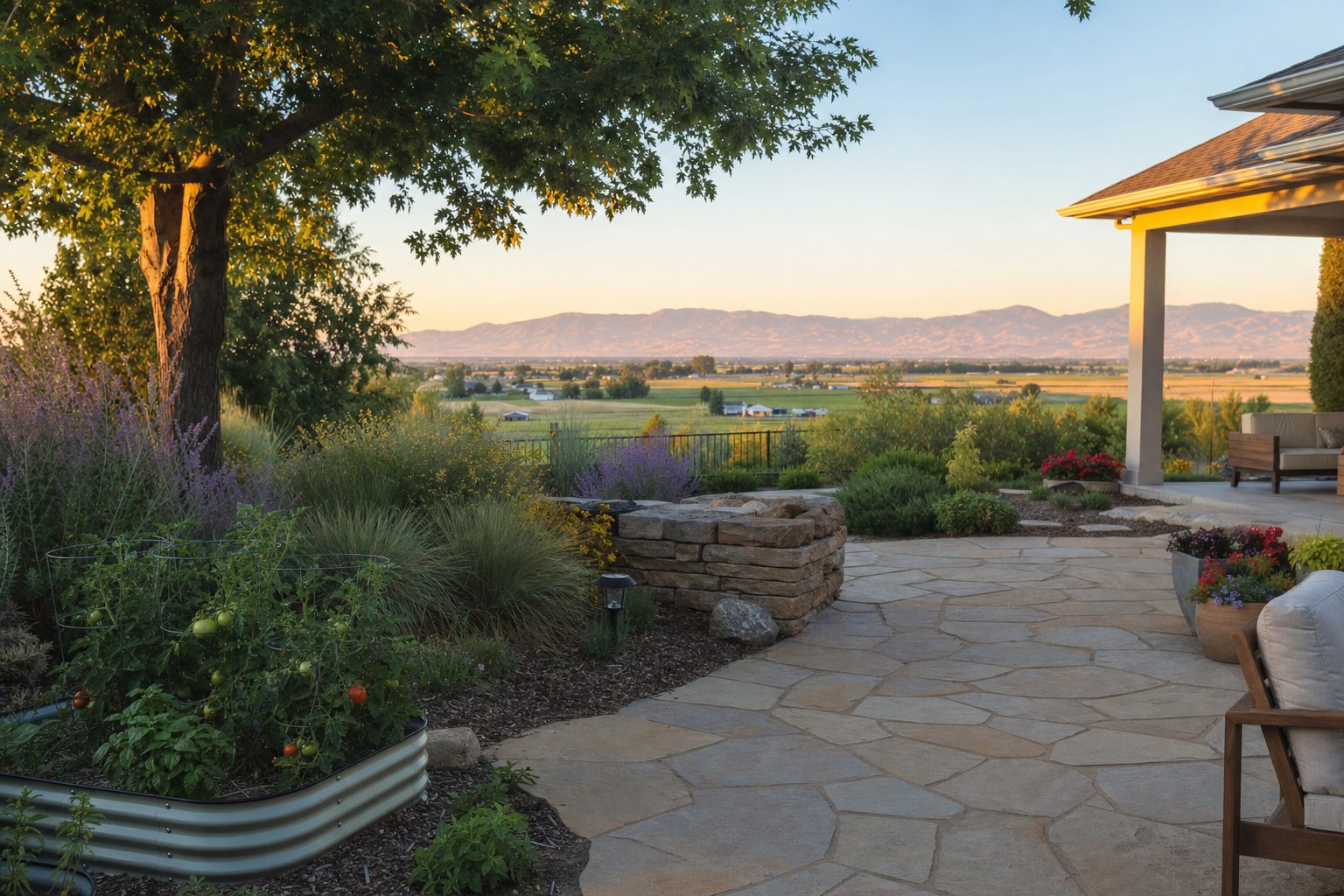
- Design approach: Clean, modern front yards that meet HOA standards; expansive backyards with patios, fire features, raised garden beds, and sometimes small orchards. Estate-sized lots allow for larger specimen trees, meadow plantings, and edible landscaping.
- Challenges: Construction-compacted soils need deep tilling and compost amendment. Wind exposure is significant in open areas without mature tree canopies. HOA design review can limit fence styles and hardscape materials.
- Opportunities: Proximity to Lake Lowell and the Deer Flat refuge creates opportunities for pollinator-friendly landscapes and native plant corridors. Pressurized irrigation is standard. Deep alluvial soils respond well to amendment. The slightly cooler microclimate near the lake can extend the growing season for some crops.
- Plant picks: Serviceberry for multi-season interest, Autumn Blaze Maple for fast shade, Russian Sage and Catmint for low-water color, Karl Foerster grass for vertical accent, Blue Fescue for border edging, Hardy Hibiscus for bold late-summer blooms.
North Nampa (Maple Leaf, Reflections Edge, Garrity corridor)
The area north of I-84 along Garrity Boulevard and the Maple Leaf subdivision near the Nampa Gateway Center. Newer construction with compact lots (0.12–0.20 acres), HOA coverage, and proximity to commercial corridors and the Idaho Center.
- Design approach: Efficient space planning is essential on compact lots. Front yards benefit from xeriscape conversions that reduce maintenance and water use. Backyards need multi-functional design — patios that double as entertaining space, raised beds that double as visual screens, vertical gardening on fences.
- Challenges: Small lots limit tree selection — avoid large-canopy trees like Norway Maple that will overwhelm the space in 15 years. Sandy loam over compacted clay subsoil needs amendment. Wind exposure on exposed north-facing lots.
- Opportunities: Clean-slate lots with no inherited landscape to remove. Pressurized irrigation is standard. Proximity to retail and the Nampa Gateway Center makes plant and material sourcing convenient.
- Plant picks: Little Leaf Linden for compact street-tree shade, Columnar Juniper for narrow privacy screens, Dwarf Burning Bush for fall color in small spaces, Knock Out roses for continuous HOA-friendly bloom, creeping thyme for park strip lawn alternatives.
Central/Downtown Nampa (Old Nampa Historic District, 12th Avenue, 1st Street)
The historic core of Nampa, with pre-1940s housing stock, tree-lined streets, and proximity to downtown Nampa's growing restaurant and arts district. The Old Nampa Historic District encompasses 243 homes — the largest historic district in the city. Properties here typically sit outside HOA boundaries, giving homeowners full creative control over landscape style.
- Design approach: Established neighborhoods with mature shade trees (American Elm, Norway Maple, Green Ash) and wider lots allow for layered landscapes — shade canopy, understory shrubs, perennial borders, and established lawns. Historic homes benefit from period-appropriate plantings: lilacs, peonies, old-fashioned roses, and cottage-garden perennials.
- Challenges: Mature tree root competition limits what grows beneath — choose shade-tolerant understory plants (hostas, ferns, dead nettle). Old irrigation systems may need upgrading. Some properties have compacted soils from decades of foot traffic. Aging trees may need professional pruning or removal.
- Opportunities: Deep, organically rich soils from a century of yard care. Mature trees provide instant shade, privacy, and property value. No HOA means full creative control for vegetable gardens, greenhouse structures, chicken coops (check city ordinances), and creative hardscape. Proximity to downtown Nampa's revitalizing restaurant and arts scene.
- Plant picks: Common Lilac for heritage fragrance, Peony for long-lived perennial color, Hosta varieties for deep shade, daylilies for sun borders, Bigleaf Hydrangea for partial shade, columnar junipers for privacy.
West Nampa / Rural-Residential (Highway 45 corridor, near Caldwell transition)
Properties along the western edge of Nampa, transitioning toward Caldwell and the agricultural land along Highway 45. A mix of established rural-residential lots, newer infill, and working farmland. Lot sizes range from 0.5 to 5+ acres.
- Design approach: Rural-transitional landscapes that blend productive gardens with ornamental beds. Room for large specimen trees, windbreak plantings, vegetable gardens, orchards, and native plant meadows. Properties with acreage can support pollinator habitat strips and food forests.
- Challenges: Heavier clay soils in many areas need gypsum and organic amendment. Wind exposure is high in open areas. Irrigation access varies — some properties rely on canal water rights rather than pressurized urban systems. Deer pressure increases in rural areas.
- Opportunities: Larger lots allow for windbreak rows, orchard plantings, and room to grow. Deep clay soils retain moisture well once amended. Privacy is easier to achieve with space for buffer plantings. Proximity to agricultural supply resources.
- Plant picks: Ponderosa Pine and Rocky Mountain Juniper for windbreaks, Serviceberry for wildlife, Russian Sage for deer-resistant color, Hackberry for tough shade, native bunchgrasses (Blue Bunch Wheatgrass, Idaho Fescue) for meadow plantings.
Recommended plants for Nampa yards
Nampa's Zone 7a climate, alkaline soils, and low annual precipitation favor plants adapted to high-desert conditions. The pressurized irrigation system makes moderate-water landscapes affordable, but drought-tolerant choices reduce maintenance and future-proof against potential water restrictions. Here are reliable performers for Nampa:
| Plant | Latin name | Type | Sun | Water | Notes |
|---|---|---|---|---|---|
| Autumn Blaze Maple | Acer × freemanii | Tree | Full sun | Moderate | Fast-growing shade tree; reliable fall color; popular in new subdivisions |
| Little Leaf Linden | Tilia cordata | Tree | Full sun | Moderate | Excellent compact street tree; dense canopy; fragrant summer flowers |
| Serviceberry | Amelanchier alnifolia | Tree/shrub | Full sun to part shade | Low–moderate | Idaho native; white spring flowers; edible berries; fall color |
| Hardy Hibiscus | Hibiscus moscheutos | Perennial | Full sun | Moderate–high | Dinner-plate blooms July–September; dies back in winter; loves Nampa's hot summers |
| Russian Sage | Perovskia atriplicifolia | Shrub | Full sun | Low | Silver foliage, lavender blooms July–September; Nampa staple |
| Rocky Mountain Juniper | Juniperus scopulorum | Shrub | Full sun | Very low | Native; steel-blue foliage; extremely drought-hardy; good for screening |
| Karl Foerster Grass | Calamagrostis × acutiflora | Grass | Full sun to part shade | Low–moderate | Vertical accent; golden plumes all winter; sterile (non-invasive) |
| Blue Fescue | Festuca glauca | Grass | Full sun | Low | Compact blue mounds; excellent for borders and mass plantings |
| Blanket Flower | Gaillardia aristata | Perennial | Full sun | Low | Native; red-orange daisy blooms May–September |
| Common Lilac | Syringa vulgaris | Shrub | Full sun | Moderate | Heritage plant for older Nampa neighborhoods; fragrant spring blooms |
| Peony | Paeonia spp. | Perennial | Full sun | Moderate | Long-lived (50+ years); thrives in Nampa's rich older soils; late spring bloom |
| Catmint | Nepeta × faassenii | Perennial | Full sun | Low | Blue-purple flowers all summer; deer-resistant; low maintenance |
| Creeping Thyme | Thymus serpyllum | Groundcover | Full sun | Low | Lawn alternative for park strips; tolerates foot traffic; blooms pink |
For a full plant list with bloom times and detailed growing notes, see our Native Plants for Treasure Valley Yards guide. For lawn replacement ideas, see our Lawn Alternatives for the Treasure Valley article.
Nampa landscaping costs
Nampa landscape project costs are generally 5–10% lower than Boise and Meridian, reflecting lower labor rates and more competitive bidding in Canyon County. However, newer-construction lots often need more soil preparation (compaction relief, compost amendment) than established neighborhoods, which adds to base costs. Here are realistic ranges:
- Front yard xeriscape conversion (builder-grade to water-wise): $3,000–$10,000 depending on size, plant selection, and hardscape elements (boulders, gravel, pathways).
- Paver patio (300 sq ft): $3,200–$6,800 installed, including base preparation.
- Retaining wall (50 linear feet, 3 feet tall): $3,500–$7,000 for segmental block.
- Fire pit (gas, stone surround): $2,500–$6,500 installed.
- Sprinkler system connection to pressurized irrigation (quarter-acre lot): $2,200–$4,500 — less than potable systems because no pump is needed.
- Sod installation: $1.25–$2.25 per square foot (sod + prep + installation).
- Full front yard landscape design + installation: $7,000–$22,000+ depending on scope.
For detailed pricing across all project types, see our Treasure Valley Landscaping Cost Guide.
Local resources for Nampa landscaping
- Adams Gardens — Locally owned full-service nursery and garden center at the corner of Greenhurst and Happy Valley Roads in South Nampa. Trees, shrubs, flowers, vegetables, fruit trees, bulk ground cover, and expert advice. Open year-round. adamsgardens.com
- Franz Witte Garden Center (Nampa location) — Full-service nursery at 20005 11th Ave N, Nampa. Wide selection of trees, shrubs, grasses, and edibles, many grown on-site. Delivery and installation available. franzwitte.com · (208) 853-0808
- Arbor Farms Nursery — Local nursery serving the Nampa area with trees, shrubs, and perennials suited to Treasure Valley conditions.
- Rolling Hills Nursery — Nampa-area nursery with trees, shrubs, and landscape plants.
- Svedin's Nursery — Local Nampa nursery offering trees, shrubs, and perennials.
- Cloverdale Nursery & Turf Farm — Trees, shrubs, sod (turf grown in Kuna), and bulk landscape products. cloverdalenursery.com
- Nampa & Meridian Irrigation District — Contact for irrigation water rights, system connection, pressure issues, and season dates. Main office: 1503 First St. South, Nampa. nmid.org · (208) 466-7861 (office) · (208) 466-0663 (maintenance)
- City of Nampa Waterworks Division — Operates and maintains pressurized irrigation pump stations in many Nampa subdivisions. cityofnampa.us/irrigation
- Canyon Soil Conservation District — Free soil testing guidance and conservation resources for Canyon County residents, including Nampa. canyonscd.org
- Deer Flat National Wildlife Refuge — The Lake Lowell Unit, managed by the U.S. Fish & Wildlife Service, is a 2.5-mile drive from south Nampa subdivisions. An excellent place to observe native plants, bird habitat, and shoreline ecology that can inform wildlife-friendly yard design. fws.gov/refuge/deer-flat
- Northwest Nazarene University — The campus on 12th Avenue features mature landscape plantings, a arboretum-worthy tree collection, and the Nampa community's best example of established campus landscaping. A good place to observe what thrives after 80+ years in Nampa's climate.
When to plant in Nampa
March–April
Plant bare-root trees and shrubs while dormant. Direct sow cool-season crops (peas, lettuce, spinach, radishes) as soon as soil can be worked — typically mid-March in Nampa. Start tomato and pepper seeds indoors. Prune fruit trees and dormant deciduous shrubs before bud break. Pressurized irrigation typically starts April 15.
May
Safe to plant most perennials, trees, and shrubs after May 5. Wait until mid-to-late May for tender annuals and warm-season vegetables — Nampa's last frost runs slightly later than Boise. Harden off seedlings before transplanting. Irrigation water is flowing — set timers for early morning watering.
June–July
Heat-loving plants go in the ground. Install or adjust drip irrigation. Mulch beds deeply (2–3 inches) to conserve moisture. Avoid planting new trees during the hottest weeks — wait for cooler fall weather. Windbreak new plantings in exposed south Nampa subdivisions near Lake Lowell.
August–September
Best time to plant trees and shrubs in Nampa. Soil is warm, air temperatures moderate, and fall rains begin. Plants establish root systems before winter dormancy. Seed new lawns in early September while irrigation water is still available. Plant fall vegetables (kale, chard, garlic) by mid-September.
October
Last call for tree and shrub planting. Plant spring-blooming bulbs (tulips, daffodils, alliums). Irrigation shuts down the first week of October — winterize sprinkler systems before first hard freeze. Apply winter mulch to tender perennials. Harvest remaining vegetables before first frost (typically October 3–7).
November–February
Dormant pruning season for deciduous trees. Protect young trees from sunscorch with trunk wrap — especially important in exposed new subdivisions. Plan next year's projects. Avoid walking on frozen lawns. Hand-water new evergreens during dry winter spells (no irrigation water available). Order seeds and plan garden layouts.