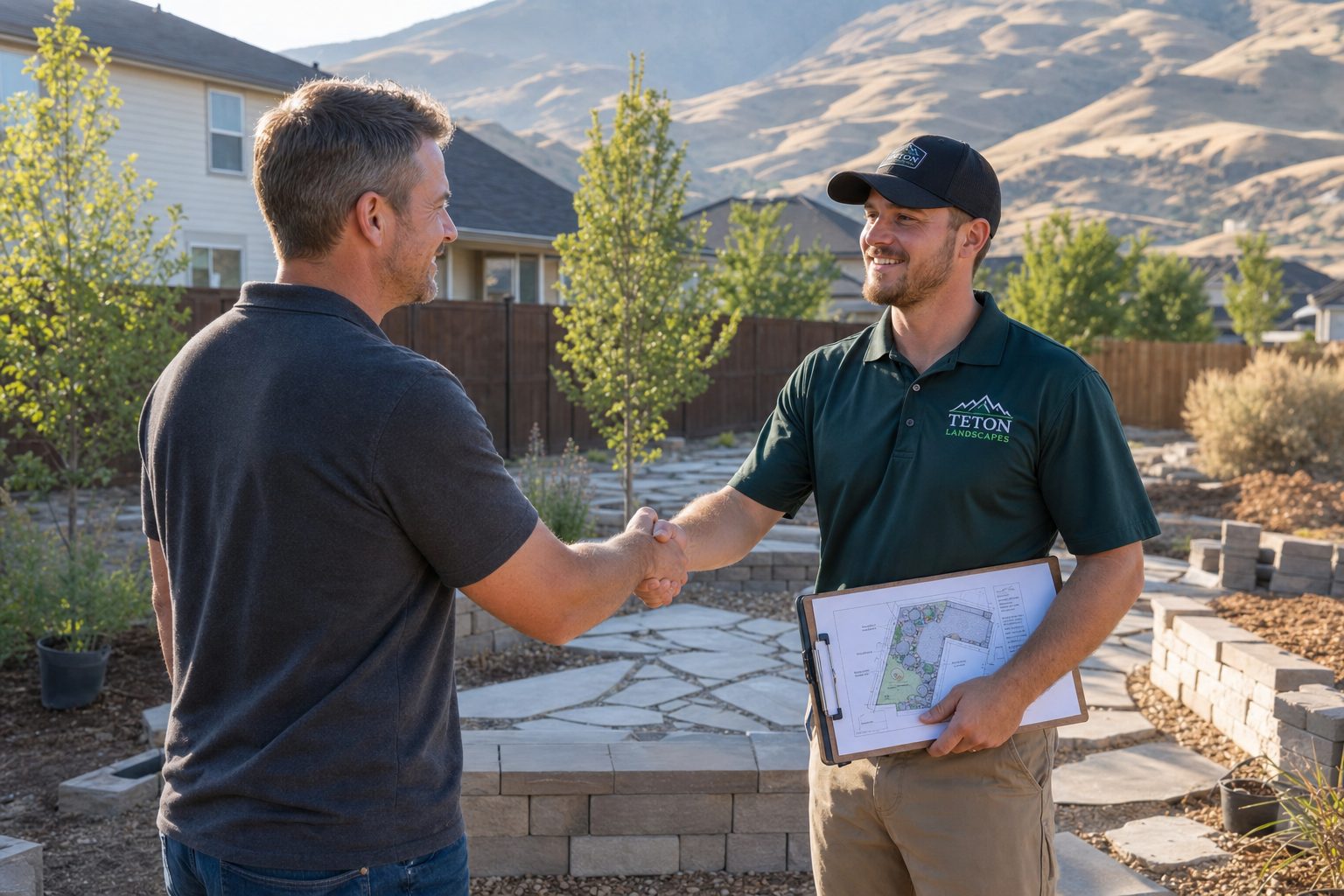
How to Pick the Best Landscape Contractor for Your Treasure Valley Project
Landscape work is an investment — a backyard transformation can run $20,000 to $60,000 or more, and mistakes in base preparation, drainage, or plant selection are expensive to fix. Yet many Treasure Valley homeowners hire the first contractor who shows up, go with the cheapest bid, or skip verifying credentials entirely. The result: shoddy work that has to be torn out and redone by someone who knows what they are doing. This guide walks you through how to avoid that outcome.
Local landscapers across the Treasure Valley report the same pattern: homeowners call them to fix projects that another contractor botched. A paver patio that heaved and cracked after one winter because the base was only two inches of sand instead of six inches of compacted gravel. A sprinkler system with frozen and split pipes because it was installed too shallow and never properly blown out. A retaining wall that leaned and failed because it had no drainage aggregate behind it. Every one of these problems is preventable — but only if you hire someone who builds to the right standard the first time.
Start with licensing and insurance — non-negotiable
In Idaho, anyone who contracts for construction work — including landscaping, hardscaping, irrigation, and fencing — must register with the Idaho State Contractors Board. This is not optional. A registered contractor has met minimum bonding requirements and is accountable to the state if something goes wrong.
How to verify an Idaho contractor's registration
- Ask for their registration number. Every registered contractor in Idaho has a unique number. A legitimate contractor will provide it immediately — if they hesitate or say they "don't need one," that is your first red flag.
- Look it up online. Verify any contractor's registration at the Idaho State Contractors Board search page (search.dol.idaho.gov). Confirm the registration is current and active, not expired or suspended.
- Check for complaints. The Contractors Board maintains complaint records. You can also check the Better Business Bureau for Idaho to see complaint history and how disputes were resolved.
Registration vs. licensure: Idaho uses a registration system, not a full licensure system like California or Oregon. Registration means the contractor has posted a bond and is in the state database — it does not guarantee quality work. That is why you need to do the additional vetting in this guide. Think of registration as the floor, not the ceiling.
Insurance: what to ask for
A contractor without insurance is a liability sitting in your yard. If a worker is injured on your property, or if a backhoe clips your gas line, you could be on the hook financially. Request a current Certificate of Insurance — not a verbal assurance, but an actual document from their insurance carrier. Check for:
| Coverage type | What it protects | Minimum to accept |
|---|---|---|
| General liability | Property damage or injury caused by the contractor's work | $1 million per occurrence |
| Workers' compensation | Injuries to workers on your property | Required by Idaho law if they have employees |
| Commercial auto | Damage from company vehicles on your property | $500,000 minimum |
| Bond (surety) | Project completion guarantee if contractor abandons work | Registered contractors carry a bond; ask for the amount |
Call the insurance company directly to confirm the policy is active — a forged certificate is rare but not impossible. A reputable contractor expects this request and will not be offended.
Read reviews critically — star ratings are not enough
Online reviews on Google, Angi (formerly Angie's List), Yelp, and Facebook are a starting point, not a finish line. A 4.8-star rating with 80 reviews is meaningful. A 5.0-star rating with 3 reviews tells you almost nothing. Here is how to read between the lines:
What to look for in reviews
- Patterns over single complaints. One bad review among 50 positive ones is normal — no one pleases everyone. But if 5 out of 30 reviews mention the same issue (communication problems, project delays, plants dying), that pattern is real.
- How they respond to negative reviews. A contractor who replies professionally and offers to fix the problem is demonstrating accountability. A contractor who argues, blames the customer, or ignores the review is showing you how they will treat you if something goes wrong.
- Reviews that mention specific project details. "They built our retaining wall and it still looks great three years later" is far more credible than "Great company, highly recommend." Vague, generic five-star reviews can be incentivized or fake.
- Review dates. A contractor with all their reviews from 2022 and nothing since may have gone downhill, lost key staff, or stopped caring. You want recent, consistent activity.
- Photo reviews. Before-and-after photos submitted by customers are the most trustworthy reviews. They show the actual quality of work, not just the contractor's curated portfolio.
Red flags in reviews
- Multiple reviews mentioning "had to hire someone else to fix their work" — this is the exact scenario this guide exists to prevent.
- Complaints about pressure to pay large upfront sums before work began.
- Reviews that say the contractor "disappeared" or "stopped returning calls" mid-project.
- A sudden cluster of five-star reviews in a short time window (can indicate the contractor offered discounts or gifts for positive reviews).
Check multiple platforms: A contractor might have great Google reviews but a trail of unresolved complaints on the BBB. Cross-reference at least two sources — Google reviews and the Better Business Bureau are a good combination. Angi and Yelp can add additional perspective. If you see a consistent reputation across platforms, that is a strong positive signal.
Get at least three detailed bids — and compare them properly
Three bids is the industry standard for a reason: it gives you a range of pricing and approaches, and it reveals outliers. If two contractors bid $18,000 and $21,000 for your project and a third bids $9,000, that third bid is not a bargain — it is a warning. The low bidder is either cutting corners on materials, base preparation, drainage, or labor, or they plan to hit you with change orders once the project starts.
What a proper bid includes
A bid scrawled on the back of an envelope or sent as a one-line text message is not a bid — it is a guess. A professional bid should include:
| Item | Why it matters |
|---|---|
| Itemized materials list | Specific products, sizes, quantities — not just "pavers." Allows apples-to-apples comparison. |
| Labor breakdown | Hours or days estimated, crew size. Reveals whether they are allocating enough time for proper prep. |
| Site preparation details | Excavation depth, base material and compaction, grading plan. This is where corners get cut. |
| Project timeline | Start date, duration, and what happens if weather delays occur. |
| Payment schedule | Deposit amount, milestone payments, final payment. Should never be "100% upfront." |
| Warranty terms | What is covered, for how long, and what voids the warranty. |
| Exclusions | What is not included — tree removal, irrigation repair, electrical, etc. Prevents surprise costs. |
How to compare bids fairly
Do not simply pick the lowest number. Lay the bids side by side and compare:
- Base preparation specifications. For paver projects, the base should be 4–6 inches of compacted 3/4-inch minus gravel plus 1 inch of bedding sand. If one bid says "2-inch sand base" and another says "6-inch gravel base," the first bid will fail within two winters of Treasure Valley freeze-thaw cycles. The second bid is higher because it is done correctly.
- Material quality and brands. Are they using Belgard, Techo-Bloc, or Pavestone pavers, or a no-name import? Are the plants from a reputable local nursery like Edwards Greenhouse or Franz Witte, or the clearance rack at a big box store? Material quality drives both cost and longevity.
- Crew experience. A bid that includes a dedicated foreman with 10+ years of experience is worth more than one where the crew is seasonal laborers who started in April.
- Warranty length and scope. A 2-year hardscape warranty is worth more than a 6-month one. A contractor who warranties plants for 2 years is confident in their plant selection and installation; one who offers no plant warranty is not.
Interview your top candidates — ask these questions
Once you have narrowed to two or three contractors with good reviews, proper licensing, and comparable bids, interview them in person. Here are the questions that separate professionals from the rest:
Experience and specialization
- "How long have you been doing landscape work in the Treasure Valley specifically?" — Local experience matters. Our soils, climate, and building codes are unique. A contractor who recently moved from California may not understand Idaho frost depths or our clay soil drainage challenges.
- "What percentage of your work is similar to my project?" — A company that specializes in large commercial maintenance may not be the best choice for a residential paver patio. Match the contractor's expertise to your project type.
- "Can I see 2–3 projects you completed in the last year that are similar to mine?" — Visit the projects if possible, or ask for recent photos with addresses you can drive by.
Project execution
- "Who will actually be on my property doing the work — your employees or subcontractors?" — Subcontractors are not inherently bad, but you want to know who is responsible for quality. If the irrigation is subbed out, who warranties it?
- "Will there be a foreman or project manager on site daily?" — A crew without supervision is a crew that cuts corners. Someone should be in charge and reachable.
- "How do you handle changes or unexpected conditions once work starts?" — This is the change order process. A professional will explain it clearly. If they say "we don't do change orders," that means either they absorb the cost (unlikely) or they bill you with no documentation.
- "What is your cleanup policy during and after the project?" — You do not want a yard full of debris for weeks. Daily cleanup is standard for professional crews.
After the project
- "What is your warranty on hardscape? On plants? On irrigation?" — Get this in writing in the contract, not just verbally. Standard: 2–5 years on hardscape, 1–2 years on plants, 1 year on irrigation workmanship.
- "How do you handle warranty claims?" — Do they come out promptly, or do you have to chase them? A contractor who stands behind their work makes warranty service easy.
- "Do you provide maintenance services, or do you recommend someone?" — Landscapes need maintenance. A contractor who can guide you on ongoing care (or offers it themselves) is invested in your project's long-term success.
Red flags: when to walk away immediately
Some warning signs are so serious that no amount of savings or charm can justify the risk. If you encounter any of the following, end the conversation and move on:
| Red flag | Why it is dangerous |
|---|---|
| Pressure to pay 50% or more upfront | Standard deposit is 10–30% to secure materials and schedule. A contractor demanding most of the money before work starts may be cash-strapped — or planning to disappear. |
| Cash-only payments, no receipts | No paper trail means no proof of payment, no warranty claim, and possible tax evasion. A legitimate business accepts checks and credit cards. |
| No written contract | A verbal agreement is unenforceable. Without a written contract specifying scope, materials, price, and timeline, you have no recourse if things go wrong. |
| Unwilling to provide references | A reputable contractor has a list of satisfied customers ready to share. Refusing to provide references means either they do not have any or their past clients would not recommend them. |
| Bid dramatically lower than competitors | If three contractors bid $18,000–$22,000 and one bids $9,000, something is wrong. They are cutting corners, using inferior materials, or planning to add change orders later to reach the real price. |
| Cannot or will not provide insurance certificate | If a worker is injured on your property and the contractor has no workers' comp, you may be liable. No insurance certificate = no hire. |
| Pushy sales tactics or "today only" pricing | A professional contractor gives you time to decide. High-pressure sales tactics are designed to prevent you from doing your homework — because your homework would reveal problems. |
| Unsolicited door-to-door offers | "We were doing work in your neighbor's yard and noticed you need..." is a common scam pattern. Legitimate contractors do not need to knock on doors for work. |
| Vague about who does the work | If they will not tell you whether employees or subcontractors will be on site, or cannot name the foreman, accountability is unclear — and unclear accountability means finger-pointing when problems arise. |
The contract: what must be in writing
Never start a project without a signed, written contract. A contract protects both you and the contractor — it eliminates ambiguity and sets expectations. At minimum, your landscape contract should include:
Essential contract elements
- Complete scope of work. Every task, spelled out: "Remove existing sod to a depth of 2 inches, install 4 inches compacted 3/4-inch minus gravel base, 1 inch bedding sand, install 400 sq ft Belgard pavers, polymeric sand joints, steel edging." Vague language like "install patio" leaves room for interpretation and disputes.
- Materials list with brands and quantities. Specific products, sizes, colors, and amounts. "12 cubic yards bark mulch" not "mulch." This prevents substitution of cheaper materials.
- Total price and payment schedule. Total cost, deposit amount, and milestone payments tied to completed work stages (e.g., "30% deposit, 30% after base prep and hardscape installation, 30% after planting, 10% on final walkthrough and approval"). Final payment should be contingent on your satisfaction — not due the day work is "done."
- Project timeline. Start date and estimated completion date, plus a clause for weather delays (common in the Treasure Valley, especially during spring rain or summer heat waves). Include a clause for unreasonable delays — e.g., "If project is not substantially complete within 45 days of start date without weather cause, contractor shall provide written explanation and revised timeline."
- Warranty terms. Exactly what is warranted, for how long, and what voids the warranty. Example: "Hardscape installation warranted against settling, cracking, or heaving for 3 years from completion date. Warranty void if additional construction or heavy equipment traverses the installation area."
- Change order process. How changes to scope are documented, priced, and approved. Both parties should sign any change order before the additional work begins. This prevents "surprise" charges at the end.
- Cleanup and site condition. The contract should specify that the site will be left clean and debris-free, with tools and materials removed. Include a clause for damage to existing property (irrigation lines, fencing, lawn) — the contractor should repair or replace anything damaged during the project.
- Permit responsibility. Who pulls permits? For retaining walls over 4 feet, structural work, or gas lines (fire pits, outdoor kitchens), permits are required in most Treasure Valley jurisdictions. The contract should specify whether the contractor or homeowner is responsible for permitting and inspections.
Never pay the full project cost before work begins. The most common contractor scam pattern is taking a large deposit and either never starting the work or starting and abandoning it. A reasonable deposit is 10–30% of the total — enough to cover materials and reserve your slot on the schedule. If a contractor says they need 50% or more upfront, ask why. If the answer is "to buy materials," offer to pay the material supplier directly. Their reaction will tell you a lot.
Payment red flags — protect your money
How and when you pay is one of the most important protections you have. Here is a practical payment guide:
| Stage | Typical payment | What should be done before you pay |
|---|---|---|
| Deposit | 10–30% of total | Contract signed, materials ordered, start date confirmed |
| Milestone 1 (hardscape) | 25–35% of total | Base prep complete, hardscape installed and inspected by you |
| Milestone 2 (planting/irrigation) | 20–30% of total | Irrigation operational, plants installed, mulch applied |
| Final payment | 10–15% of total | Punch list complete, site cleaned, final walkthrough done, you are satisfied |
Additional payment safeguards:
- Pay by check or credit card — never cash. A paper trail is your proof of payment. Credit cards offer dispute resolution if the contractor does not deliver. Cash payments leave you with no recourse.
- Never pay for work that has not been done. If a contractor asks for the next milestone payment before that milestone is complete, decline politely and refer to the contract schedule.
- Hold the final payment until the punch list is done. The final 10–15% is your leverage. Once you pay in full, motivation to fix small issues drops sharply. Walk the property with the contractor, note any issues, and do not release final payment until they are resolved.
- Beware of "we need money for materials" mid-project. If materials were supposed to be covered by the deposit, a request for more material money mid-project suggests the deposit was used for something else. Refer to the contract.
Treasure Valley-specific considerations
Our region has conditions that make contractor selection even more important:
Freeze-thaw and base preparation
The Treasure Valley experiences 100+ freeze-thaw cycles each winter. Any hardscape — paver patios, walkways, retaining walls — must be built with proper base depth (4–6 inches compacted gravel minimum) and drainage to survive. Contractors from warmer climates may not understand how critical this is. Ask specifically: "What base depth do you use for paver patios, and why?" The right answer is 4–6 inches of compacted 3/4-inch minus gravel. "A couple inches of sand" is the wrong answer.
Irrigation and winterization
Every irrigation system in the Treasure Valley must be winterized (blown out with compressed air) before the first hard freeze, typically mid-October. Pipes installed too shallow will freeze and split. Ask: "How deep do you install irrigation mainlines?" The answer should be at least 12 inches. Ask: "Do you offer winterization service, and is it included in the warranty?" A contractor who installs irrigation but does not offer winterization is leaving you to find someone else for a critical annual service.
Soil and drainage
Treasure Valley soils range from sandy loam on the Boise Bench to heavy clay in parts of Nampa, Caldwell, and Meridian. Clay soil retains water and requires drainage solutions (French drains, amended planting holes, raised beds). A contractor who does not ask about your soil type or propose a soil test before planting is not planning properly. Our soil amendment guide covers what proper soil preparation looks like — use it as a benchmark.
Plant selection for Zone 6b–7a
Contractors should specify plants by Latin binomial and select species hardy to our climate zone. A contractor who says "I'll pick some nice shrubs at the nursery" without discussing species, mature size, water needs, or sun exposure is not designing — they are filling space. Our native plants guide and best trees guide list species that thrive here. Cross-reference the contractor's plant list against these resources.
Local suppliers
Established Treasure Valley contractors have relationships with local suppliers — Idaho Materials & Construction, Belknap Landscape Supply, Creative Landscape Supply, Edwards Greenhouse, Franz Witte, FarWest Landscape. A contractor who sources everything from a single big-box store is either new to the area or cutting corners on material quality.
Where to find reputable Treasure Valley contractors
Start your search with trusted sources rather than clicking the first Google ad:
- Our local landscapers directory — a curated list of established Treasure Valley landscape companies with contact information and specializations.
- Word of mouth — ask neighbors whose yards you admire. Ask in local Facebook groups like "Boise Area Gardeners" or "Meridian Neighborhoods." A personal recommendation from someone who has lived through a project is the most reliable referral.
- Idaho Nursery & Landscape Association (INLA) — member contractors have committed to professional standards. The INLA website maintains a member directory.
- Better Business Bureau — search for accredited businesses with A or A+ ratings and a history of resolving complaints.
- Angi and Google reviews — use these to build your initial list, then do the vetting described above. Do not hire based on reviews alone.
The cheapest bid is rarely the least expensive. When a paver patio installed for $9,000 heaves and cracks after two winters and has to be torn out and reinstalled properly for $15,000, the "cheap" option cost $24,000 total. The contractor who bid $18,000 the first time — with a 6-inch gravel base, proper compaction, and a 3-year warranty — would have been the better financial decision. Value is not the lowest price; it is the price for work that lasts.
A quick checklist before you sign
Before you sign a contract or hand over a deposit, run through this final checklist:
- ☐ Verified contractor registration at search.dol.idaho.gov
- ☐ Received and confirmed current Certificate of Insurance (liability + workers' comp)
- ☐ Checked reviews on at least two platforms (Google + BBB minimum)
- ☐ Read negative reviews and evaluated how the contractor responded
- ☐ Obtained at least three written, itemized bids
- ☐ Compared bids on base prep, materials, crew experience, and warranty — not just price
- ☐ Interviewed top candidates in person and asked the questions above
- ☐ Visited or drive-by viewed at least one recent completed project
- ☐ Reviewed the written contract for all essential elements (scope, materials, payment, timeline, warranty, change orders, cleanup, permits)
- ☐ Confirmed payment schedule is milestone-based with no more than 30% deposit
- ☐ Confirmed warranty terms are in writing in the contract
- ☐ Verified the contractor uses local suppliers and specifies climate-appropriate plants
If you can check every box, you have significantly reduced your risk of becoming the next homeowner who has to pay twice. A few hours of vetting on the front end saves thousands of dollars and months of frustration on the back end.