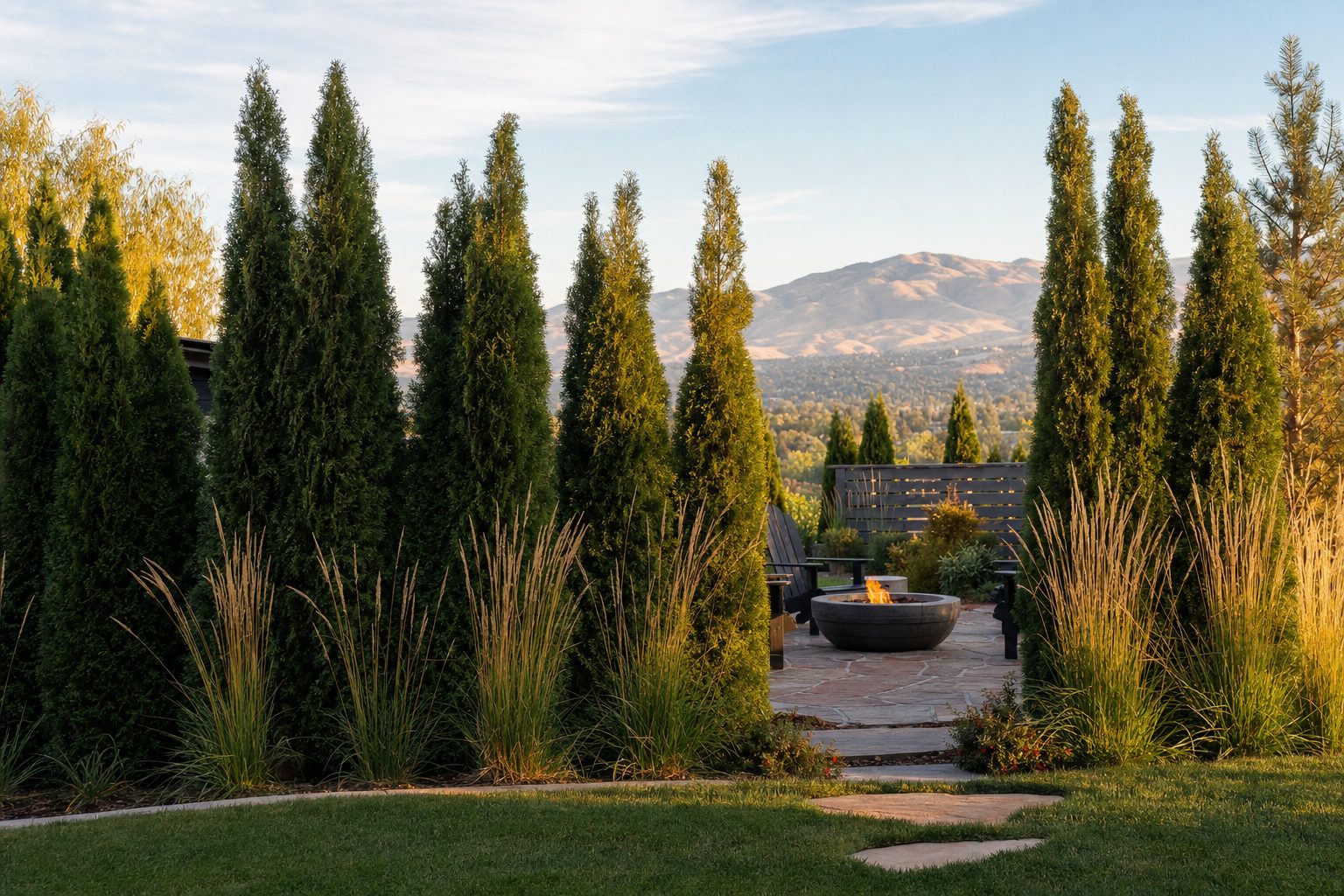
Privacy Screening for Treasure Valley Yards
Whether your new-construction lot in Meridian backs to a community greenbelt, your Boise North End yard is visible from three directions, or your Eagle estate needs a windbreak that doubles as a privacy wall — the right screening plants and hardscape can transform how your yard feels without making it look like a fortress.
Why Privacy Screening Matters in the Treasure Valley
The Treasure Valley's growth pattern has changed the privacy equation for many homeowners. Master-planned communities in Meridian, Nampa, and Kuna often place homes closer together with rear lot lines facing community greenbelts or pathways — great for neighborhood feel, less great when you want to grill in your robe. In Boise's older neighborhoods (North End, East End, Morris Hill), mature trees that once provided privacy have aged out, and infill construction has replaced single-story homes with two-story builds that look directly into yards that were once private.
At the same time, our climate limits what will work. The Treasure Valley sits in USDA hardiness zone 7a (Boise valley) to 6b (outlying areas like Caldwell and Kuna), with annual rainfall of only 11–12 inches, alkaline soils (pH 7.5–8.5), and summer temperatures that regularly exceed 100°F. Many privacy plants that thrive in the Pacific Northwest — like English laurel, privet, and hemlock — struggle here without afternoon shade and supplemental water. The good news is that many excellent screening plants are uniquely suited to our high-desert conditions.
Planning Your Privacy Screen: Four Questions
Before buying plants, answer these four questions — they'll narrow your options dramatically and save you money:
1. How much time do you spend outside in winter?
If you use your patio mostly from April through October, a deciduous screening plant that drops its leaves in November may be fine — you get summer privacy and winter sunlight. If you're outside year-round, or if your screening need is visual (a neighbor's window looks into your yard), choose evergreens.
2. How wide is the planting space?
Measure the actual planting strip. A common mistake in Treasure Valley yards is planting a species that will eventually spread 10 feet wide in a 4-foot strip between a fence and a sidewalk. Columnar and fastigiate forms (narrow, upright growth habit) solve this problem — they grow tall without spreading wide.
3. How much sun does the spot get?
In Idaho's intense summer sun, broadleaf evergreens like cherry laurel and skip laurel will burn without afternoon shade. Most conifers (junipers, arborvitae, cypress, spruce) thrive in full sun. Watch the spot for a full day before choosing — south-facing walls reflect heat, and west-facing exposures get the hottest afternoon sun.
4. How patient are you?
Fast-growing screens (Leyland cypress, Green Giant arborvitae, Swedish aspen) can add 2–3 feet per year, reaching effective screening height in 3–4 years. Slower growers (columnar spruce, Medora juniper) take 5–8 years but are denser, longer-lived, and need less pruning. A common strategy: plant fast growers as a "nurse crop" with slower, denser plants behind them — remove the fast growers once the permanent screen fills in.
Best Evergreen Trees for Privacy Screening
Evergreens are the workhorses of privacy screening — they provide year-round coverage, reduce wind, and buffer street noise. Here are the best options for the Treasure Valley, drawn from local nursery recommendations and proven landscape performance:
| Tree | Botanical name | Mature height | Spread | Growth rate | Sun | Notes |
|---|---|---|---|---|---|---|
| Emerald Isle Leyland Cypress | Cupressocyparis leylandii | 25 ft | 8 ft | Fast (2–3 ft/yr) | Full sun | Naturally pyramidal, no pruning needed in natural form. Soft textured, deep green. Fastest screening option for Treasure Valley. |
| Green Giant Arborvitae | Thuja plicata × standishii | 30–40 ft | 8–12 ft | Fast (2–3 ft/yr) | Full sun | Vigorous, wind-resistant once established. Handles snow loads. Rich green foliage. Best in irrigated beds — needs regular water in Boise's dry summers. |
| 'Cupressina' Columnar Spruce | Picea abies 'Cupressina' | 25 ft | 6 ft | Moderate (1–1.5 ft/yr) | Full sun | Columnar form, same width base to crown. Dark green needles. Dense, uniform, strong vertical presence. Withstands snow loads better than most columnar evergreens. Recommended by Franz Witte garden center. |
| 'Medora' Juniper | Juniperus scopulorum 'Medora' | 12 ft | 2–3 ft | Slow (6–12 in/yr) | Full sun | Compact, upright, no pruning needed. Powdery blue needles. Extremely cold hardy, alkaline soil tolerant, drought tolerant once established. Better heat tolerance than arborvitae. Perfect for tight spaces. |
| 'Trautman' Juniper | Juniperus chinensis 'Trautman' | 12–15 ft | 4 ft | Moderate (1 ft/yr) | Full sun | Slim, upright form for tight spaces. Blue-green foliage holds color in heat and cold. Drought tolerant. Female plants produce silvery-blue berries that feed birds through winter. Creates an airy screen rather than a dense hedge. |
| 'Wichita Blue' Juniper | Juniperus scopulorum 'Wichita Blue' | 15–25 ft | 6–8 ft | Moderate (6–12 in/yr) | Full sun | Beautiful blue-gray color year-round. Thick screen at maturity. Deer resistant. Birds love the berries. Good fast-growth option with a more unusual color than standard green screening. |
| Arizona Cypress | Cupressus arizonica | 20–30 ft | 10–15 ft | Fast (1.5–2 ft/yr) | Full sun | Excellent heat and drought tolerance — ideal for west-facing exposures and dry sites without irrigation. Silvery-blue foliage. Best in informal screens, not tight hedge applications. |
Spacing for a solid screen: Plant evergreens at 60–75% of their mature spread. For an 8-foot-wide arborvitae, space plants 5–6 feet apart center-to-center. Closer spacing gives faster fill but increases long-term pruning needs; wider spacing looks more natural and reduces disease pressure from poor air circulation.
Best Deciduous Trees for Privacy
Deciduous trees provide lush summer screening and often bring fall color, spring flowers, or interesting bark. In the Treasure Valley, these are the most reliable performers:
| Tree | Botanical name | Mature height | Spread | Best for |
|---|---|---|---|---|
| Swedish Aspen | Populus tremula 'Erecta' | 30–40 ft | 6–10 ft | Fast screening, narrow spaces. Rounded leaves rustle in breeze. Excellent fall color (gold to orange). Cold hardy. Send up suckers — plant where spreading is acceptable. |
| Fine Line Buckthorn | Rhamnus frangula 'Fine Line' | 7 ft | 2–3 ft | Short screening, tight spaces, patio edges. Fern-like fine leaves on a columnar form. Deciduous but intricate branching provides winter privacy. Non-invasive sterile variety. |
| Red Twig Dogwood | Cornus sericea | 8–10 ft | 6–8 ft | Summer privacy with winter interest. White summer flowers, striking red stems in winter after leaves drop. Native to Idaho — thrives in our climate. Best in groups for a layered, naturalistic screen. |
Shrubs for Mid-Height Screening (6–18 feet)
Shrubs fill the gap between low hedges and full-sized trees. They're ideal for screening a patio, blocking a neighbor's first-floor window, or creating a layered privacy planting in front of taller evergreens.
| Shrub | Botanical name | Height | Spread | Sun | Notes |
|---|---|---|---|---|---|
| Skip Cherry Laurel | Prunus laurocerasus 'Schipkaensis' | 10–18 ft | 10 ft | Part shade | Broadleaf evergreen with waxy dark green leaves and white spring flowers. Dense growth — excellent hedgerow. Plant on raised mounds for extra height. Requires afternoon shade in Boise — leaves burn in full west-facing sun. |
| Cheyenne Privet | Ligustrum vulgare 'Cheyenne' | 10–12 ft | 6–8 ft | Full sun | Cold-hardy privet variety bred for Rocky Mountain conditions. Fast-growing hedge (up to 2–3 ft/yr). Dense, dark green foliage. Deciduous in Boise but branching structure provides partial winter screening. Tolerates shearing into formal hedges. |
| Common Lilac | Syringa vulgaris | 12–15 ft | 8–12 ft | Full sun | Idaho's state flower. Dense, multi-stemmed shrub with fragrant spring blooms. Suckers and spreads over time — ideal for informal hedges and border screening. Extremely cold hardy and drought tolerant once established. Deciduous but stems provide some winter structure. |
| Wood's Rose | Rosa woodsii | 3–6 ft | spreads | Full sun/part shade | Idaho native shrub. Forms dense thickets — excellent for low-to-mid screening along property edges. Pink flowers in June, rose hips in fall. Extremely drought and cold tolerant. Spreads by rhizomes — give it room or contain with a root barrier. |
Ornamental Grasses for Quick Patio Privacy
Ornamental grasses are the fastest way to add seasonal privacy to a patio or deck. They grow to full height in a single season (no waiting years for trees to fill in), bring movement and sound to the landscape, and many are drought tolerant — perfect for the Treasure Valley. Cut back to 4–6 inches in late winter; they regrow to full height by mid-summer.
| Grass | Botanical name | Height (with plumes) | Spread | Best for |
|---|---|---|---|---|
| Giant Silver Grass | Miscanthus giganteus | 9–12 ft | 4–5 ft | Full-height privacy screen. Forms massive clumps that hide an entire family. Pink plumes in fall. Sterile — won't self-seed. Plant 3–4 feet apart for a solid wall. |
| Maiden Grass | Miscanthus sinensis 'Gracillimus' | 6–7 ft | 4–5 ft | Standard patio screen. Full, fluffy growth with silvery plumes in late summer. Clumping — gets wider each year but doesn't spread invasively. |
| Zebra Grass | Miscanthus sinensis 'Zebrinus' | 5–8 ft | 4–6 ft | Variegated screening with yellow horizontal stripes. Pale pink plumes in late summer. Same privacy function as maiden grass with more visual interest. |
| Karl Foerster Feather Reed Grass | Calamagrostis × acutiflora 'Karl Foerster' | 5–6 ft | 2–3 ft | Narrow, upright screening for tight spaces. Golden plumes persist through winter — provides some winter structure unlike miscanthus. Very cold hardy. |
Hardscape Privacy Options
Plants aren't the only way to create privacy. Hardscape screening is immediate, maintenance-free, and works in any climate. The right option depends on your budget, aesthetic, and whether you need to comply with HOA or city fence height restrictions.
Privacy Fencing (6–8 feet)
Standard cedar privacy fencing runs $25–$45 per linear foot installed in the Treasure Valley. Boise city code allows rear and side yard fences up to 7 feet without a permit (front yard fences are limited to 3–4 feet depending on setback). Meridian and Nampa allow 6–8 feet in rear yards. Always check your HOA CC&Rs — many Treasure Valley subdivisions restrict fence materials, colors, and heights below what city code permits.
Gabion Walls
Gabion walls — wire mesh cages filled with stone — are increasingly popular in Idaho residential landscapes. They provide instant, solid privacy, require zero maintenance, and use locally sourced basalt or river rock. A gabion privacy wall 6 feet tall and 1 foot thick runs $80–$120 per linear foot, including wire cages and stone fill. The look is rustic and architectural — best in contemporary or transitional landscape designs. FarWest Landscape in Boise has installed gabion privacy walls with planted "windows" (pockets in the cage where herbs and perennials grow through the mesh).
Living Walls and Vertical Gardens
For smaller spaces — a narrow side yard, a patio edge, or a deck railing — living wall systems offer greenery and privacy in one. Felt pocket systems planted with herbs, trailing perennials, or succulents can screen a 6-foot section of fence for $200–$600 in materials. These need a drip irrigation line (timer-controlled, 1–2 gallons per day in July and August) but provide a lush, aromatic screen that doubles as an herb garden for the grill.
Lattice and Pergola Screens
A cedar lattice panel mounted on 4×4 posts gives 6 feet of privacy for $40–$60 per 4×8 panel section (materials only — add $20–$30 per section for installation). Train a vine on the lattice — Virginia creeper (Parthenocissus quinquefolia) for fall color, sweet autumn clematis (Clematis terniflora) for white late-summer blooms, or hops (Humulus lupulus) for rapid coverage — and the screen becomes a living element. Virginia creeper grows 6–10 feet per season in Boise and turns brilliant orange-red in October.
Designing a Layered Privacy Planting
The most effective and beautiful privacy screens use layered plantings — a combination of heights, textures, and types that create depth and seasonal interest. Here's how to build one:
Layer 1: Backbone evergreens (background)
Plant a row of columnar evergreens 5–6 feet apart along the property line. Use 'Cupressina' spruce or Green Giant arborvitae for heights over 15 feet, or 'Medora' juniper for 10–12 foot screens in tight spaces. This is your year-round privacy layer — the green wall that's there even in January.
Layer 2: Deciduous shrubs (midground)
In front of the evergreens, plant a staggered row of deciduous shrubs 4–6 feet from the first row. Lilac, red twig dogwood, or Fine Line buckthorn add flower power, fall color, and textural contrast. Stagger the planting (offset every other plant) rather than planting in a straight line — this fills gaps faster and looks more natural.
Layer 3: Ornamental grasses (foreground)
Along the patio or seating area edge, plant clumps of maiden grass or Karl Foerster grass 4–5 feet apart. These grow to full height by July, providing immediate summer privacy while the trees and shrubs mature. In late winter, cut the grasses back — you'll lose foreground privacy for 2–3 months but gain fresh growth that reaches screening height again by early summer.
The layered approach solves a common Treasure Valley problem: New-construction lots in Meridian, Kuna, and Nampa often have no existing privacy. A pure evergreen screen takes 5–8 years to fill in. By adding ornamental grasses (full height in year one) and fast-growing deciduous shrubs (screening height in 2–3 years), you get usable privacy in the first growing season while the permanent evergreen backbone matures.
Planting and Establishment Care
Privacy screening plants are an investment — a single 6-foot Green Giant arborvitae costs $80–$150 at local nurseries, and a mature screening project of 10–15 trees runs $1,500–$4,000 in plants alone. Proper planting and first-year care are critical to protect that investment.
Planting timing
The best planting windows in the Treasure Valley are early spring (March–April) and early fall (September–October). Spring planting gives roots a full growing season before winter. Fall planting takes advantage of cooler temperatures and natural rainfall — but everything must be in the ground 4–6 weeks before the first hard freeze (typically late October in Boise, earlier in outlying areas). Avoid planting during June–August heat unless you can water daily.
Soil preparation
Treasure Valley soils are typically alkaline (pH 7.5–8.5) and range from sandy loam (Nampa, Caldwell) to heavy clay (Meridian, parts of Boise). Most screening plants tolerate alkaline conditions, but all benefit from amended planting holes. Dig holes 2–3 times wider than the root ball but no deeper. Mix the native soil with 25% compost (Boise's free compost program at the Ada County Landfill is an excellent local source). Do not add sulfur to the entire planting area — it's expensive and temporary. Instead, focus on good drainage and mulch.
Watering during establishment
Newly planted screening trees need deep, regular watering for their first two growing seasons. In Boise's dry summers (June–September), plan on 5–10 gallons per tree, twice per week, applied slowly at the root zone. Install drip irrigation with 2–3 emitters per tree (2 gal/hr each, running 30–45 minutes per cycle) for reliable, efficient watering. After the second year, most evergreens listed here are drought tolerant and need only monthly deep watering during the hottest part of summer.
Mulch
Apply 2–3 inches of bark mulch or arborist wood chips in a 3-foot radius around each tree, keeping mulch 2–3 inches away from the trunk. Mulch retains moisture, moderates soil temperature, and suppresses weeds. Refresh annually. Never use weed fabric under mulch — it prevents organic matter from entering the soil and creates a sterile, compacted layer.
Cost Overview
| Screening type | Materials (per linear foot) | Installed (per linear foot) | Time to full screen |
|---|---|---|---|
| Cedar privacy fence (6 ft) | $15–$25 | $25–$45 | Immediate |
| Gabion stone wall (6 ft tall) | $60–$90 | $80–$120 | Immediate |
| Green Giant arborvitae (5 gal, 5 ft spacing) | $20–$30 | $35–$55 | 3–4 years |
| Leyland cypress (5 gal, 6 ft spacing) | $18–$28 | $30–$50 | 3–4 years |
| Layered planting (evergreen + shrub + grass) | $35–$50 | $50–$75 | 1–2 years (partial), 4–5 (full) |
| Lattice + vine screen | $10–$15 | $20–$35 | 1–2 growing seasons |
| Ornamental grass (1 gal, 4 ft spacing) | $8–$12 | $12–$20 | 1 season |
Costs assume 2026 Treasure Valley nursery and contractor pricing. Tree prices vary by pot size: a #5 container (5-gallon) Green Giant arborvitae runs $60–$90 at FarWest Landscape or Franz Witte; a #15 container (15-gallon, already 6–7 feet tall) runs $150–$220. Starting with larger plants gives instant impact but costs 2–3× more per linear foot of screening.
Where to Buy Screening Plants in the Treasure Valley
- FarWest Landscape & Garden Center — 5798 W State Street, Boise. 7-acre garden center with the largest plant selection in the Treasure Valley. Carries arborvitae, junipers, cypress, ornamental grasses, and all shrubs listed above. Offers design-build services for privacy screening installation. (208) 853-4057.
- Franz Witte Garden Center — 9155 N Highway 20, Nampa. Staff-picked screening tree recommendations available — their team includes Leyland cypress, Medora juniper, Cupressina spruce, skip laurel, Trautman juniper, and Fine Line buckthorn among their personal favorites. Knowledgeable staff can advise on the right species for your specific sun exposure and space. (208) 442-4040.
- Edwards Greenhouse — 416 E Shore Drive, Boise. Local nursery with trees and shrubs suited to the Treasure Valley. Good selection of ornamental grasses in spring and fall. (208) 342-7548.
- Northwind Perennial Farm — Stocked at several local nurseries. Specialty source for Karl Foerster grass and other ornamental grasses.
Common Mistakes to Avoid
Planting arborvitae in full west exposure without irrigation
Arborvitae are the most popular privacy screen in America — and the most commonly killed in the Treasure Valley. In Boise's 100°F+ summer afternoons, arborvitae planted in west-facing exposures without drip irrigation will brown and die within 1–2 seasons. If you must plant arborvitae, choose Green Giant (more heat and drought tolerant than Emerald Green), site them with afternoon shade if possible, and commit to drip irrigation.
Overplanting — too many trees too close
It's tempting to plant 3-foot spacing for an "instant hedge." But at maturity, those trees will be competing for water, nutrients, and light — leading to thinning, disease, and dead sections. Follow the 60–75% spacing rule and accept a 2–3 year fill-in period. You'll have healthier, longer-lived plants.
Ignoring mature size
That cute 3-foot Leyland cypress will be 25 feet tall and 8 feet wide in a decade. Before planting, look up the mature size of every species and measure your actual available space. Allow for setbacks from property lines (check your city code — Boise requires 2 feet minimum from the property line for hedges and screens), underground utilities, and overhead power lines.
Using only one species
Monoculture screens are vulnerable — a single disease or pest can wipe out the entire planting. Mix 2–3 species in your screening row. If you're planting 10 trees, use 6 of one species and 4 of another, planted in an alternating or grouped pattern. This also looks more natural than a single-species hedge.