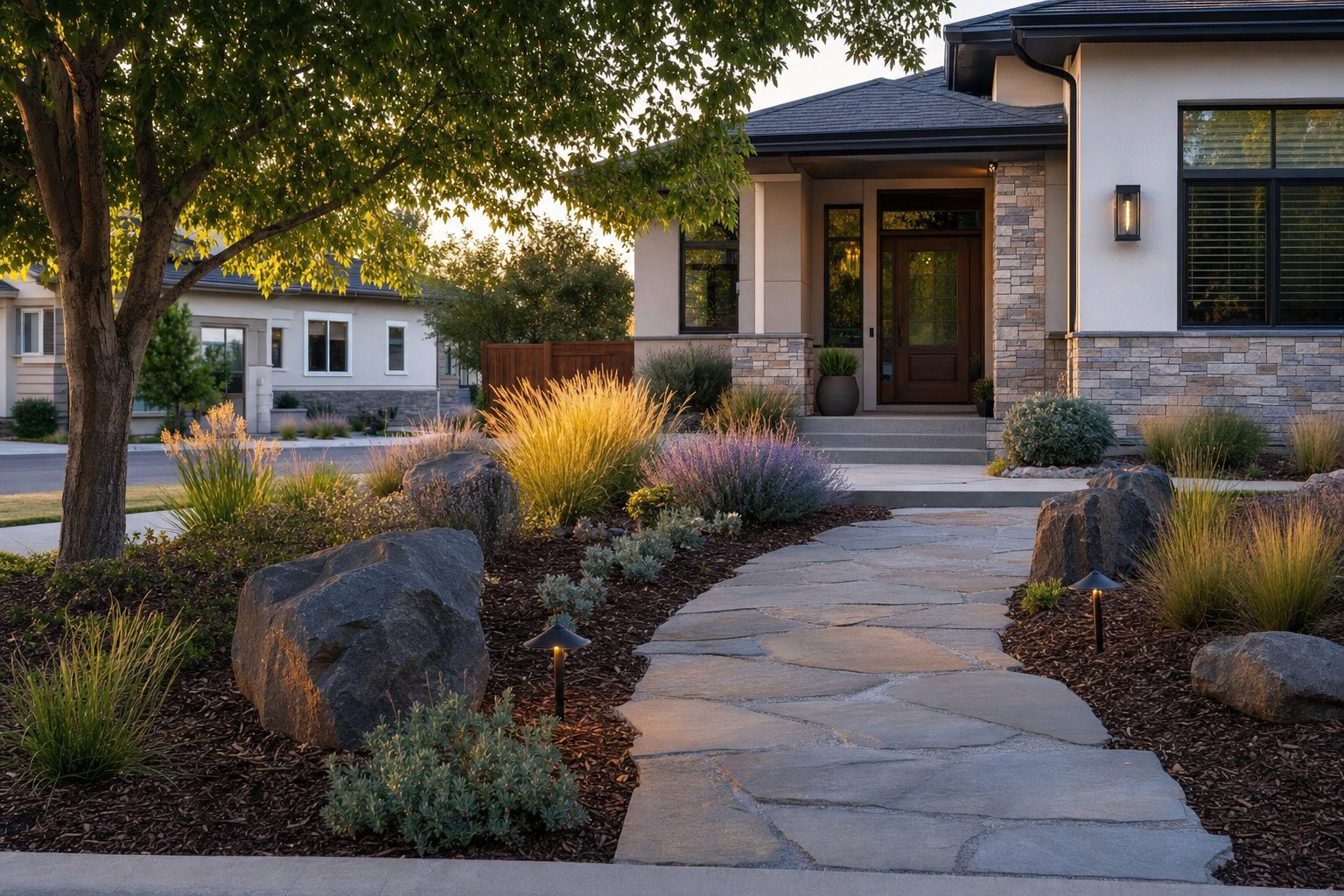
Front Yard Landscaping Ideas for the Treasure Valley
Your front yard is the first thing visitors, neighbors, and potential buyers see. In the Treasure Valley, a good front yard design balances curb appeal with water efficiency, handles our alkaline clay soils, survives July heat above 95°F and January freezes below 20°F, and doesn't require a weekend of maintenance every month.
Across Boise, Meridian, Eagle, Nampa, Caldwell, and Kuna, homeowners are moving away from the default front yard — flat lawn corner-to-corner, a row of boxwoods under the windows, and a concrete walkway straight to the door. The new approach layers hardscape, drought-tolerant planting beds, shade trees, and purposeful lawn areas. It looks better, costs less to maintain, and uses 30–50% less water.
Start with the entry path
The walk from the sidewalk to your front door sets the tone for the entire yard. A 4-foot-wide concrete sidewalk is functional but forgettable. Upgrading the entry path is the single highest-impact change you can make to front yard curb appeal — and it doesn't require touching a single plant.
Path materials that work in the Treasure Valley
| Material | Cost per sq ft (installed) | Best for |
|---|---|---|
| Flagstone (irregular) | $18–30 | Organic, naturalistic front yards; blends with planting beds |
| Concrete pavers | $12–25 | Clean, geometric designs; freeze-thaw resistant |
| Decomposed granite | $8–15 | Rustic, budget-friendly paths; good for informal yards |
| Stepping stones + groundcover | $6–12 | Cottage-style or xeriscape yards; low-traffic paths |
| Poured concrete (stamped or colored) | $10–18 | Modern, clean-lined homes; durable and low-maintenance |
The path should be at least 4 feet wide — 5 feet if two people will walk side by side. If the path curves, use a gentle radius that guides the eye toward the front door rather than wandering aimlessly. Line the path with low-growing plants: Woolly Thyme (Thymus pseudolanuginosus) between stepping stones, or Karl Foerster Feather Reed Grass (Calamagrostis x acutiflora) along a paved walkway for vertical texture.
Local tip: Avoid smooth, polished stone for front walkways in the Treasure Valley. Our winter ice makes any slick surface treacherous. Textured flagstone, tumbled pavers, and broom-finished concrete all provide better traction when temperatures drop below freezing.
The parking strip: Your most visible (and most wasted) space
That strip of ground between the sidewalk and the street — the "parking strip" or "hellstrip" — is the single most visible piece of your front yard. It's also usually the most poorly maintained: patchy lawn, weeds, bare dirt, and a dying tree. Every Treasure Valley city has different rules for what you can do with it, but most allow conversion from lawn to planted beds with approval.
Parking strip rules by city
- Boise: The city's Street Tree program manages tree selection and planting in parking strips. Non-lawn ground covers are permitted if they stay under 24 inches tall and don't obstruct visibility. Call Digline at 811 before digging.
- Meridian & Eagle: Similar rules to Boise. Low-growing plants and decorative rock are common replacements for turf in parking strips.
- Nampa & Caldwell: Check with the city's planning department for parking strip regulations. Generally, non-lawn landscapes are allowed if they maintain pedestrian sightlines.
Plants that thrive in parking strips
Parking strips are brutal environments: reflected heat from pavement, compacted soil, road salt in winter, and dog traffic. Choose plants that can handle all of it:
- Woolly Thyme (Thymus pseudolanuginosus) — 2–3 inches tall, silvery foliage, pink summer blooms, survives foot traffic and reflected heat. Water every 10–14 days once established.
- Creeping Thyme (Thymus serpyllum) — similar to woolly thyme but with darker pink flowers and a more vigorous spread.
- Blue Grama Grass (Bouteloua gracilis) — native bunchgrass, 12–18 inches tall, drought-tolerant, distinctive eyelash-shaped seed heads. Can be mowed to 4 inches or left natural.
- Snow-in-Summer (Cerastium tomentosum) — silvery foliage, white spring flowers, 6–8 inches tall, spreads to fill bare spots. Prefers poor, well-drained soil.
- Ice Plant (Delosperma cooperi) — low succulent groundcover, magenta flowers all summer, thrives in reflected heat. Excellent for south-facing strips.
Average cost to convert a parking strip from lawn to planted beds: $3–8 per square foot for DIY, $10–18 per square foot professionally installed. This includes lawn removal, soil amendment, plants, drip irrigation, and mulch.
Plant beds that look good year-round
The biggest mistake in Treasure Valley front yards is planting only for spring and summer. From November through April, your yard is visible every day — that's five months of curb appeal that many homeowners ignore. Structure your planting beds with three layers:
Layer 1: Structural backbone (evergreens and woody plants)
These are the plants that hold the yard together when everything else is dormant. Choose 2–3 evergreen shrubs for the front foundation (the bed against the house):
- Blue Star Juniper (Juniperus squamata 'Blue Star') — 2–3 ft tall and wide, steely blue foliage, zero maintenance. $35–60 per plant at local nurseries.
- Globe Arborvitae (Thucla occidentalis 'Technito') — round, dense, deep green, 3–4 ft tall. Good for anchoring corners of the house. $50–80 per plant.
- Mugo Pine (Pinus mugo) — compact, dark green, 3–5 ft tall and wide. Handles wind and cold. $60–100 per plant.
- Creeping Juniper (Juniperus horizontalis 'Blue Rug') — 4–6 inches tall, spreads 6–8 ft, silvery-blue. Excellent groundcover for slopes and hot banks. $25–45 per plant.
Layer 2: Seasonal interest (deciduous shrubs and ornamental grasses)
These provide color changes, flowers, and texture that shift through the seasons:
- Russian Sage (Perovskia atriplicifolia) — silver foliage, lavender-blue flowers July–September, 3–4 ft tall. Blooms during the hottest weeks when little else does. Cut back to 6 inches in early spring.
- Ninebark (Physocarpus opulifolius 'Diablo') — deep burgundy foliage, white spring flowers, exfoliating bark for winter interest. 5–8 ft tall. Best for larger front yards.
- Karl Foerster Feather Reed Grass (Calamagrostis x acutiflora 'Karl Foerster') — upright, 4–5 ft tall, golden seed heads persist through winter. The most versatile ornamental grass for Treasure Valley front yards.
- Rabbitbrush (Chrysothamnus nauseosus) — native, silver foliage, golden yellow flowers in late fall when everything else is done. 3–6 ft tall. Pollinator magnet.
Layer 3: Ground-level color (perennials and groundcovers)
- Blanket Flower (Gaillardia aristata) — red-and-yellow daisy flowers, June–September, 18–24 inches tall. Idaho native. Deadhead for repeat bloom.
- Penstemon (Penstemon strictus or Penstemon palmeri) — tubular flowers in blue, purple, or pink. Attracts hummingbirds. 2–4 ft tall depending on variety.
- Moonshine Yarrow (Achillea 'Moonshine') — silvery fern-like foliage, flat lemon-yellow flower clusters, 18–24 inches. Drought-tolerant and long-blooming.
- Catmint (Nepeta 'Walker's Low') — lavender-blue flowers May–September, 2–3 ft tall and wide. Cut back after first bloom for a second flush. Deer-resistant.
Where to buy: Edwards Greenhouse (Boise), FarWest Landscape (Boise), Franz Witte Garden Center (Meridian), and Terra Vita Garden Center (Meridian) all carry a strong selection of drought-tolerant Treasure Valley plants. For natives, check the Idaho Botanical Garden's annual plant sale (April) and the Ada Soil & Water Conservation District's Water Wise Gardening resources.
Shade trees: The front yard's biggest investment
A mature shade tree is the single most valuable element in a front yard — it increases property value by 7–15%, reduces cooling costs in summer, and defines the character of the entire streetscape. In the Treasure Valley, choose species that handle alkaline soil, drought once established, and hardiness zone 6b–7a winters.
| Tree | Mature size | Best for | Cost (5-gallon) |
|---|---|---|---|
| Autumn Blaze Maple (Acer x freemanii) | 50 ft × 40 ft | Fast-growing shade, brilliant red fall color | $120–180 |
| Western Hackberry (Celtis occidentalis) | 50 ft × 40 ft | Drought-tolerant, native, handles alkaline soil | $80–120 |
| Serviceberry (Amelanchier alnifolia) | 15–25 ft | Small yards, white spring flowers, edible berries | $60–90 |
| Robusta Hackberry (Celtis occidentalis 'Robusta') | 45 ft × 25 ft | Upright form for narrow spaces | $100–140 |
| Bur Oak (Quercus macrocarpa) | 60 ft × 50 ft | Large yards, very long-lived, deep shade | $100–150 |
For the Treasure Valley Tree Selection Guide — published by the City of Boise with species recommendations for our specific climate zone — see the official guide (PDF). It lists approved street tree species, planting distances from utilities and sidewalks, and mature size data for every recommended tree.
Important: Before planting any tree in the parking strip or near underground utilities, call Digline (811 or 208-342-1585) at least two business days ahead. It's free, it's the law, and it prevents cutting a gas line.
Three front yard design styles for the Treasure Valley
Style 1: Modern xeriscape
Best for: newer homes in Meridian, west Boise, and Nampa with clean architectural lines. Full-sun exposures. Homeowners who want minimal maintenance and maximum water savings.
Recipe: Remove all lawn. Lay a flagstone or paver walkway from sidewalk to front door, slightly curved. Flank the path with decomposed granite or bark mulch beds. Plant 3–5 Russian Sage, 2 Blue Star Junipers near the entry, and a cluster of Karl Foerster grass near the property corner. Add 2–3 basalt boulders for texture. Install drip irrigation. Finish with 3 inches of dark bark mulch. Total water use: 70–80% less than lawn.
Estimated cost (800 sq ft front yard): $6,000–12,000 professional installation; $2,000–4,000 DIY.
Style 2: Hybrid lawn-and-beds
Best for: established Boise neighborhoods (North End, East End, SE Boise), Eagle, and Star. Homeowners who want some lawn for kids, pets, or curb appeal but want to reduce water and maintenance.
Recipe: Keep a smaller, well-defined lawn area (300–500 sq ft) in the center or near the street. Convert the parking strip to low-growing drought-tolerant groundcover. Add planting beds along the foundation and fence line with a mix of evergreens (Blue Star Juniper, Mugo Pine) and seasonal color (Catmint, Blanket Flower, Karl Foerster grass). Line the walkway with pavers or flagstone. Add one shade tree (Autumn Blaze Maple or Western Hackberry) in the front corner. Keep sprinkler system but convert beds to drip.
Estimated cost (800 sq ft front yard): $8,000–15,000 professional installation; $3,000–6,000 DIY.
Style 3: Cottage-style front yard
Best for: older homes in Boise's North End, Hyde Park, or historic Nampa. Homeowners who love lush, colorful, and slightly informal landscapes with personality.
Recipe: Replace lawn with a winding flagstone path bordered by mixed perennial beds. Dense, layered plantings: taller shrubs (Ninebark, Serviceberry) at the back, mid-height perennials (Penstemon, Blanket Flower, Moonshine Yarrow) in the middle, and low groundcovers (Woolly Thyme, Snow-in-Summer) at the edges. Add a picket fence or low stone wall for definition. Include at least one flowering tree (Serviceberry or Hawthorn) for spring blooms. Mulch with bark, not rock. This style needs more water than xeriscape but far less than full lawn if plants are grouped by water needs.
Estimated cost (800 sq ft front yard): $10,000–18,000 professional installation; $4,000–7,000 DIY.
Common front yard mistakes in the Treasure Valley
- Overplanting the foundation. Shrubs planted 18 inches from the house will grow to 6 feet wide and block windows. Always space for mature size, even if it looks sparse the first year.
- Using rock mulch against the house. Gravel and river rock absorb heat and radiate it into the foundation, raising indoor temperatures. Use bark mulch within 3 feet of the house; save rock for open beds.
- One of everything. A yard with one Russian Sage, one Catmint, one Blanket Flower, and one Juniper looks like a test garden, not a design. Plant in groups of 3–5 for visual impact.
- Ignoring winter structure. If your front yard has no evergreens and no ornamental grass seed heads, it's a bare mud patch from December through March. Always include 2–3 evergreen shrubs and at least one grass that holds its shape in winter.
- Watering everything the same. Lawn sprinklers soaking your drought-tolerant beds is the most common — and most wasteful — irrigation mistake. Install separate zones: spray heads for lawn, drip lines for beds.
Budget realities: What does a front yard cost?
Based on 2026 Treasure Valley contractor pricing, here are realistic cost ranges for a typical 800–1,200 square foot front yard:
| Project scope | DIY cost | Professional cost |
|---|---|---|
| Parking strip conversion (lawn to beds) | $300–600 | $1,000–2,500 |
| Walkway replacement (concrete to pavers) | $1,200–2,500 | $3,000–6,000 |
| Foundation planting beds (new) | $500–1,500 | $2,000–4,500 |
| Full front yard redesign (no lawn) | $2,000–4,000 | $6,000–12,000 |
| Full front yard redesign (hybrid lawn) | $3,000–6,000 | $8,000–15,000 |
| Shade tree (5-gallon, planted) | $80–180 | $200–400 |
| Irrigation conversion (spray to drip for beds) | $200–500 | $800–2,000 |
Costs vary based on plant sizes, material choices, site access, and contractor rates. These ranges reflect Treasure Valley market conditions as of mid-2026.
Getting started: A phased approach
You don't have to redo the entire front yard in one weekend — or one season. A phased approach lets you spread the cost, learn what works, and build confidence:
- Phase 1 (this month): Convert the parking strip from lawn to drought-tolerant groundcover with drip irrigation. Immediate curb appeal boost, low cost, high impact.
- Phase 2 (fall): Plant one shade tree in the front yard. By the time everything else is done, the tree will already be growing. Fall planting (September–October) gives roots time to establish before summer heat.
- Phase 3 (next spring): Replace the front walkway. This changes the entire feel of the yard and sets the framework for new planting beds.
- Phase 4 (next spring/summer): Install foundation planting beds along the house. Start with evergreens for structure, add perennials for color.
- Phase 5 (next fall): Reduce lawn area or remove it entirely, depending on your style preference. Convert spray irrigation to drip for all beds.
For a full planting calendar — including the best months to plant trees, shrubs, and perennials in the Treasure Valley — see our Seasonal Maintenance Calendar.