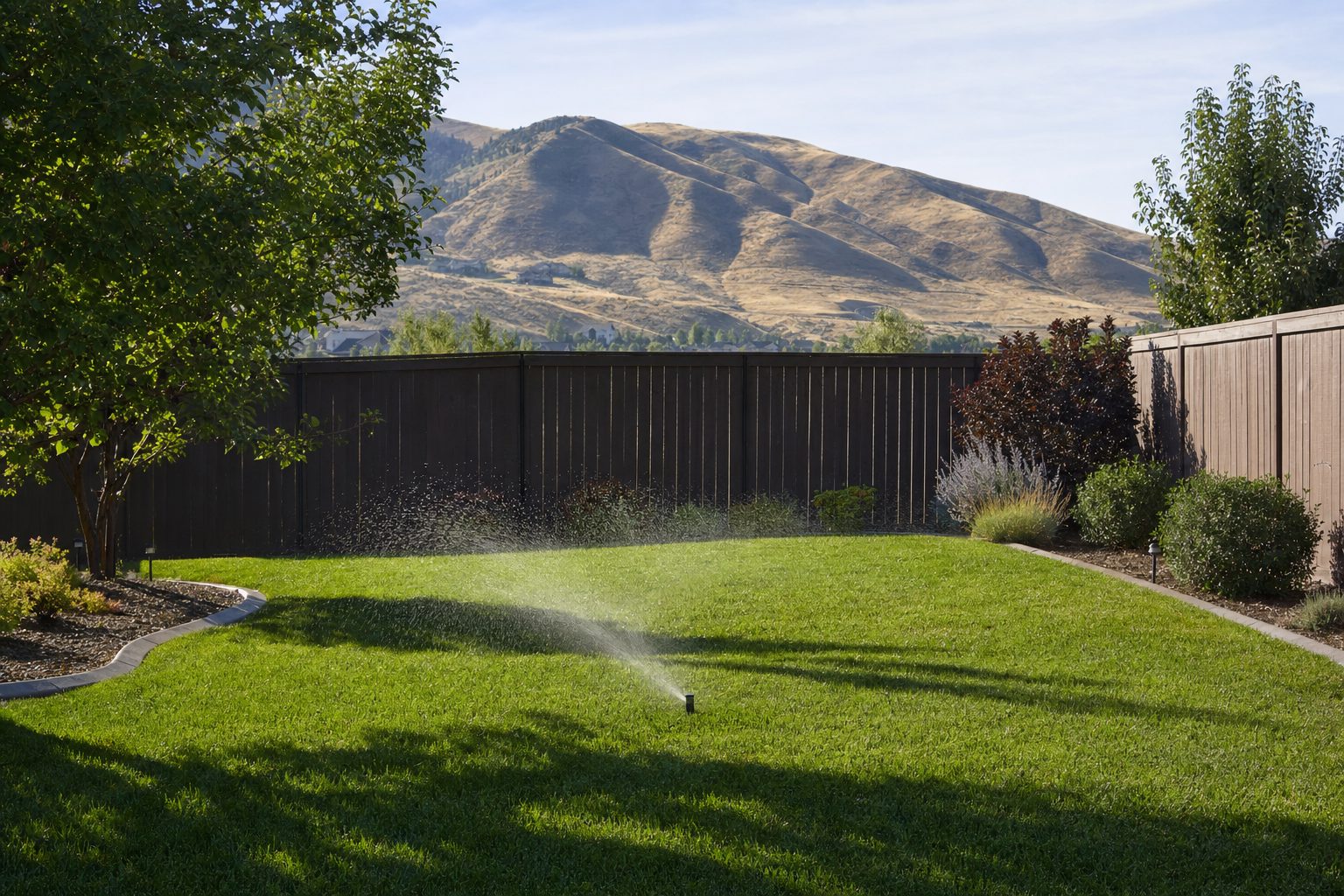
Treasure Valley Lawn Care Guide: A Seasonal Schedule for Boise & Southwest Idaho
A great lawn in the Treasure Valley isn't about luck — it's about timing. Our high-desert climate (long hot summers, cold winters, 11 inches of annual precipitation) demands a different schedule than the Midwest or the Pacific coast. This guide walks you through every task, month by month, with grass types, watering schedules, fertilization, aeration, overseeding, and common pests specific to Boise, Meridian, Eagle, Nampa, Caldwell, and surrounding areas.
The grass types that thrive here
The Treasure Valley sits in USDA Hardiness Zone 7a (with 7b microclimates near the river bottoms). Our summers are hot and dry (90–100°F highs from June through August), our winters are cold (drops below 10°F), and we get only 11–12 inches of precipitation annually. That rules out warm-season grasses like Bermuda and zoysia, which would go dormant for 7 months. Three cool-season grasses dominate local lawns:
| Grass Type | Water Need | Shade Tolerance | Traffic Tolerance | Best For |
|---|---|---|---|---|
| Kentucky Bluegrass (Poa pratensis) | High (1.5–2" per week) | Moderate | Excellent | Full-sun yards, families with kids/pets, the most common Treasure Valley lawn |
| Tall Fescue (Festuca arundinacea) | Medium (1–1.5" per week) | Good | Good | Yards with partial shade, lower-water areas, deeper root system tolerates drought better |
| Perennial Ryegrass (Lolium perenne) | Medium-High | Moderate | Moderate | Overseeding Kentucky bluegrass for quick green-up; rarely used alone here |
What about fine fescue? Fine fescues (creeping red, chewings, hard fescue) tolerate shade and low water, but they don't handle foot traffic well. They're better suited for shady borders and low-traffic areas than a primary lawn. If you have mature trees shading large parts of your yard, consider a fine fescue blend for those areas and Kentucky bluegrass or tall fescue for the sunny sections.
Sod vs. seed in the Treasure Valley
Most Treasure Valley lawns are installed as sod — typically Kentucky bluegrass blends from local growers like Emerald Sod Farms in Star or Webfoot Sod Farms. Sod gives you an instant lawn and can be laid from April through October, though the best windows are May and September when temperatures are moderate.
Seeding is cheaper ($0.05–0.15 per square foot for seed vs. $0.30–0.45 for sod) but takes 6–8 weeks to establish and is riskier — you need consistent moisture and protection from birds, wind, and sudden heat. The ideal seeding window is late August through September, when soil is warm, nights are cooling, and weed pressure is declining. Spring seeding (March–April) works but faces more weed competition and summer heat stress before roots are established.
Watering: the single most important factor
With only 11 inches of natural rainfall, Treasure Valley lawns rely almost entirely on irrigation. Most neighborhoods in Boise, Meridian, and Nampa have access to pressurized irrigation (a separate water system from domestic water, billed as a flat seasonal fee) — but Eagle, Kuna, and rural areas may rely on well water or domestic supply.
How much and how often
Cool-season grasses need 1.5–2 inches of water per week during the growing season (May–September). That translates to about 30–45 minutes per zone with typical pop-up spray heads, or 60–90 minutes with rotor heads. The golden rule: water deeply and infrequently. Three days per week is better than five short cycles. Deep watering encourages roots to grow 6–8 inches down, making the lawn more drought-resistant.
| Season | Frequency | Minutes per Zone (Spray) | Best Time |
|---|---|---|---|
| April–May (spring green-up) | 2–3 days/week | 15–25 min | 5:00–7:00 AM |
| June–August (peak heat) | 3–4 days/week | 25–35 min | 4:00–6:00 AM |
| September–October (cool-down) | 2 days/week | 20–30 min | 6:00–8:00 AM |
| November–March (dormant) | 0 (unless no snow & dry wind) | — | Mid-day if needed |
Never water in the evening. Watering after 7 PM leaves grass wet all night, which invites fungal diseases like brown patch and dollar spot — both common in Treasure Valley lawns during July and August. Water between 4:00 and 8:00 AM so the grass dries quickly in the morning sun.
Pressurized irrigation vs. city water
If your neighborhood has pressurized irrigation, use it for your lawn — it's significantly cheaper (a flat seasonal fee of $200–400 vs. metered city water that could run $100+/month in summer). However, irrigation water is untreated and can carry sediment, so install a filter on your sprinkler intake. If you're on city water, consider a smart controller (Rain Bird ESP-Me, Hunter Hydrawise, or Rachio) that adjusts watering based on local weather data — these can cut water use 20–30%.
The 12-month lawn care calendar
Here's your month-by-month schedule, timed to the Treasure Valley's growing season. Our last spring frost averages May 10 (range April 25–May 20) and our first fall frost averages October 5 (range September 25–October 20).
January–February
Lawn is dormant. No tasks needed. If we get a dry, windy stretch with no snow cover, a mid-day watering (above 40°F) prevents desiccation, especially on south-facing slopes. Avoid walking on frozen grass — it breaks the crowns.
March
First tasks of the season. Rake up debris and dead material. Apply pre-emergent crabgrass preventer (prodiamine or dithiopyr) when soil temperatures reach 50°F — typically mid-to-late March in the Treasure Valley. Don't aerate or overseed if you're applying pre-emergent (it prevents all seed germination for 8–12 weeks).
April
First mowing once grass starts active growth (usually early April). Mow at 2.5" to remove winter kill. Apply first round of fertilizer (slow-release nitrogen, 1 lb N per 1,000 sq ft). Check sprinkler system for winter damage and do a full coverage audit — adjust heads, fix leaks, replace broken nozzles. Turn on irrigation after the last frost.
May
Peak spring growth. Mow weekly at 3–3.5". Apply broadleaf weed control (2,4-D or dicamba-based) for dandelions and clover while weeds are actively growing. This is the last good window for laying sod before summer heat. Watch for first signs of billbug damage (patches of dying grass near sidewalks and driveways).
June
Transition to summer watering schedule. Raise mowing height to 3.5–4" — taller grass shades the soil, conserves moisture, and develops deeper roots. Apply second round of fertilizer (slow-release, 0.75–1 lb N per 1,000 sq ft). Monitor for white grubs and billbugs. Start checking for brown patch if nights stay above 65°F with high humidity.
July
Hottest month. Water deeply 3–4 days per week. Do NOT fertilize during heat waves — it stresses the grass. Mow at 4" and never remove more than 1/3 of the blade height per mowing. Watch for chinch bugs in full-sun areas and sod webworms near lights. If grass goes dormant (turns brown but recovers with water), don't panic — Kentucky bluegrass naturally goes dormant under heat/drought stress and recovers in fall.
August
Continue deep watering. Late August is the time to plan your fall aeration and overseeding. Apply grub control (imidacloprid or chlorantraniliprole) if you had grub damage last year — grubs feed on roots in late summer before going deep for winter. Start ordering seed for overseeding.
September
The most important month of the lawn care year. Core aerate when soil is moist but not soggy — typically early to mid-September. Overseed thin areas with a Kentucky bluegrass/perennial ryegrass blend (2–3 lbs per 1,000 sq ft). Apply fall fertilizer (higher potassium for root development, 1 lb N per 1,000 sq ft). This is the ideal time to start a new lawn from seed. Lower mowing height back to 3".
October
Continue mowing until growth stops (usually mid-October). Apply winterizer fertilizer (high nitrogen, slow-release) in late October — this feeds roots through fall and gives a quick green-up next spring. Blow out sprinkler system before first hard freeze (average first frost October 5, but first hard freeze often mid-October). Last chance for overseeding — seed after mid-October likely won't establish before winter.
November
Lawn is going dormant. Final mowing at 2.5" to prevent matting and snow mold over winter. Clean up leaves — don't let them smother the grass. Apply a final light watering if November is dry (November is often our driest month). Sprinkler system should already be winterized.
December
Lawn is dormant. Keep off frozen grass. No tasks required. If we get heavy snow, avoid piling shoveled snow on the lawn in large mounds — it takes longer to melt and can cause snow mold.
Mowing: height matters more than frequency
The most common lawn care mistake in the Treasure Valley is mowing too short. Homeowners often set their mowers at 2" thinking it means less frequent mowing — but short grass has shallow roots, dries out faster, and invites weeds. Here are the mowing heights that produce the healthiest Treasure Valley lawns:
| Season | Kentucky Bluegrass | Tall Fescue | Why |
|---|---|---|---|
| Spring (April–May) | 3–3.5" | 3–3.5" | Encourages dense spring growth |
| Summer (June–August) | 3.5–4" | 3.5–4" | Taller grass shades soil, conserves water, deeper roots |
| Fall (September–October) | 3" | 3–3.5" | Standard growing height |
| Final cut (November) | 2.5" | 2.5–3" | Prevents matting and snow mold over winter |
The 1/3 rule: never remove more than 1/3 of the grass blade height in a single mowing. If your grass is 4" tall, don't cut below 2.7". If you've let it grow too long, cut it down over two mowings a few days apart. Keep your mower blade sharp — a dull blade tears the grass, leaving ragged edges that turn brown and invite disease.
Fertilization: three feedings, not five
Many homeowners over-fertilize, burning their lawns and wasting money. Three applications per year are sufficient for most Treasure Valley lawns:
- Spring (April): Slow-release nitrogen (1 lb N per 1,000 sq ft). This kickstarts growth after winter dormancy. Use a balanced fertilizer like 16-16-16 or a slow-release urea product.
- Early summer (June): Slow-release nitrogen (0.75–1 lb N per 1,000 sq ft). Avoid fast-release nitrogen in July — it causes rapid growth that the plant can't sustain in heat, leading to stress and disease susceptibility.
- Fall (late September–October): This is the most important feeding of the year. Use a winterizer fertilizer with higher nitrogen and potassium (e.g., 22-3-10 or similar). The grass stores nutrients in its roots through the dormant period and uses them for a strong green-up the following spring.
Treasure Valley soil note: Most valley soils are alkaline (pH 7.5–8.2) and high in phosphorus and potassium, so you often don't need phosphorus-heavy fertilizers. A soil test from the University of Idaho Extension ($35) or Ada Soil & Water Conservation District will tell you exactly what your lawn needs. Apply sulfur (elemental sulfur or gypsum) if pH is above 8.0 — it lowers pH and improves nutrient availability.
Aeration and overseeding: the September ritual
Core aeration is the single most beneficial thing you can do for an established Treasure Valley lawn. Our soils — especially in newer subdivisions in Meridian, Nampa, and Kuna — are often compacted from construction. Compaction prevents water, air, and nutrients from reaching the roots. Aeration pulls 2–3 inch plugs of soil from the ground, relieving compaction and allowing the lawn to breathe.
When to aerate
Early to mid-September is the ideal window. The soil is still warm from summer (promoting root growth), cooler nights reduce heat stress, and weed pressure is declining. Aerate when the soil is moist but not saturated — water deeply 24 hours before, or aerate after a rain. Avoid aerating bone-dry soil (the tines won't penetrate) or soggy soil (they'll compact it further).
How to aerate
- Rent a core aerator from Home Depot, United Rentals, or local equipment rental shops ($60–90 per day). Go over the lawn twice in perpendicular directions for thorough coverage.
- Leave the plugs on the lawn — they'll break down in 1–2 weeks and return organic matter to the soil surface. Don't rake them up.
- Overseed immediately after while the holes are open. Seed makes direct contact with soil in the aeration holes, dramatically improving germination rates.
Overseeding: filling in thin and bare spots
Overseeding introduces new grass plants to thicken the lawn and fill in areas thinned by summer heat, disease, or insect damage. Use a blend of Kentucky bluegrass and perennial ryegrass (ryegrass germinates in 5–7 days for quick cover; bluegrass takes 14–21 days but is the long-term backbone).
- Seed rate: 2–3 lbs per 1,000 sq ft for overseeding an existing lawn; 4–5 lbs per 1,000 sq ft for bare areas.
- Seed-to-soil contact is critical. After aerating, broadcast seed, then lightly rake or drag a mat over the area to work seed into the aeration holes.
- Water 2–3 times daily (5–10 minutes each) for the first 2 weeks to keep seed constantly moist. Reduce to once daily once seedlings emerge, then taper to normal watering after 4 weeks.
- Hold off on mowing until new seedlings are at least 2" tall (usually 3–4 weeks after seeding). Mow at 3" to avoid uprooting tender new plants.
Common Treasure Valley lawn pests and diseases
White grubs
Grub larvae (Japanese beetle, June beetle, and masked chafer species) feed on grass roots in late summer (August–September). Affected lawns feel spongy underfoot and can be rolled back like a carpet because the roots are gone. Skunks and raccoons may dig up the lawn looking for grubs. Apply grub preventer (chlorantraniliprole or imidacloprid) in June–July before eggs hatch. If you already have grubs, use trichlorfon for a curative treatment in August–September.
Billbugs
The bluegrass billbug is the most destructive lawn insect in the Treasure Valley. Adults lay eggs in grass stems in May–June; larvae tunnel inside stems and then drop into the soil to feed on roots. Damage appears as irregular brown patches near sidewalks and driveways (where adults overwinter) starting in June. To check: grab a handful of grass in the affected area and pull — if it breaks off at the crown with sawdust-like frass at the base, it's billbugs. Apply a preventative insecticide (imidacloprid) in May before adults lay eggs.
Brown patch
A fungal disease that thrives in hot, humid conditions (nights above 65°F with high humidity). It causes circular patches of brown, thinning grass 6 inches to several feet in diameter, often with a smoke-ring border. In the Treasure Valley, brown patch is most common in July–August on overwatered, over-fertilized lawns. Fix: reduce watering frequency, water only in early morning, reduce nitrogen, and improve air circulation by pruning nearby shrubs. Fungicides (azoxystrobin, propiconazole) are a last resort.
Snow mold
Pink and gray snow mold appear in late winter/early spring when snow melts off lawns that were left too long in fall. Patches of matted, pinkish or grayish grass appear as snow retreats. Prevent it by mowing short (2.5") on the final cut, cleaning up leaves, and avoiding late-fall nitrogen applications. Most lawns recover on their own as spring growth resumes — lightly rake the matted areas to encourage airflow.
Lawn care cost guide for the Treasure Valley
| Service | DIY Cost | Professional Cost | Frequency |
|---|---|---|---|
| Mowing (avg 5,000 sq ft lot) | Time only | $35–55 per cut | Weekly (Apr–Oct) |
| Fertilization (3 applications) | $60–90 (product) | $200–350/season | 3× per year |
| Core aeration | $60–90 (rental) | $120–200 | Annually (September) |
| Overseeding (5,000 sq ft) | $40–60 (seed) | $250–400 (with aeration) | Annually or as needed |
| Weed control (broadleaf) | $20–30 (product) | $50–75 per application | 2–3× per year |
| Grub/insect control | $25–40 (product) | $75–125 per application | 1× per year (preventative) |
| Sprinkler winterization | $0 (DIY with compressor) | $60–100 | Annually (October) |
| Full-season lawn care package | — | $500–900/season | April–October |
When to call a professional
DIY lawn care is entirely feasible for most Treasure Valley homeowners — the tasks are straightforward and the equipment is readily available. Consider hiring a professional if:
- Your lawn has persistent disease or insect problems you can't diagnose
- You're establishing a new lawn from seed and can't water 2–3× daily
- Your lot is large (over 10,000 sq ft) and mowing takes more than an hour
- You travel frequently and can't maintain a weekly mowing schedule
- You've aerated and overseeded for 2 years and the lawn is still thin — a pro can assess soil compaction, pH, and hidden pest issues
For help choosing a reliable local contractor, see our guide to picking the best landscape contractor.