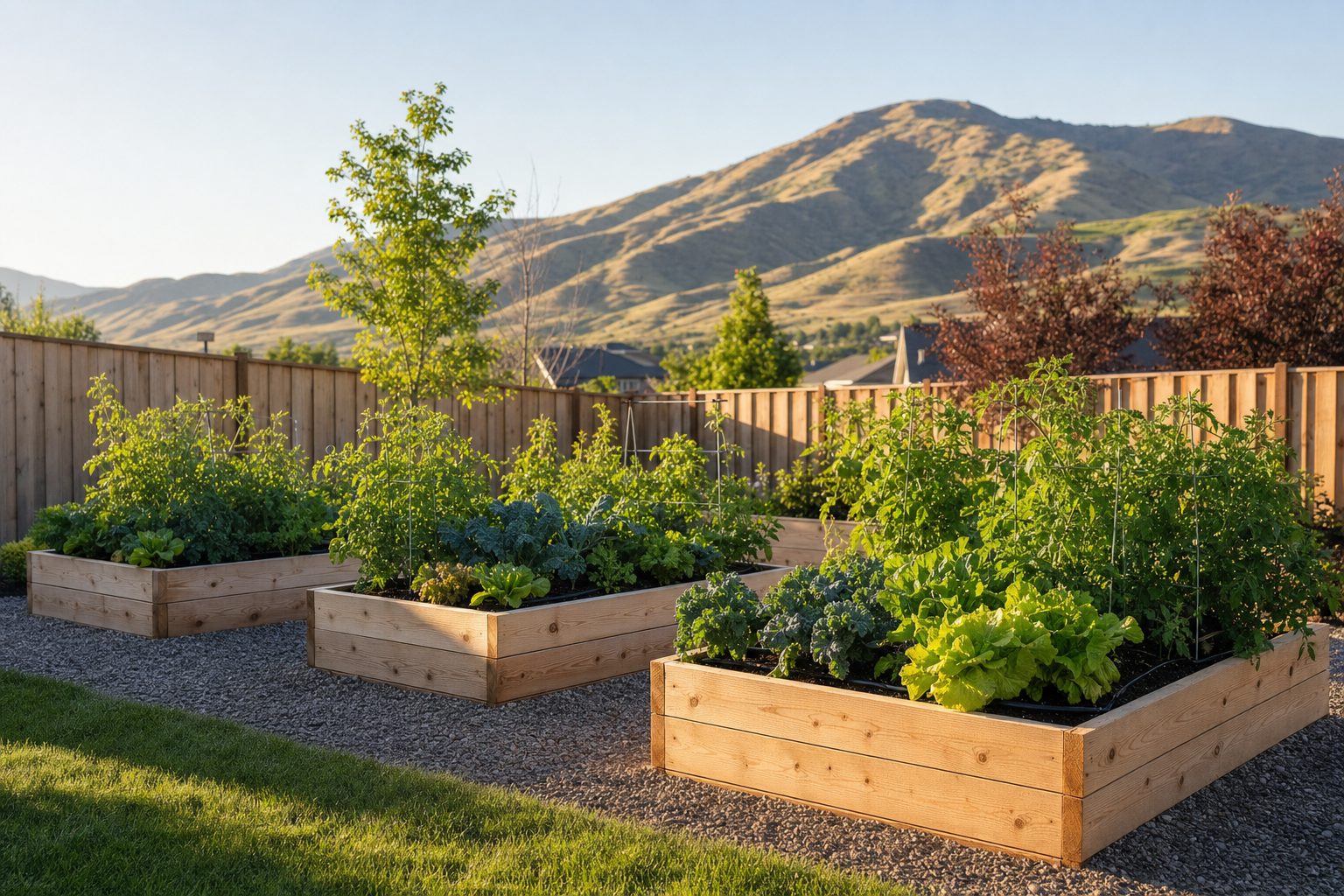
Raised Bed Gardening Guide for the Treasure Valley
Raised beds are the single most effective way to grow vegetables in the Treasure Valley — because they let you bypass the two things that make in-ground gardening hardest here: alkaline native soil and the cement-like caliche layer that sits beneath much of the valley floor.
If you've ever tried to dig a garden in a new Boise or Meridian subdivision and hit a white, concrete-hard layer 12 inches down, you've met caliche. If you've planted tomatoes in Nampa's silty clay and watched them yellow from iron chlorosis because the soil pH is 8.0+, you've met alkaline soil. Raised beds solve both problems by letting you build the ideal growing environment on top of the ground instead of trying to fix what's underneath it.
This guide covers everything you need to know to build, fill, plant, and maintain raised beds in Idaho's Treasure Valley — materials, soil mixes, planting calendars, irrigation, and the crops that thrive in our USDA Zone 6b–7a high-desert climate.
Why raised beds work in the Treasure Valley
The Treasure Valley's native soils pose three challenges that raised beds sidestep entirely:
- Alkaline pH (7.8–8.5) — Most valley soils are alkaline, which locks up iron, manganese, and phosphorus. Plants develop chlorosis (yellow leaves with green veins) even when nutrients are present in the soil. Raised beds let you fill with a neutral-pH mix (6.5–7.0) where nutrients are immediately available.
- Caliche hardpan — A layer of calcium carbonate cemented soil that forms 6–24 inches below the surface across much of the valley, especially in new developments in Boise's West Bench, Meridian, and Nampa. Caliche blocks root penetration and drainage. A raised bed 12–18 inches tall puts the root zone entirely above it.
- Compacted construction soil — New subdivisions in Meridian, Kuna, and Star often have topsoil scraped off during building, then a thin layer of poor-quality "builder's topsoil" spread back. Raised beds let you start fresh with quality soil instead of spending years amending compacted ground.
Raised beds also warm up 2–3 weeks earlier in spring than in-ground gardens, which extends the growing season in a valley where the last spring frost falls around May 10–12 and the first fall frost arrives October 14–17. That's roughly 150–160 frost-free days — decent, but not generous. Every week of early soil warming matters.
Soil conditions vary by neighborhood. The north end of Boise and the Foothills tend to have well-drained sandy loam. South Boise and the West Bench often hit caliche at 12 inches. Nampa's soils range from sandy loam near Lake Lowell to heavier silty clay. Caldwell and Melba have deep sandy loam — some of the best native garden soil in the valley, though still alkaline. Eagle's river-adjacent areas have sandy, well-drained soil, while the hillside developments have shallow soil over basalt. Raised beds normalize all of these to one consistent growing environment.
Choosing materials: cedar, metal, concrete, or composite
The material you choose for your raised bed walls affects longevity, cost, and soil temperature. Here's how each option performs in the Treasure Valley's intense UV, freeze-thaw winters, and dry summers:
| Material | Cost per 4×8 ft bed | Lifespan | Treasure Valley notes |
|---|---|---|---|
| Cedar | $60–$120 | 10–15 years | Naturally rot-resistant. Western red cedar is the gold standard. Available at most Boise-area lumber yards. Resists our dry-rot conditions well. Warm, natural appearance. |
| Corrugated metal | $80–$150 | 20–30+ years | Galvanized steel panels with cedar or steel corner posts. Extremely popular in modern Boise landscapes. Reflects heat — soil along the edges can run 5–10°F hotter in afternoon sun. Plant heat-sensitive crops toward the center. |
| Concrete blocks | $40–$90 | Indefinite | CMU blocks from Home Depot or Boise Block. Excellent thermal mass — absorbs heat during the day and releases it at night, extending the fall season. Permanent, but heavy to install. |
| Douglas fir (untreated) | $30–$60 | 5–8 years | Cheap and widely available. Will rot faster in our climate than cedar due to freeze-thaw cycles and summer irrigation. Fine for a trial bed — replace with cedar when it rots. |
| Composite lumber | $100–$200 | 25+ years | Recycled plastic/wood fiber. Won't rot, but expensive and can get very hot in direct sun. Available at Treasure Valley lumber yards. |
| Treated lumber | $40–$80 | 15–20 years | Modern ACQ-treated wood is considered safe for garden use by the EPA. Still, some Treasure Valley gardeners prefer to line the interior with a plastic barrier. Avoid older CCA-treated lumber entirely. |
Avoid railroad ties (creosote leaches into soil) and painted or stained salvaged wood (unknown chemicals). If you're on a tight budget, untreated Douglas fir is fine for your first season — you'll learn what works and can upgrade to cedar or metal later.
Sizing and building your raised bed
Dimensions
The ideal raised bed for vegetable gardening in the Treasure Valley is:
- Width: 3–4 feet (so you can reach the center from either side without stepping on the soil). A 4-foot width is standard.
- Length: 6–8 feet for a starter bed, up to 12 feet for experienced gardeners. Longer beds are more efficient with materials but harder to reach across.
- Height: 12–18 inches for most vegetables. 18–24 inches if you're growing root vegetables like carrots and potatoes, or if you know caliche sits close to the surface on your property.
A 4×8 foot bed at 12 inches tall gives you 32 square feet of planting space — enough for 8–10 tomato plants, or a mixed garden of tomatoes, peppers, herbs, and greens. Two such beds (64 square feet) can produce a meaningful share of a household's summer vegetables.
Building steps
- Choose a site with at least 6–8 hours of direct sunlight. In the Treasure Valley, a south or southeast exposure is ideal. Avoid low-lying frost pockets at the base of the Foothills — cold air drains downhill on spring nights and can damage early plantings.
- Level the ground. Clear sod and weeds. If you're placing the bed on lawn, lay down cardboard (remove all tape and staples) as a weed barrier — it decomposes in one season and adds organic matter.
- Build the frame. Cut boards to length. Use 4×4 corner posts for beds over 8 feet long. Connect with exterior screws (3-inch galvanized or deck screws). Pre-drill to prevent splitting in our dry cedar.
- Line the bottom with hardware cloth (1/2-inch mesh) if gophers or voles are a problem — common in rural Kuna, Star, and the Boise Foothills. Bend the edges up the inside walls 4 inches.
- Fill with soil mix (see next section). Water thoroughly to settle the soil, then top off — the mix will compact 10–15%.
The Treasure Valley raised bed soil mix
The single biggest mistake new raised-bed gardeners make in the Treasure Valley is filling beds with native soil or cheap "topsoil" from a landscape supply yard. That soil is typically alkaline (pH 8.0+), low in organic matter, and may contain weed seeds or caliche fragments. You're building a raised bed to escape that soil — don't fill it with the same stuff.
The ideal raised bed mix for the Treasure Valley, adapted from the well-known "Mel's Mix" formula but adjusted for our alkaline conditions:
| Component | Proportion by volume | What it does | Local source |
|---|---|---|---|
| Compost | 1/3 | Organic matter, nutrients, microbial life. Lowers pH toward neutral. | Boise Curb It compost (free for residents), Zamzows compost, or homemade (see our composting guide) |
| Coconut coir or peat moss | 1/3 | Water retention and aeration. Peat is slightly acidic (helps offset alkaline water). Coir is pH-neutral and more sustainable. | Zamzows, Edwards Greenhouse, North End Nursery |
| Pumice or perlite | 1/3 | Drainage and aeration. Pumice is preferred — it's mined in Idaho and retains moisture better than perlite while still draining. | Zamzows, local nurseries, or order Idaho pumice online |
For a single 4×8×12 inch bed (about 26 cubic feet of soil), you'll need roughly 9 cubic feet each of compost, coir/peat, and pumice. Cost breakdown:
- Compost: Free (Curb It) to $30 (bagged)
- Coir: $20–$30 (3 compressed bricks expand to ~9 cubic feet)
- Pumice: $15–$25 (bagged) or cheaper in bulk from landscape supply
Total soil cost per bed: $35–$85. If you're filling multiple beds, buying compost in bulk from a local supplier like Snake River Organics or Western Organics is far cheaper than bagged product. One cubic yard (27 cubic feet) of bulk compost runs $30–$50 versus $60–$90 for the same volume in bags.
Test your soil pH annually. Treasure Valley irrigation water is alkaline (pH 7.5–8.0 from canal-derived municipal supplies). Over time, watering will slowly raise the pH of your raised bed mix back toward alkaline. Test with a simple pH meter or kit (available at Zamzows or Edwards Greenhouse for $8–$15). If pH climbs above 7.5, add agricultural sulfur (1–2 cups per 4×8 bed) or work in a layer of coffee grounds and pine needle mulch, both slightly acidic.
Irrigation: watering raised beds in a high-desert climate
The Treasure Valley receives only 12–14 inches of precipitation annually — and most of that falls November through March, not during the growing season. From June through September, your raised beds will need supplemental irrigation almost every day. A 4×8 foot bed in July typically needs 8–12 gallons of water per day, depending on temperature and wind.
Drip irrigation: the only sensible option
Drip irrigation is strongly recommended for Treasure Valley raised beds. It delivers water directly to the root zone, minimizes evaporation (critical when humidity drops below 20% on summer afternoons), and keeps foliage dry — reducing the risk of fungal diseases that can otherwise take hold during the rare humid spells in August.
A basic drip system for one 4×8 bed costs $25–$50:
- 1/2-inch mainline along the bed perimeter
- 1/4-inch emitter lines running lengthwise every 12 inches
- Emitters: 0.5 GPH every 12 inches (or use drip tape with pre-installed emitters)
- A battery-operated timer ($20–$35) on your hose bib — set for early morning, 15–20 minutes daily
For multiple beds, consider a zone-based system with a manifold splitter. The Idaho Botanical Garden uses drip irrigation throughout its vegetable beds, and local nurseries like Edwards Greenhouse and Zamzows carry complete kits.
Watering rules for Treasure Valley summers
- Water early morning (5–7 AM) — the coolest, calmest time. Evening watering is second-best but can promote fungal growth if foliage stays damp overnight.
- Never water at midday — up to 50% of water is lost to evaporation in the dry, hot afternoon air. Plants that look wilted at 2 PM are often just conserving energy and will recover by evening.
- Check soil moisture by pushing a finger 2–3 inches into the bed. If it feels dry, water. If it's still damp, wait. The surface dries fast in our climate but the root zone may still be moist.
- Mulch the surface with 2 inches of straw, dried leaves, or grass clippings (no herbicide-treated clippings). Mulch reduces evaporation by 50–70% and keeps soil temperatures 10–15°F cooler. See our mulching guide for details.
What to plant: a Treasure Valley raised bed planting calendar
The Treasure Valley sits in USDA Hardiness Zones 6b–7a, with a growing season from approximately May 10 to October 14 — about 155 frost-free days. But raised beds extend the season on both ends: soil warms 2–3 weeks earlier in spring, and the insulating mass of the soil protects plants from light fall frosts that would kill in-ground plantings.
Cool-season crops (plant early — March to mid-April)
These crops tolerate frost and thrive in the cool, moist spring conditions before summer heat arrives. Plant them as soon as the soil in your raised bed is workable — typically early to mid-March in Boise, a week later in the outlying valley areas.
| Crop | Planting window | Spacing | Notes |
|---|---|---|---|
| Leaf lettuce (Lactuca sativa) | Mar 1–Apr 15 | 6–8 inches | Looseleaf varieties ('Salad Bowl', 'Red Sails') outperform head lettuce. Sow every 2 weeks for continuous harvest. Bolts by mid-June in heat. |
| Spinach (Spinacia oleracea) | Mar 1–Apr 15 | 4–6 inches | Loves cool weather. Harvest before late May — will bolt quickly once days exceed 75°F. |
| Peas (Pisum sativum) | Mar 15–Apr 15 | 2 inches, in rows | Snap and snow peas do better than shell peas here. Plant along the north edge so they don't shade shorter crops. Provide a trellis. |
| Radishes (Raphanus sativus) | Mar 1–Apr 30 | 2–3 inches | Ready in 25–30 days. 'French Breakfast' and 'Cherry Belle' are reliable. Succession plant every 2 weeks. |
| Kale (Brassica oleracea) | Mar 15–Apr 15 | 12–18 inches | 'Lacinato' (dinosaur kale) and 'Red Russian' handle our spring temperature swings well. Will survive into December with a frost cloth. |
| Carrots (Daucus carota) | Mar 15–Apr 30 | 2–3 inches | Raised beds are ideal for carrots — no rocks or caliche to fork the roots. 'Nantes' types are best for our climate. |
| Onions (sets or transplants) | Mar 15–Apr 15 | 4–6 inches | Use 'Walla Walla' sweet onion transplants or red onion sets. Available at local nurseries in March. |
Warm-season crops (plant after last frost — mid-May)
Wait until the last spring frost (approximately May 10–12 in Boise) has passed before transplanting warm-season crops. Soil temperature in the raised bed should be at least 60°F — check with a soil thermometer. In raised beds, soil typically reaches this temperature 1–2 weeks earlier than in-ground gardens.
| Crop | Planting window | Spacing | Notes |
|---|---|---|---|
| Tomatoes (Solanum lycopersicum) | May 10–25 | 24–36 inches | Choose determinate ('Celebrity', 'Roma') for beds, indeterminate ('Early Girl', 'Sungold') for vertical trellising. Plant deep — bury the stem 4–6 inches. Protect from late frost with a frost cloth or wall-of-water. |
| Peppers (Capsicum annuum) | May 15–Jun 1 | 18–24 inches | Peppers love heat. Use black plastic mulch to warm the soil further. 'California Wonder' (bell) and 'Anaheim' (chili) are reliable valley performers. |
| Zucchini (Cucurbita pepo) | May 10–25 | 36 inches | One plant feeds a family. 'Black Beauty' and 'Costata Romanesco' are dependable. Plant at the edge of the bed so the sprawling foliage doesn't shade neighbors. |
| Bush beans (Phaseolus vulgaris) | May 10–Jul 1 | 4–6 inches, in rows | 'Provider' and 'Contender' are excellent for our climate. Succession plant every 2 weeks through July for continuous harvest. |
| Cucumbers (Cucumis sativus) | May 15–Jun 1 | 12 inches on trellis | Trellis cucumbers on the north side of the bed to save space and prevent powdery mildew (a common late-summer issue in the valley). 'Lemon' and 'Marketmore 76' are proven varieties. |
| Basil (Ocimum basilicum) | May 15–Jun 15 | 12 inches | Plant alongside tomatoes — the classic companion planting. Basil repels some tomato pests and the two share similar water needs. 'Genovese' is the standard. |
Fall crops (plant July to mid-August for harvest Sep–Nov)
One of the great advantages of raised beds in the Treasure Valley is the extended fall season. As summer crops finish, pull them out and replant with cool-season crops for a second harvest. The soil is still warm enough for germination in late July and August, and the raised bed protects from early frosts.
- Lettuce and spinach — sow from July 20 to August 15. They'll mature as temperatures cool and provide harvests into November.
- Radishes — sow August 1–20. 30 days to harvest means you'll have crisp radishes by mid-September.
- Garlic — plant cloves in mid-October (separate from the summer garden, but worth noting). Garlic overwinters in raised beds and is harvested the following June. 'Inchelium Red' and 'German Extra Hardy' are reliable Idaho varieties.
- Kale and collards — transplant seedlings in early August. They sweeten after the first frost and can survive with a frost cloth into December.
See our fall vegetable garden guide for a detailed second-season planting plan.
Managing heat waves in raised beds
Treasure Valley summers regularly hit 95–105°F for stretches of 5–10 days. Raised beds — especially metal-sided ones — can heat up significantly, stressing plants and drying soil faster than in-ground gardens. Here's how to protect your beds during heat waves:
- Shade cloth — 30–40% shade cloth draped on hoops reduces soil temperature by 10–15°F. Essential for lettuce and other cool crops trying to survive past June. Available at Edwards Greenhouse and Zamzows.
- Intensive planting — a fully planted bed with leaf canopy shading the soil stays cooler than a bed with bare soil between plants. Plant closely enough that mature leaves just touch.
- Deep watering the night before a predicted heat wave — soak the bed thoroughly so roots have a moisture reserve to draw on during the hottest hours.
- Mulch heavily — increase mulch to 3 inches during heat waves. Straw is ideal; it reflects sunlight and insulates the soil.
- Don't water at midday — it's tempting to "rescue" wilting plants with a hose at 2 PM, but you'll lose most of the water to evaporation and can actually burn leaves if droplets act as lenses. Wait until evening.
Local nurseries for raised bed supplies. Edwards Greenhouse (410 E Warm Springs Ave, Boise) carries soil components, seedlings, and shade cloth. North End Nursery (1402 N 13th St, Boise) is the go-to for heirloom vegetable starts and compost tea. Zamzows (multiple Treasure Valley locations) stocks soil mixes, fertilizer, drip irrigation kits, and pest controls. Franz Witte Nursery (8200 S Federal Way, Boise) offers higher-end materials and a good selection of perennial herbs for companion planting.
Soil maintenance: keeping your beds productive year after year
A raised bed is a closed system — unlike in-ground gardens, there's no subsoil connection to replenish nutrients. Each season, you need to add back what the plants took out. Here's the annual maintenance cycle for Treasure Valley raised beds:
Spring (March–April)
- Add 2–3 inches of fresh compost to the top of each bed and work it in lightly with a hand fork.
- Add a balanced organic fertilizer (like Zamzows 'Soil Restore' or Dr. Earth 'Home Grown') at the rate recommended on the package — typically 1–2 cups per 4×8 bed.
- Test pH. If above 7.5, add agricultural sulfur.
- Check drip lines for freeze damage and flush the system.
Summer (June–August)
- Side-dress heavy feeders (tomatoes, peppers, cucumbers) with compost or worm castings every 4–6 weeks.
- Reapply mulch as it decomposes — a 2-inch layer should be maintained all season.
- Monitor for pests: aphids, cabbage worms, and squash bugs are the most common Treasure Valley raised-bed pests. Hand-pick squash bugs daily in July–August. Use floating row cover to protect brassicas from cabbage moths.
Fall (October–November)
- After the final harvest, remove all plant material (don't compost diseased plants — bag them). Leaving dead plants in the bed over winter harbors pests.
- Plant a cover crop of winter rye or crimson clover if you won't be planting garlic or overwintering kale. Cover crops add organic matter and prevent winter wind erosion, which can blow dry soil out of raised beds.
- Alternatively, cover the bed with 2 inches of compost and a layer of straw mulch to protect the soil through winter.
Cost breakdown: building your first raised bed
Here's what it costs to build and fill one 4×8×12 inch cedar raised bed in the Treasure Valley, using locally available materials:
| Item | Source | Cost |
|---|---|---|
| 2×12 cedar boards (2 × 8 ft + 2 × 4 ft cuts) | Boise lumber yard or Home Depot | $60–$90 |
| 4×4 corner posts (2 posts, 12 inches) | Same | $8–$12 |
| 3-inch deck screws (1 box) | Hardware store | $6–$8 |
| Compost (9 cubic feet) | Curb It (free) or bagged | $0–$30 |
| Coconut coir (3 blocks) | Zamzows or online | $20–$30 |
| Pumice (9 cubic feet) | Landscape supply or bagged | $15–$25 |
| Hardware cloth (optional, for gophers) | Hardware store | $10–$15 |
| Drip irrigation kit (1 bed) | Zamzows or Home Depot | $25–$50 |
| Total | $144–$260 |
That's a one-time investment that lasts 10–15 years (the cedar frame). The soil will need annual topping with compost ($0–$30 per year) but doesn't need to be replaced wholesale. Over a 10-year lifespan, the cost per year of a productive 32-square-foot garden is $14–$26 — far less than the value of the food it produces.
Common raised bed problems in the Treasure Valley
Blossom-end rot on tomatoes
Dark, sunken patches on the bottom of tomatoes are caused by calcium deficiency — usually not because calcium is absent from the soil, but because inconsistent watering prevents the plant from taking it up. The fix is reliable, even irrigation: set your drip timer to run daily at the same time, and never let the bed dry out completely between waterings. Our dry climate makes this the most common raised-bed tomato problem.
Yellowing leaves (iron chlorosis)
If leaves yellow while veins stay green, the soil pH has likely crept above 7.5 — the Treasure Valley irrigation water is alkaline and will slowly raise bed pH over time. Test the pH, then add agricultural sulfur or chelated iron. Planting in fresh mix usually avoids this for the first 1–2 years.
Squash bugs
The most persistent pest for Treasure Valley raised-bed squash growers. Adults are brown, shield-shaped, about 5/8 inch long. They appear in July and can kill a zucchini plant in days. Hand-pick them off daily (drop into soapy water), and look for the copper-colored egg clusters on the undersides of leaves. Companion-planting nasturtiums as a trap crop helps redirect them.
Powdery mildew
A white fungal coating on cucumber and squash leaves in late summer. Our dry climate usually suppresses it, but it can appear after the rare humid spell or if plants are crowded with poor air circulation. Space plants properly, trellis cucumbers, and remove affected leaves promptly. A spray of 1 part milk to 9 parts water applied weekly can suppress early stages.
Drying out too fast
Raised beds dry out faster than in-ground gardens, especially in our low-humidity climate and windy conditions. If your bed is drying out in a single day, the likely causes are: insufficient organic matter (add more compost), no mulch (add 2–3 inches of straw), or the bed is too shallow (less than 10 inches). Increasing the compost proportion in your mix to 40–50% significantly improves water retention.