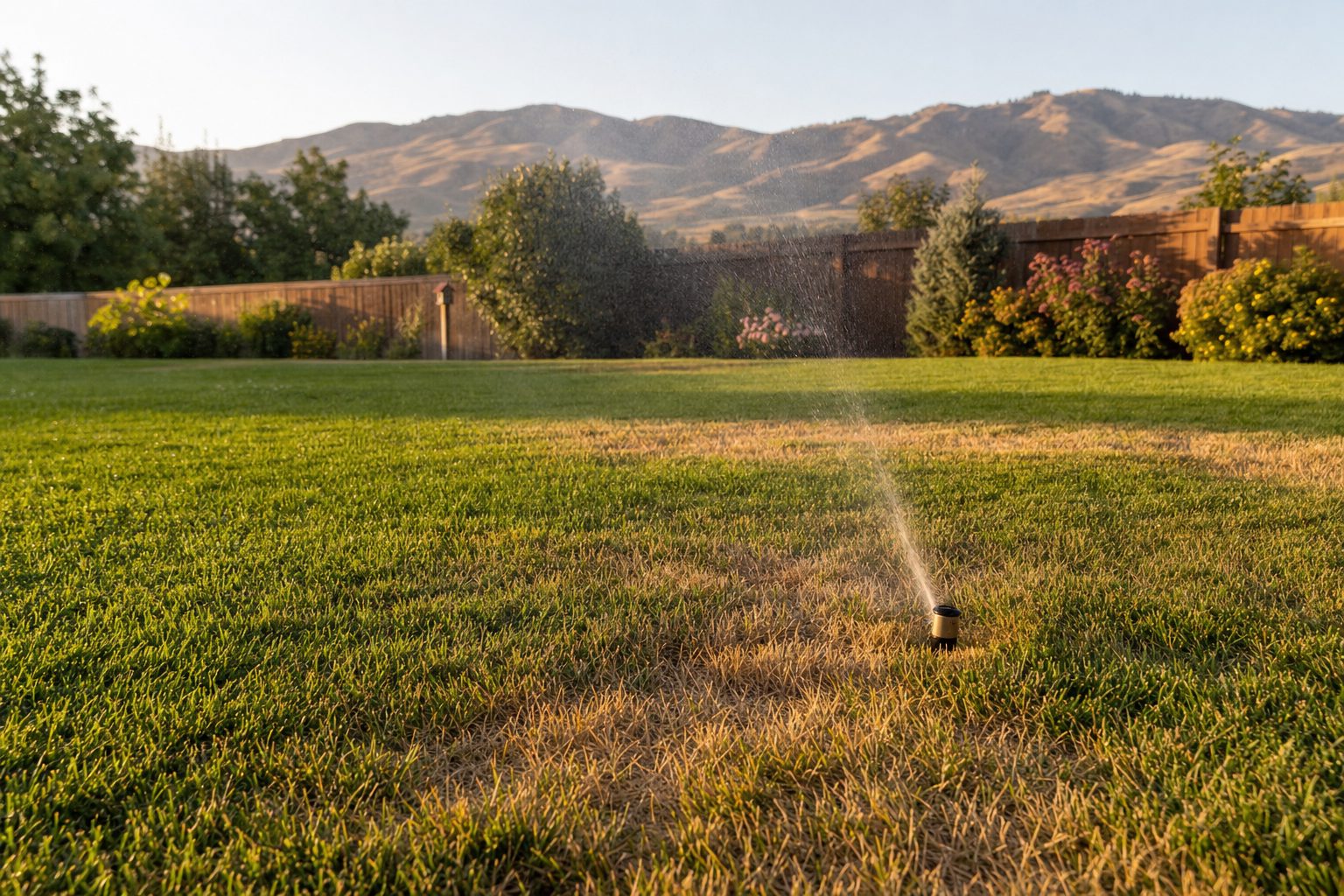
By early August, most Treasure Valley lawns have weathered six straight weeks of 90–100°F highs and barely a trace of rainfall. Even well-maintained Kentucky bluegrass and tall fescue lawns show brown patches, thinning areas, and slowed growth. The good news: late August through September is the single best window in the entire year to repair heat-damaged lawns in the Treasure Valley — cooler nights, shorter days, and still-warm soil create ideal growing conditions.
Diagnosing the damage: what's wrong with your lawn?
Before you apply any treatment, figure out what's actually causing the problem. Heat stress, drought stress, grub damage, and fungal disease all look similar from the sidewalk but require completely different fixes. Here's how to tell them apart in a Treasure Valley yard:
| Problem | What It Looks Like | How to Test | Fix |
|---|---|---|---|
| Drought stress | Uniform gray-green or purplish tint, footprints stay visible after walking on grass, blades fold in half lengthwise | Push a screwdriver 6 inches into the soil — if it won't go in easily, the soil is bone dry | Deep soak 1–1.5 inches per week in 2–3 sessions |
| Heat scorch | Brown tips on green blades, south-facing slopes and full-sun areas worst, shaded areas still green | Check blades individually — brown tips but green bases means heat, not drought | Raise mowing height to 3.5–4 inches, wait for cooler temps |
| Grub damage | Irregular brown patches that peel back like loose carpet, skunks or raccoons digging in lawn at night | Cut a 1-foot square of turf 3 inches deep and flip it over — count white C-shaped grubs. More than 5&ndash7 per square foot means treatment needed | Apply imidacloprid or chlorantranilipole in August (see below) |
| Fungal disease | Circular brown patches (6 inches–3 feet), gray-white mold in early morning, grass blades with lesions | Look for a "smoke ring" of gray-black at the edge of the patch in early morning dew | Reduce evening watering, apply fungicide if spreading |
| Compaction | Thin, weak grass in high-traffic areas, water puddles or runs off instead of soaking in | Try to push a pencil into the soil — if it resists, soil is compacted | Core aerate in September (see below) |
The screwdriver test: The fastest way to assess any Treasure Valley lawn in August is the screwdriver test. Push a 6-inch screwdriver into the soil in several spots. If it slides in easily to the hilt, moisture is adequate and your problem is likely heat or disease. If it resists or stops at 2–3 inches, the soil is too dry and you need to water more deeply. This single test eliminates most guesswork.
Watering: the single most important thing you can do
In the Treasure Valley's high-desert climate, watering is both the most common cause of lawn problems and the most effective cure. Boise averages only 11–12 inches of precipitation annually, and August typically delivers less than 0.4 inches. Your sprinkler system is the only thing keeping the lawn alive.
How much to water in August
Kentucky bluegrass needs 1.5–2 inches of water per week in August. Tall fescue needs 1–1.5 inches. Fine fescue in shaded areas needs 0.75–1 inch. Measure your output by placing flat tuna cans or rain gauges around the lawn and running your sprinklers for 15 minutes — measure the depth and calculate how long it takes to deliver 0.5 inches per session.
| Grass Type | Weekly Water (Aug) | Sessions per Week | Best Time |
|---|---|---|---|
| Kentucky Bluegrass (Poa pratensis) | 1.5–2 inches | 3–4 deep sessions | 5:00–7:00 AM |
| Tall Fescue (Festuca arundinacea) | 1–1.5 inches | 2–3 deep sessions | 5:00–7:00 AM |
| Fine Fescue (shade mix) | 0.75–1 inch | 2 sessions | 5:00–7:00 AM |
Why morning watering matters
Watering between 5:00 and 7:00 AM is optimal for three reasons: (1) evaporation is minimal because the sun is low and temperatures are at their coolest, (2) the grass blades dry quickly as the sun rises, which prevents fungal diseases like brown patch and dollar spot that thrive on prolonged leaf wetness, and (3) wind is typically calmest in the early morning, giving you more even coverage. Evening watering leaves grass wet all night and is the #1 cause of fungal problems in Treasure Valley lawns. Midday watering loses 30–50% of the water to evaporation before it reaches the roots.
Boise water restrictions: The city of Boise allows watering on any day of the week, but encourages voluntary odd-even scheduling (odd addresses water on odd days, even on even days). Nampa and Caldwell have no mandatory restrictions but encourage conservation. Meridian and Eagle follow Ada County guidelines. Check your city's website for current rules before August watering — drought years can trigger temporary restrictions.
Deep and infrequent vs. shallow and daily
The biggest watering mistake Treasure Valley homeowners make is running sprinklers for 10 minutes every day. This creates shallow root systems that can't survive a single missed watering cycle. Instead, water deeply (30–45 minutes per zone, enough to wet the soil 6 inches deep) and infrequently (every 2–3 days for bluegrass, every 3–4 days for fescue). Deep watering forces roots to grow deeper in search of moisture, making the lawn dramatically more drought-tolerant. See our Treasure Valley Irrigation Guide for detailed sprinkler scheduling.
Mowing adjustments for heat-stressed lawns
Mowing height is the second most important factor in August lawn health. Cutting too short is the fastest way to kill a heat-stressed lawn — short grass has less leaf surface for photosynthesis, exposes soil to sun (increasing evaporation), and weakens root systems. Here's how to adjust for August:
- Raise the deck to 3.5–4 inches. Taller grass shades the soil, keeping it cooler and reducing water loss. The taller canopy also crowds out weeds like crabgrass and spotted spurge, which germinate in bare soil during summer heat.
- Never remove more than one-third of the blade height in a single cut. If your lawn is at 4 inches and you want it at 3.5, that's fine. If it grew to 5 inches while you were on vacation, cut it to 3.5 inches over two sessions, 3 days apart — cutting from 5 to 3.5 in one pass shocks the plant.
- Keep mower blades sharp. Dull blades tear rather than cut, leaving ragged tips that lose more moisture and are more susceptible to disease. Sharpen blades at least twice per season — or three times if you have a large lot. A sharp blade test: freshly cut grass should have a clean, straight edge, not a white, frayed tip.
- Mow in the evening or early morning, not midday. Cutting grass in peak heat causes additional stress. Wait until temperatures drop below 85°F.
- Leave clippings on the lawn. Grass clippings are 80–90% water and return nitrogen to the soil. They do not cause thatch — that's a myth. Thatch is caused by dead roots and rhizomes, not clippings.
Grub damage: the hidden killer
August is peak grub season in the Treasure Valley. White grubs — the larval stage of masked chafers and June beetles — feed on grass roots just below the soil surface. By the time you see above-ground symptoms (browning, thinning), the roots may already be severed and the grass can be peeled back like a rug.
How to check for grubs
Cut a 1-foot square section of turf 3 inches deep with a spade. Fold it back and look at the soil and roots. White, C-shaped larvae with brown heads are grubs. Count them: fewer than 5 per square foot is normal and doesn't require treatment. 5–10 per square foot means the lawn will thin but may recover with extra water. More than 10 per square foot requires treatment — the lawn won't recover on its own.
Treatment options
If you find damaging grub populations in August, two options work in the Treasure Valley:
- Chlorantraniliprole (Scotts GrubEx, Bayer Season-Long Grub Control): Apply in August. It works on young grubs and provides 4 months of protection. Water in with 0.5 inches of irrigation immediately after application. Available at Home Depot (Boise, Meridian, Nampa), Lowe's (Boise, Meridian), and Zamzows (Boise, Eagle, Nampa, Caldwell, Meridian). Cost: $25–35 per 5,000 sq ft bag.
- Beneficial nematodes (Heterorhabditis bacteriophora): An organic option that parasitizes grubs. Apply in late evening (UV light kills them) and water in thoroughly. Best results when soil is above 65°F, which is the case throughout August in the Treasure Valley. Available online from Arbico Organics or locally at Edwards Greenhouse in Boise. Cost: $30–50 per 5,000 sq ft. Less effective than chemical controls but completely safe for kids, pets, and pollinators.
Don't bother with milky spore in Idaho. Milky spore disease (Bacillus popilliae) only controls Japanese beetle grubs, which are not established in the Treasure Valley. Our grubs are primarily masked chafer larvae, which milky spore doesn't affect. You'll see milky spore for sale at garden centers — skip it.
Fertilization: less is more in August
Fertilizing a heat-stressed lawn in August can do more harm than good. Nitrogen pushes top growth, which increases water demand and stress on an already struggling root system. If your lawn is brown and thinning from heat, hold off on fertilizer until September, when cooler temperatures allow the grass to use nutrients efficiently.
If your lawn is still relatively green and healthy (good watering and mowing practices have kept it going), a light application of slow-release nitrogen in late August is fine. Apply no more than 0.5 lb of nitrogen per 1,000 sq ft — about a quarter of the spring rate. Look for products labeled "slow release" or "controlled release" (sulfur-coated urea or polymer-coated urea). Available at Zamzows, Home Depot, and Lowe's. Cost: $30–45 for a bag covering 5,000–10,000 sq ft.
The September renovation window
The real magic of late summer lawn recovery happens in September, not August. September is the single best month for lawn renovation in the Treasure Valley for three reasons: (1) soil is still warm (65–70°F), which seeds germinate quickly in, (2) daytime highs drop to the 70s and 80s, reducing heat stress, and (3) cool nights slow evaporation, so the soil stays moist longer. The window is short — seed sown after October 15 may not establish before the first hard freeze.
Core aeration
If your lawn is compacted (the screwdriver test resists, or water runs off instead of soaking in), core aeration is the fix. A core aerator pulls 2–3 inch plugs of soil from the lawn, allowing water, air, and nutrients to penetrate deeper. It also reduces thatch accumulation.
- When: September 1–30. Soil should be moist but not muddy — water 24 hours before aerating if the ground is hard.
- Equipment: Rent a core aerator from Home Depot (Boise, Nampa), Big R (Meridian, Nampa), or Diamond Turf & Rental (Boise). Cost: $60–90 for a half-day rental.
- Professional cost: $120–200 for a typical 5,000 sq ft lot. If you're also overseeding, many companies include aeration in the overseeding package.
- Method: Make 2–3 passes in different directions across the lawn. Leave the plugs on the surface — they'll break down in 1–2 weeks and return nutrients to the soil. Don't use spike aerators (they just push soil aside and actually increase compaction around the holes).
Overseeding
If your lawn has bare patches or thin areas (common after August heat), overseeding fills them in before winter. Combine with core aeration for best results — the holes give seed direct contact with soil, which is essential for germination.
- Seed selection: For Kentucky bluegrass lawns, overseed with a Kentucky bluegrass blend (3–4 cultivars mixed for disease resistance). For tall fescue lawns, use a turf-type tall fescue blend. Don't mix grass types — a bluegrass/fescue mix looks patchy. If your lawn is a mix already and you want to unify it, choose the grass that's currently dominant.
- Seed rate: 2–3 lbs per 1,000 sq ft for Kentucky bluegrass, 4–6 lbs per 1,000 sq ft for tall fescue. For spot repair of bare patches, seed at the higher end and rake lightly to cover.
- Where to buy seed: Zamzows (Boise, Eagle, Meridian, Nampa, Caldwell) carries locally-adapted seed blends formulated for Treasure Valley conditions. Home Depot and Lowe's stock national brands (Scotts, Pennington). For premium seed, United Seeds in Nampa supplies local sod farms and sells retail.
- Watering after seeding: This is the critical step. Newly seeded areas must stay consistently moist for 14–21 days. Water lightly 3–4 times per day for 10–15 minutes each. Once seedlings are 1.5–2 inches tall (typically 2–3 weeks), reduce to once-daily deep watering. See our irrigation guide for new-seed schedules.
- Cost: $40–60 for seed (5,000 sq ft lot) if DIY. Professional overseeding with aeration: $250–400 for a typical lot.
The golden window: Seed sown between September 1 and September 30 has the highest success rate in the Treasure Valley. Grass that germinates in September develops 6–8 weeks of root growth before the first hard freeze (typically late October–early November). Seed sown in October has half that time and is at much higher risk of winter kill. Plan to overseed the first week of September if possible.
August lawn care calendar for the Treasure Valley
Week 1 (Aug 1–7)
Diagnose any problem areas with the screwdriver test. Check for grubs. Raise mowing height to 3.5–4 inches. Confirm sprinkler coverage and adjust for 1.5 inches/week for bluegrass, 1 inch for fescue.
Week 2 (Aug 8–14)
Apply grub control if needed (chlorantraniliprole or nematodes). Spot-water dry patches by hand. Avoid all fertilization on heat-stressed areas. Keep mowing tall and sharp.
Week 3 (Aug 15–21)
Begin planning September renovation. Order seed (especially from United Seeds or Zamzows — popular blends sell out by Labor Day). Reserve a core aerator rental for the first week of September.
Week 4 (Aug 22–31)
As nighttime lows drop into the 50s, lawns begin recovering naturally. Light slow-release fertilizer (0.5 lb N/1,000 sq ft) only on green, healthy sections. Prepare for aeration and overseeding in early September.
Should you replace your lawn instead?
If your lawn has been struggling for multiple seasons — constant brown patches despite proper watering, recurring grub infestations, or the wrong grass type for your sun exposure — late summer is also the best time to consider alternatives. A full lawn renovation (kill existing grass, amend soil, reseed) costs $1,500–3,500 for a 5,000 sq ft lot, vs. $500–900 per season for ongoing professional care.
If you're questioning whether a traditional lawn is worth the water and effort in the Treasure Valley's climate, you're not alone. Many Boise-area homeowners are converting to lawn alternatives — creeping thyme, buffalo grass, yarrow, and native bunchgrass meadows that need 50–75% less water. See our lawn alternatives guide for a full comparison of water use, maintenance, cost, and appearance.
Where to buy supplies in the Treasure Valley
- Zamzows (Boise, Eagle, Meridian, Nampa, Caldwell): Locally owned. Best source for Treasure Valley-adapted grass seed, fertilizer, and organic soil amendments. Staff can advise on local conditions. Multiple locations.
- Home Depot (Boise, Meridian, Nampa): Core aerator rentals, bulk seed, fertilizer, grub control. Reserve rental equipment online.
- Lowe's (Boise, Meridian): Seed, fertilizer, grub control, sprinkler parts. Slightly different brand selection from Home Depot.
- United Seeds (Nampa): Wholesale and retail grass seed supplier. Premium blends used by Treasure Valley sod farms. Best for large lots or whole-lawn renovations.
- Edwards Greenhouse (Boise): Organic options including beneficial nematodes, compost, and organic fertilizers. Also a great source for cover crop seed if you're renovating soil.
- Big R (Meridian, Nampa): Farm and ranch supply with core aerator rentals, bulk seed, and competitive pricing on fertilizer and pest control.
When to call a professional
Most August lawn recovery tasks — adjusting watering, raising mowing height, applying grub control — are straightforward DIY work. But consider calling a professional if:
- You can't diagnose the problem after the screwdriver and grub tests — a lawn care service can identify disease, nutrient deficiency, or soil pH issues
- Your lot is over 10,000 sq ft and aeration/overseeding is physically demanding
- You've been fighting the same lawn problems for 2+ seasons and nothing works — the issue may be soil compaction, caliche layer, or pH imbalance that needs professional testing
- You're considering a full lawn replacement and want it done right the first time
For help choosing a reliable local contractor, see our guide to picking the best landscape contractor.