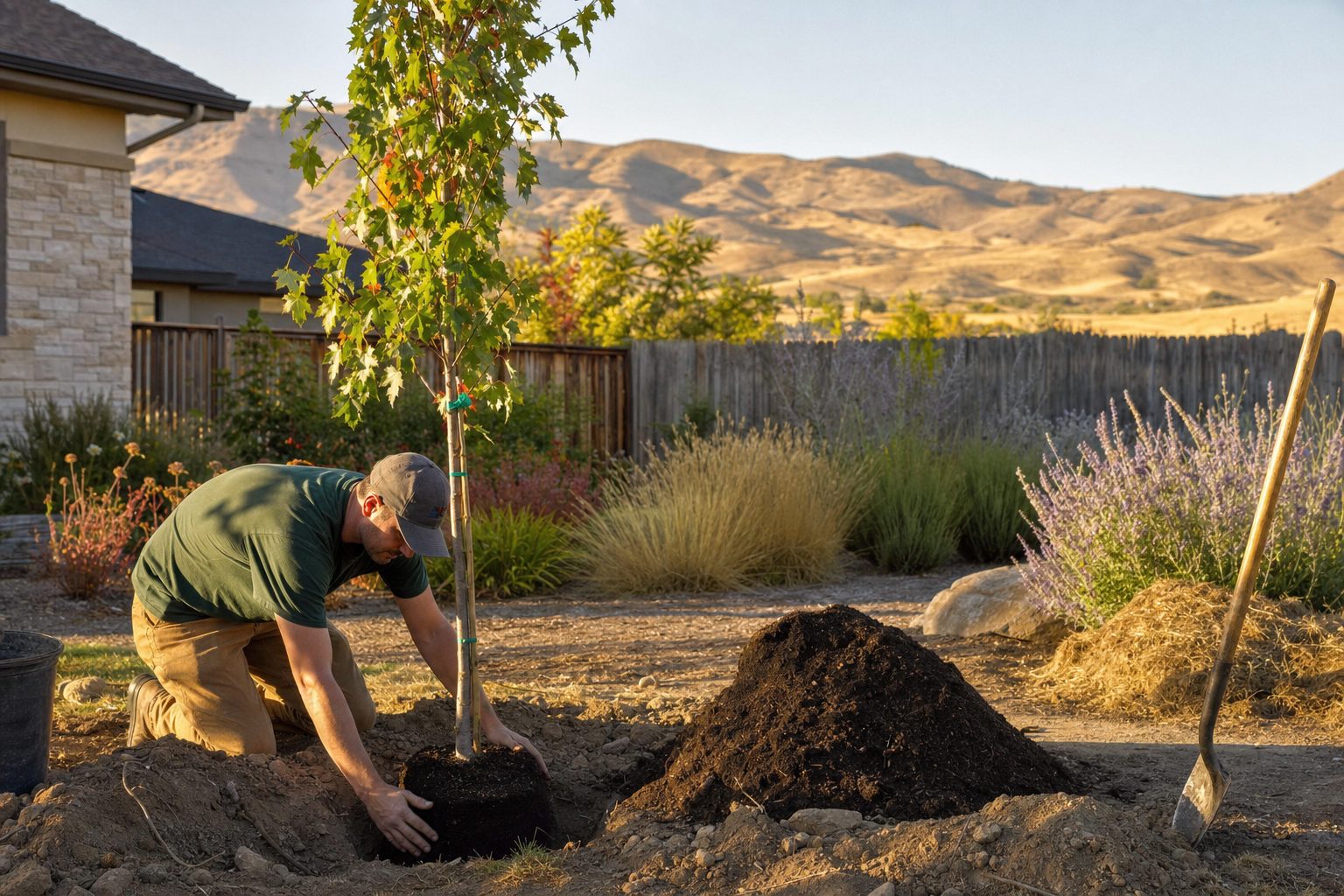
Fall Planting Guide for the Treasure Valley
If you plant one tree all year, do it in September. Fall is the Treasure Valley's best-kept landscaping secret: cooler air temperatures reduce transplant shock, soil is still warm enough for root growth, and fall rains mean less hand-watering. A tree planted in October will outperform the same tree planted the following May — every time.
Why fall planting beats spring in the Treasure Valley
Most homeowners assume spring is the time to plant. For the Treasure Valley, that assumption costs plants. Here is what actually happens underground:
In spring, you plant into soil that is just warming up after winter. Air temperatures climb fast — we regularly hit 90°F by late May and 100°F by June. A newly planted tree or shrub must support a full canopy of leaves through that heat stress while its root system is still confined to the original root ball. The result is transplant shock: wilting, leaf scorch, stunted growth, and in hot years, death.
In fall, the equation reverses. Air temperatures drop (70s in September, 60s in October), so leaves transpire less and demand less water. But the soil — which has been baking all summer — stays warm well into November. In the Treasure Valley, soil at 12 inches depth typically holds 55–60°F through October. That warmth drives root growth even as the air cools. A tree planted in late September puts on 4–8 weeks of new root growth before the ground freezes, then wakes up in spring already established — weeks ahead of a spring-planted counterpart.
The root-growth window: Roots keep growing at soil temperatures above 40°F. In the Treasure Valley, soil typically stays above 40°F through late November. That gives fall-planted trees and shrubs 6–10 weeks of root establishment before true dormancy — a head start that spring planting simply cannot match.
Key Treasure Valley frost and freeze dates
Timing fall planting starts with knowing your frost dates. The Treasure Valley's average dates, based on NWS Boise climate data (Boise Airport station, 30-year normals):
| Milestone | Average date | Typical range |
|---|---|---|
| First light frost (32°F) | October 12–15 | Sept 28 – Oct 29 |
| First hard freeze (28°F) | October 25–31 | Oct 10 – Nov 13 |
| Soil drops below 40°F at 12″ depth | Late November | Varies by exposure |
| Ground freezes solid (sustained) | Mid-December–January | Some winters: never |
These dates shift slightly across the valley. Caldwell and Nampa run a few degrees colder on clear nights (cold air drains to lower elevations). Boise's foothills and the river corridor near Eagle can be a touch warmer, but frost pockets in hollows can be colder. Use the October 15 first-frost date as your planning anchor and aim to have everything planted by mid-October.
The fall planting calendar
August 15 – September 15
Early fall window: The ideal window for planting all trees and large shrubs. Soil is at peak warmth, nights are cooling, and you have 8–10 weeks of root-growth weather ahead. Plant shade trees (Autumn Blaze maple, bur oak, hackberry), ornamental trees (serviceberry, redbud), and evergreens (ponderosa pine, limber pine) now.
September 15 – October 15
Peak fall planting: The best two weeks of the entire year for planting. Trees, shrubs, perennials, and cool-season lawns all thrive. Air temps are in the 60s–70s, soil is still 55°F+. Plant everything on your list now. This is also the window for dividing perennials and moving established plants.
October 15 – October 31
Late fall window: Still viable for most deciduous trees and shrubs (they are going dormant and won't notice). Riskier for evergreens, which need more root establishment before hard freezes. Perennials can still go in. Finish spring-flowering bulb planting by the end of October.
November
Margin window: Deciduous trees and shrubs can still be planted if the ground isn't frozen, but root growth is slowing. Avoid planting evergreens, perennials in small pots, or anything marginally hardy. Better to heel-in plants in their nursery pots over winter and plant in early spring.
What to plant this fall
Trees — the #1 fall planting priority
If you do one thing this fall, plant a tree. Deciduous trees are the easiest and safest fall plantings: they drop their leaves, enter dormancy, and spend the cool months quietly growing roots. By spring, a fall-planted maple is already anchored and ready to push new growth.
| Tree | Type | Fall planting? | 5-gal cost |
|---|---|---|---|
| Autumn Blaze Maple (Acer × freemanii 'Jeffersred') | Shade | Excellent — best window | $120–180 |
| Bur Oak (Quercus macrocarpa) | Shade | Excellent — deep root growth | $100–150 |
| Western Hackberry (Celtis occidentalis) | Shade | Excellent | $80–120 |
| Thornless Honeylocust (Gleditsia triacanthos var. inermis) | Shade | Good | $100–160 |
| Serviceberry (Amelanchier alnifolia) | Ornamental | Excellent — native, tough | $60–90 |
| Western Redbud (Cercis orbiculata) | Ornamental | Good (protect first winter) | $80–130 |
| Crabapple (Malus 'Prairifire') | Ornamental | Excellent | $70–120 |
| Ponderosa Pine (Pinus ponderosa) | Evergreen | Good if planted by Sept 15 | $90–140 |
Evergreens deserve a caveat. Pines, spruce, and fir keep transpiring moisture through winter and are more vulnerable to winter burn if planted too late. If you are planting evergreens, aim for the early fall window (by September 15). Anything later risks dessication before roots are established. See our Best Trees for the Treasure Valley guide for the full species list with mature sizes, growth rates, and local nursery sources.
Shrubs for fall planting
Shrubs love fall planting. Deciduous shrubs go dormant, so transplant shock is minimal. Evergreen shrubs (juniper, manzanita) benefit from the cooler air and can establish roots before the ground freezes.
| Shrub | Mature size | Why plant in fall | 2-gal cost |
|---|---|---|---|
| Common Lilac (Syringa vulgaris) | 8–12 ft | Establishes roots before spring bloom | $35–60 |
| Russian Sage (Perovskia atriplicifolia) | 3–4 ft | Drought-tolerant, fills in before winter | $25–40 |
| Apache Plume (Fallugia paradoxa) | 4–6 ft | Native, bulletproof in alkaline soil | $30–50 |
| Curl-leaf Mountain Mahogany (Cercocarpus ledifolius) | 8–15 ft | Idaho native evergreen, deep roots | $40–70 |
| Blue Mist Spirea (Caryopteris × clandonensis) | 2–3 ft | Late bloom, roots before dormancy | $25–45 |
| Red-Twig Dogwood (Cornus sericea) | 6–9 ft | Winter stem color on new plantings | $30–55 |
| Juniper 'Spartan' or 'Blue Point' (Juniperus chinensis) | 5–15 ft | Evergreen screen, plant by mid-Sept | $40–80 |
Perennials — plant now for bigger plants next spring
Fall-planted perennials have a massive advantage: they spend autumn and early winter growing roots, so by spring they are established and ready to push top growth immediately. A fall-planted coneflower will be 30–50% larger by its second summer than the same plant installed in May.
Best fall-planted perennials for Treasure Valley conditions:
- Blanket Flower (Gaillardia aristata) — native, blooms first year from fall planting, drought-tolerant, $8–15 per 1-gal pot
- Purple Coneflower (Echinacea purpurea) — deep taproot benefits from fall establishment, $10–20
- Penstemon, Rocky Mountain (Penstemon strictus) — Idaho native, blue-purple spikes, thrives in alkaline soil, $8–15
- Yarrow (Achillea millefolium) — ferny foliage, flat flower clusters, spreads by rhizome, $7–12
- Missouri Primrose (Oenothera macrocarpa) — native, yellow evening blooms, drought-tough, $8–14
- Firewitch Dianthus (Dianthus gratianopolitanus 'Firewitch') — pink blooms, blue-green foliage, evergreen, $10–18
- Ornamental grasses — Blue Grama (Bouteloua gracilis) and Little Bluestem (Schizachyrium scoparium) establish best in fall, $12–25
Divide existing perennials now. September is the ideal time to dig and divide overcrowded clumps of daylilies, hostas, ornamental grasses, yarrow, and blanket flower. Replant divisions immediately and water well — they will root in before winter and bloom at full size next year.
Spring-flowering bulbs — plant in October
Bulbs are the easiest fall planting of all. They go in the ground in October, sleep through winter, and erupt in March and April. The Treasure Valley's cold winters provide the chilling hours most spring bulbs require.
| Bulb | Plant depth | Bloom time | Cost per 25 bulbs |
|---|---|---|---|
| Daffodil (Narcissus) — 'Dutch Master', 'Ice Follies' | 6″ deep | March–April | $20–35 |
| Tulip (Tulipa) — 'Purple Prince', 'Pink Impression' | 6″ deep | April–May | $18–30 |
| Grape Hyacinth (Muscari armeniacum) | 3″ deep | March | $10–18 |
| Crocus (Crocus vernus) | 3″ deep | February–March | $12–20 |
| Allium (Allium giganteum or 'Globemaster') | 6–8″ deep | May–June | $25–40 |
| Siberian Squill (Scilla siberica) | 3″ deep | February–March | $10–15 |
Deer resistance note: Daffodils and alliums are deer-proof — they contain compounds deer avoid. Tulips are deer candy. If you live in the foothills or near open space (Boise Foothills, Eagle, north Meridian), plant tulips inside fenced areas or skip them. Daffodils and grape hyacinth will naturalize and spread over the years.
Cool-season lawn seeding and overseeding
Early to mid-September is the single best time to seed a new lawn or overseed a thin one in the Treasure Valley. Soil is warm (fast germination), air temperatures are cool (less seedling stress), and there is far less weed competition than spring seeding. Kentucky bluegrass germinates in 14–21 days at these soil temperatures; tall fescue in 7–12 days.
Steps for fall lawn seeding:
- Prepare the seedbed: Rake the area to a fine, loose surface. Remove debris and rocks. A thin layer (1–2″) of compost incorporated into the top 3 inches improves our alkaline, compacted soils.
- Choose the right seed: For full-sun Treasure Valley lawns, a Kentucky bluegrass blend (80%) with perennial ryegrass (20%) for quick germination. For lower-water lawns, tall fescue blends. See our Lawn Alternatives guide for drought-tolerant options like buffalo grass and blue grama.
- Seed at the right rate: New lawn: 3–4 lb per 1,000 sq ft (Kentucky bluegrass). Overseeding: 1–2 lb per 1,000 sq ft.
- Water frequently: Keep the seedbed consistently moist for the first 3 weeks — light watering 2–3 times daily. Reduce frequency as seedlings establish. By late October, deep weekly watering is enough.
- Mulch lightly: A thin layer of straw (not hay — hay contains weed seeds) helps retain moisture and protect seedlings.
Avoid spring seeding if possible. Spring-seeded lawns face crabgrass pressure, hot June temperatures before they are established, and higher water demands. A fall-seeded lawn is typically fully established by the following summer; a spring-seeded lawn often needs reseeding.
For cool-season crops and garlic, see our fall vegetable garden guide.
How to plant in fall — step by step
Digging the hole
The single most common planting mistake is digging a hole that is too deep and too narrow. The hole should be 2–3 times as wide as the root ball but no deeper. In the Treasure Valley's alkaline, often compacted soils, a wide hole loosens the surrounding soil so new roots can push out laterally. A too-deep hole settles, leaving the plant buried — a common cause of failure.
Test the depth by setting the plant (still in its pot) in the hole. The top of the root ball should sit at or 1–2 inches above the surrounding grade — never below it. In heavy clay areas (common in Meridian and Nampa), planting slightly high improves drainage and prevents crown rot.
Soil amendment — less is more
There is a long-standing debate about amending backfill soil. The current best practice, supported by university extension research, is to use the native soil with minimal amendment. Heavily amended planting holes create a "flower pot" effect: roots thrive in the rich amended soil but refuse to venture into the surrounding native soil, leading to a root-bound plant that fails in drought.
For Treasure Valley alkaline soils, the best amendment is compost mixed at no more than 25% by volume into the backfill. The City of Boise offers free compost through its compost program — available at the Joint Sewage Treatment Plant and pick-up events. Adding elemental sulfur (1–2 lb per plant, depending on size) can help lower pH around acid-loving plants, though the effect is gradual. See our Soil Amendment Guide for detailed guidance on testing and fixing Treasure Valley soils.
Watering new fall plantings
Fall plantings need consistent moisture even as temperatures drop. The goal is to keep the root zone moist (not saturated) until the ground freezes. Here is the schedule:
| Plant type | First 2 weeks | Weeks 3–6 | Until ground freezes |
|---|---|---|---|
| Trees (5–15 gal) | 10–15 gal, 2×/week | 10–15 gal, weekly | Deep soak every 2–3 weeks |
| Shrubs (1–5 gal) | 3–5 gal, 2×/week | 3–5 gal, weekly | Bi-weekly check |
| Perennials (1 gal) | 1–2 gal, 2–3×/week | 1–2 gal, weekly | Bi-weekly check |
| Bulbs | Water once after planting | Rely on rain | Only if dry |
Critical: Water before the ground freezes. The most important watering of the entire fall is the deep soak you give every tree and shrub in late November, just before the ground freezes. Plants that go into winter with dry roots are the ones that die over winter or leaf out weakly in spring. This is especially critical for evergreens, which continue to lose moisture through their foliage all winter.
Mulch for winter protection
Apply a 2–3 inch layer of mulch over the root zone — bark mulch, shredded leaves, or arborist wood chips all work. Mulch insulates the soil, conserves moisture, suppresses weeds, and protects newly planted roots from freeze-thaw heaving. Keep mulch 2–3 inches away from the trunk or crown to prevent rot and rodent damage.
Avoid "volcano mulching" — piling mulch against the trunk. This is a common mistake that smothes bark, invites fungal disease, and creates habitat for voles that girdle the trunk under the mulch. Mulch should look like a donut, not a volcano.
Winter protection for new fall plantings
Tree wrap
Young, thin-barked trees (maples, ash, crabapples, fruit trees) are vulnerable to winter sunscald — intense high-altitude sun warms the south and west bark, which then cracks when temperatures plummet at night. Wrap trunks with white tree wrap from November through March for the first 2–3 winters. Remove the wrap each spring.
Evergreen winter burn
Evergreens (pine, spruce, juniper, arborvitae) continue to transpire moisture through winter, especially on windy, sunny days. Newly planted evergreens with limited root systems can dessicate and brown. Protect them by:
- Watering deeply before the ground freezes (late November)
- Applying 3–4 inches of mulch over the root zone
- Installing a burlap screen on the windward side for exposed evergreens in their first winter
- Avoiding planting evergreens after October 1 — they need more root establishment than deciduous plants
Frost heaving
Our freeze-thaw cycles can literally push shallow-rooted plants out of the ground. Newly planted perennials and small shrubs are most vulnerable. A 2–3 inch mulch layer stabilizes soil temperature and prevents heaving. If you notice a plant heaving up, press it gently back into the soil on a warm day and add more mulch.
Vole and rabbit protection
In winter, voles and rabbits gnaw the bark off young trees and shrubs at or below the snow line. Protect young trunks with a cylinder of hardware cloth (1/4″ mesh) buried 2–3 inches into the soil and extending 18–24 inches above the expected snow line. Remove the guards in spring.
Where to buy plants this fall
Local nurseries have their best selection in September, and many run fall sales as they clear inventory before winter. Recommended Treasure Valley nurseries:
- FarWest Landscape (5718 W State St, Boise) — 7-acre garden center, full tree and shrub selection, knowledgeable staff. (208) 853-4057.
- Edwards Greenhouse (410 E Warm Springs Ave, Boise) — family-owned since 1926, trees, shrubs, perennials, and spring bulbs.
- Casa Flora (3694 S Eckert Rd, Boise) — perennials, natives, and unusual varieties; strong in fall bulbs.
- Dalsing Garden Center (3580 S Maple Grove Ave, Boise) — trees, shrubs, and soil amendments.
- Home Depot / Lowe's (Boise, Meridian, Nampa) — budget option for common trees and shrubs. Inspect root balls carefully; big-box plants can be root-bound or improperly watered.
Tip: Always inspect the root ball before buying. Gently pull the plant from its pot. Healthy roots are white or light tan, firm, and distributed throughout the root ball. Avoid plants with circling, matted roots (root-bound), or with roots that smell of rot. A root-bound plant can be salvaged by scoring the root ball vertically in 3–4 places before planting, but starting with a healthy plant is always better.
Common fall planting mistakes to avoid
1. Planting too deep. The root flare (where the trunk widens at the base) should be visible above the soil. Burying it causes bark rot and slow decline. Always find the root flare and plant it at or slightly above grade.
2. Not watering enough in fall. "It's cool and rainy, so I don't need to water" is the #1 killer of fall plantings. New plants have confined root balls that dry out even in cool weather. Check the root ball directly — not the surrounding soil — by poking a finger 2 inches into the root ball. If it's dry, water.
3. Fertilizing at planting time. Fall is not the time for nitrogen fertilizer — it pushes tender new growth that will not harden off before winter. Use a root-stimulating fertilizer with phosphorus (for root growth) only, or skip fertilizer entirely the first fall. Save nitrogen for spring.
4. Forgetting the pre-freeze deep soak. The late-November watering before the ground freezes is the most critical water your new plants will get all year. Set a calendar reminder for Thanksgiving weekend: deep-water everything planted this fall.
Fall planting quick-reference checklist
- ☐ Plant trees and shrubs between August 15 and October 15
- ☐ Dig the hole 2–3× as wide as the root ball, no deeper
- ☐ Find the root flare and plant it at or above grade
- ☐ Backfill with native soil + max 25% compost
- ☐ Water deeply immediately after planting
- ☐ Apply 2–3″ mulch in a donut shape (not against the trunk)
- ☐ Plant spring bulbs by October 31 (daffodils, tulips, crocus, allium)
- ☐ Seed or overseed lawns in early September
- ☐ Divide perennials in September and replant immediately
- ☐ Wrap thin-barked young trees in November
- ☐ Deep-soak everything before the ground freezes (late November)
- ☐ Install hardware cloth cylinders to protect against voles and rabbits