Common Landscaping Mistakes in the Treasure Valley — and How to Avoid Them
Every spring, nurseries across Boise, Meridian, and Nampa fill with homeowners carrying dead plants in pots, asking what went wrong. Most of the time, the answer is the same handful of mistakes — ones that are easy to make in a high-desert climate where the soil fights you, the sun is relentless, and the difference between a thriving yard and a dead one comes down to timing and preparation.
This guide walks through the 12 most common landscaping mistakes Treasure Valley homeowners make, why they happen here specifically, and what to do instead. Some of these cost a few hundred dollars to fix. Others can save you thousands in replanted trees, regraded drainage, and water bills.
1. Planting before the last frost date
The Boise area's average last spring frost falls around May 10, but cold snaps into the low 30s have been recorded as late as May 25 at the Boise airport. That means a warm weekend in April can tempt you to put tomatoes, peppers, basil, and tender annuals in the ground — only to lose them to a single cold night.
The fix
Wait until Memorial Day weekend to plant warm-season vegetables and tender annuals. If you cannot resist starting early, use frost cloth (also called row cover) rated for 28°F and weigh it down with rocks or landscape staples. Wall-O-Water plant protectors — those red plastic teepees filled with water — can buy you two extra weeks for tomatoes.
Hardy perennials, trees, and shrubs can go in earlier. Cool-season crops like peas, lettuce, kale, and spinach can be direct-sown as early as mid-March in the Treasure Valley.
Local tip: The Ada Soil & Water Conservation District (3101 S. Sunflower Ln, Boise) offers free frost-date resources and planting calendars for valley residents. The University of Idaho Extension office in Ada County publishes a vegetable planting guide specific to elevations under 3,000 feet — which covers the entire Treasure Valley.
2. Ignoring clay soil and caliche hardpan
If you dig a hole in your Boise or Meridian backyard and hit something that looks like concrete two feet down, that is likely caliche — a layer of calcium carbonate-cemented soil that occurs naturally across the Treasure Valley. It stops water from draining, blocks root growth, and kills trees that cannot push through it.
Even where caliche is absent, much of the valley floor has heavy clay loam soil that drains slowly, compacts under foot traffic, and turns into adobe bricks in summer. Planting without addressing this is the single most common reason new landscapes fail in their first year.
The fix
Before planting anything significant, test your soil. A basic kit from Edwards Greenhouse or Zamzows costs $15–$30 and tells you pH, nitrogen, phosphorus, and potassium. For caliche, you need to know how deep the layer sits:
- Dig a 2-foot test hole. If you hit a white, chalky layer, that is caliche.
- For trees and large shrubs, excavate an area 3× the root ball width and break through the caliche layer entirely. If you cannot break through, choose a different planting spot or build a raised bed instead.
- Amend the entire planting area (not just the hole) with 2–3 inches of compost mixed into the top 12 inches of native soil. Do not add sand to clay — it creates concrete. Add organic matter instead.
For a full deep-dive on this topic, see our Soil Amendment Guide for the Treasure Valley.
3. Overwatering (the #1 plant killer in the valley)
It sounds counterintuitive in a desert, but overwatering kills more Treasure Valley plants than drought. Clay soil holds water for days. Sprinkler systems run on timers regardless of rain. And many homeowners water every day because they assume the dry climate demands it — when in reality, daily shallow watering produces shallow roots that cannot survive heat stress.
The fix
Water deeply and infrequently. For established lawns, 1–1.5 inches per week in one or two sessions is enough — not 15 minutes every day. For trees and shrubs, a slow deep soak once every 7–10 days during summer produces roots that reach 18–24 inches down, making them far more drought-tolerant.
Install a rain sensor on your irrigation controller ($20–$40 at any hardware store) so the system skips cycles after rain. Better yet, upgrade to a smart controller like Rachio or Rain Bird ESP-Me that adjusts based on local weather data.
For a complete irrigation schedule, see our Treasure Valley Irrigation Guide.
4. Choosing plants rated for a warmer zone
The Treasure Valley sits in USDA Hardiness Zones 6b to 7a, depending on elevation and microclimate. Boise's downtown and river corridors tend to be 7a (minimum temperature 0–5°F), while the foothills and outlying areas like Kuna and Star dip to 6b (−5 to 0°F). Nurseries sometimes stock plants rated for Zone 8 or 9 — plants that will not survive a hard Treasure Valley winter.
The fix
Always check the plant tag for the hardiness zone. If it says Zone 8 or higher, treat it as an annual or plan to bring it inside. Some commonly sold plants that struggle here:
| Plant | Often sold as | Reality in Treasure Valley |
|---|---|---|
| Oleander (Nerium oleander) | Zone 8–10 evergreen shrub | Will die to the ground most winters; not a reliable perennial |
| Bougainvillea (Bougainvillea spp.) | Zone 9–11 flowering vine | Cannot survive outdoors; indoor only |
| Citrus trees | Zone 9–11 | Need a heated greenhouse; will not survive Treasure Valley winters |
| Some lavender varieties | Zone 8–9 Mediterranean types | Choose English lavender (Lavandula angustifolia), Zone 5–8, instead |
For reliable choices, see our Best Trees for the Treasure Valley and Native Plants Guide.
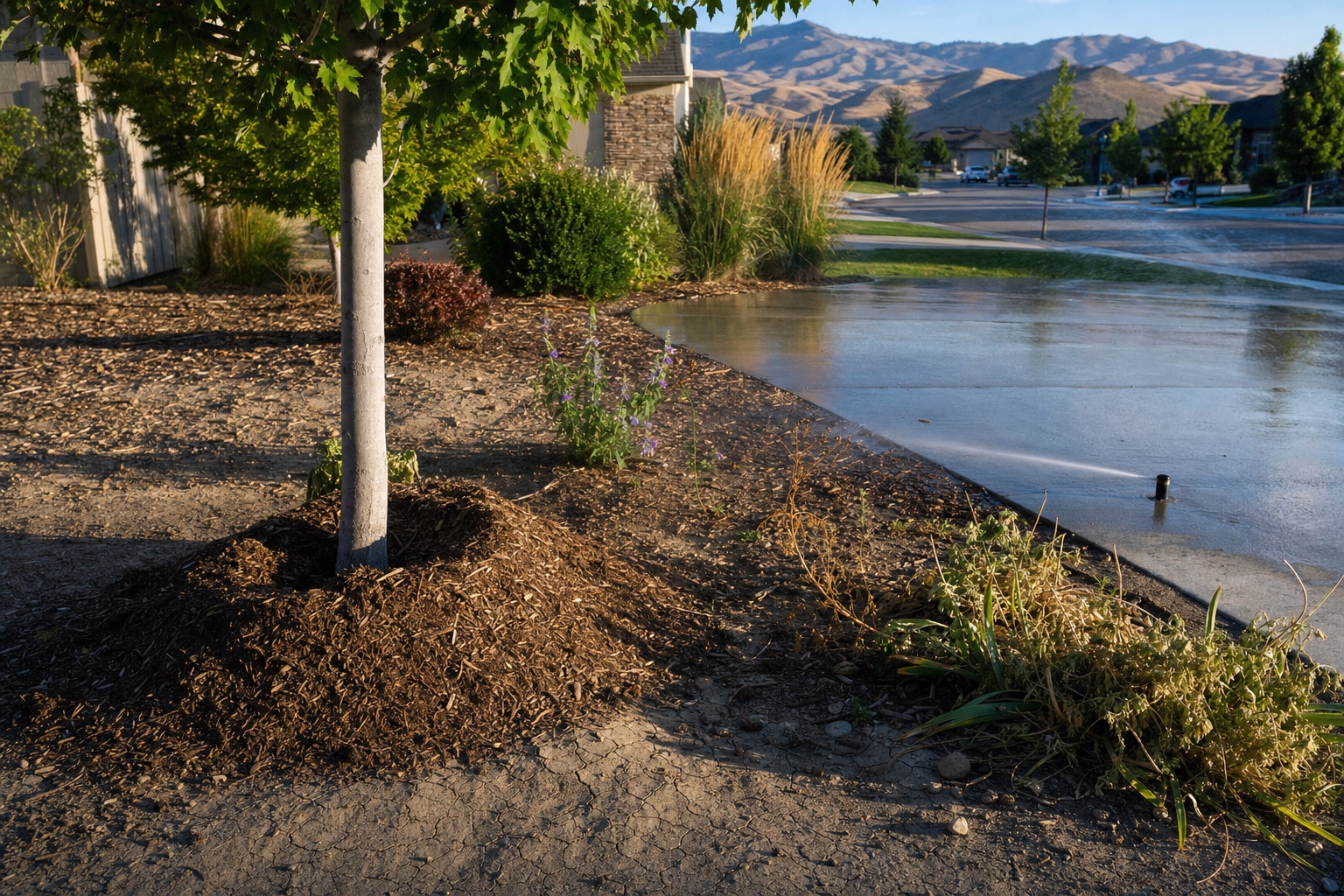
5. Creating "mulch volcanoes" around tree trunks
You have seen it in every strip mall parking lot in Meridian: a mound of bark mulch piled 8–12 inches high against the trunk of a young tree. This is called a mulch volcano, and it is one of the most damaging — and most common — landscaping mistakes in the country. The mulch traps moisture against the bark, causing rot, inviting fungal disease, and creating a habitat for bark-burrowing pests. The tree slowly declines over 3–5 years and eventually dies.
The fix
Apply mulch in a donut shape, not a volcano. The mulch ring should be 2–4 inches deep, extend 3 feet from the trunk, and leave a 3–6 inch gap of bare soil around the trunk itself. The root flare (where the trunk widens at the base) should always be visible above the mulch line.
6. Planting too close to the house, fence, or other plants
A shrub that looks perfect in a 1-gallon pot can become a 6-foot monster in three years. Many homeowners plant based on the size the plant is at purchase, not its mature size — leading to overcrowded beds, plants growing into gutters, and shrubs blocking windows. The fix is simple but requires discipline.
The fix
Read the plant tag for mature height and spread. Space plants accordingly, even if the bed looks sparse at first. For foundation plantings, keep shrubs at least 3 feet from the house wall to allow for air circulation, pest inspection access, and paint maintenance. For trees, plant at least 15 feet from structures for small trees (under 25 feet mature) and 25+ feet for large shade trees.
If you want a full look immediately, fill the gaps with short-lived perennials or annuals that you can remove as the permanent plants grow. Zinnias, cosmos, and California poppies thrive in Treasure Valley summers and fill in nicely for a season or two.
7. Sprinklers watering the driveway, sidewalk, and house
Drive through any Nampa or Caldwell neighborhood in July and you will see sprinkler arcs landing on asphalt, concrete walkways, and house siding. This wastes water, damages hardscape, can stain siding, and — in the case of water pooling against the foundation — can contribute to basement seepage and crawl space moisture.
The fix
Adjust sprinkler heads seasonally. Pop-up spray heads should be set to cover only planting areas. For narrow strips (parkway strips, side yards), use strip-pattern nozzles rather than full-circle heads. Check coverage by placing flat-bottomed containers (tuna cans work) across the lawn — if water collects in the can nearest the driveway at the same rate as the center of the lawn, your head is aimed wrong.
Consider converting planting beds to drip irrigation, which delivers water directly to root zones with zero overspray. Drip lines cost $0.50–$2.00 per foot and can cut outdoor water use by 30–50%.
8. Not planning for the Boise sun
The Treasure Valley gets over 200 sunny days per year, and at 2,700 feet elevation, the UV index runs higher than at sea level. A "full sun" plant tag means something different here than it does in Portland or Seattle. Plants that tolerate full sun in cooler, cloudier climates can scorch in a Boise July — especially in south-facing exposures with reflected heat from walls or pavement.
The fix
Map your yard's sun exposure before buying plants. Track where sun falls at 9 AM, noon, and 4 PM during summer. Areas that get 6+ hours of direct afternoon sun need heat-tolerant species: Russian sage (Perovskia atriplicifolia), yarrow (Achillea millefolium), blanket flower (Gaillardia aristata), and ornamental grasses like blue fescue (Festuca glauca).
For south-facing walls and reflected-heat zones, even "full sun" plants benefit from afternoon shade. Plant a shade tree or install a pergola to break up the intense southwestern exposure.
9. Skipping the soil test and guessing on amendments
Treasure Valley soils are typically alkaline (pH 7.5–8.5), the opposite of what most popular garden plants prefer. Adding the wrong amendments — or adding the right ones in the wrong amounts — can make things worse. Lime, for example, is commonly sold at garden centers but should never be added to Treasure Valley soil. It is already too alkaline.
The fix
Test first, amend second. The University of Idaho Analytical Lab offers soil testing for $35–$50 per sample and provides crop-specific recommendations. Local garden centers like Franz Witte and Edwards Greenhouse carry home test kits for quick pH checks. Most valley soils need:
- Compost — 2–3 inches incorporated annually to improve structure and drainage
- Elemental sulfur — to lower pH for acid-loving plants like blueberries (apply per test results, not by guess)
- Iron sulfate — for chlorosis (yellowing leaves with green veins) common in alkaline soils
Never add lime. Never add sand to clay. Never add fresh manure (it burns roots). Aged compost is the universal amendment.
10. Poor drainage grading around the foundation
Many Treasure Valley homes built since 2000 sit on graded lots where the soil settles unevenly over the first few years. If the ground slopes toward your foundation instead of away from it, every irrigation cycle and thunderstorm sends water against your home's stem wall. In clay soil, this water can take days to drain, leading to crawl space moisture, foundation cracks, and mold.
The fix
The ground should slope away from the foundation at 1 inch per foot for the first 6 feet. If it does not, regrade by adding clean fill soil (not topsoil with organic matter — it decomposes and settles) and compacting it. Never raise the soil level above the foundation's weep screed (the horizontal gap in stucco near the ground). Install French drains or surface swales in low spots where water collects.
If you are planning a patio or walkway near the house, make sure it slopes away too — a 1/4-inch drop per foot is the minimum for hardscape surfaces.
11. Planting water-loving plants in a xeriscape zone
Mixing plants with different water needs in the same irrigation zone is a recipe for dead plants. If your sprinkler controller runs the same cycle for a thirsty hydrangea and a drought-tolerant Russian sage, one will drown and the other will thrive — and you will not know which until it is too late.
The fix
Group plants by water needs — a practice called hydrozoning. Create three zones:
- High water — lawn, vegetable garden, moisture-loving perennials (hostas, ferns, astilbe) in shaded areas
- Medium water — most ornamental shrubs, roses, fruit trees
- Low water — xeriscape beds with native plants, ornamental grasses, and Mediterranean herbs
Put each zone on a separate irrigation valve so you can water appropriately. Low-water zones may need irrigation only during establishment (first 1–2 years) and then be weaned off entirely. See our Boise Xeriscaping Guide for water-wise plant selections.
12. Neglecting fall preparation
The Treasure Valley's first fall frost typically arrives around October 5–10. Homeowners who do not winterize their irrigation systems, protect young trees, and cut back perennials before the ground freezes lose plants, pipes, and money every winter. A $30 blowout kit and an hour of work in October can save thousands in burst irrigation lines and dead specimen plants.
The fix
Follow a fall checklist:
- Blow out irrigation lines by late October, before overnight lows drop below 32°F. Rent a compressor or hire a local company ($75–$150).
- Wrap young tree trunks with white tree wrap to prevent sunscald (winter sun warms the bark, causing it to expand during the day and crack at night). Remove wrap in April.
- Mulch perennials with 2–3 inches of bark after the ground freezes — this keeps the soil cold and prevents freeze-thaw cycles from heaving roots out of the ground.
- Cut back ornamental grasses in late winter (February) rather than fall — they provide winter interest and habitat for beneficial insects.
For a complete checklist, see our Winterization Checklist for Treasure Valley Landscapes.
The bottom line: Most landscaping mistakes in the Treasure Valley come down to three things: not understanding the soil, not understanding the water, and not understanding the timing. Fix those three, and you eliminate 80% of the problems before they start. The other 20% — plant selection, spacing, and sun exposure — are easy to get right once you know the local rules.
Quick reference: the mistake checklist
| Mistake | Cost to fix | Cost if ignored |
|---|---|---|
| Planting before last frost | $0 (wait 2 weeks) | $50–$200 in dead plants |
| Ignoring caliche/clay | $15 soil test + $30–$60 compost | $200–$2,000 in dead trees and shrubs |
| Overwatering | $20 rain sensor | $50–$100/month extra water + dead plants |
| Mulch volcanoes | $0 (rake mulch away from trunk) | $200–$500 in replacement trees |
| Wrong plant spacing | $0 (plan before planting) | $500–$2,000 in removal and replanting |
| Sprinkler overspray | $0 (adjust heads) | $20–$50/month wasted water |
| Poor foundation drainage | $200–$500 regrading | $2,000–$15,000 foundation repair |
| Skipping winterization | $30–$150 blowout | $500–$3,000 in burst pipes and dead plants |