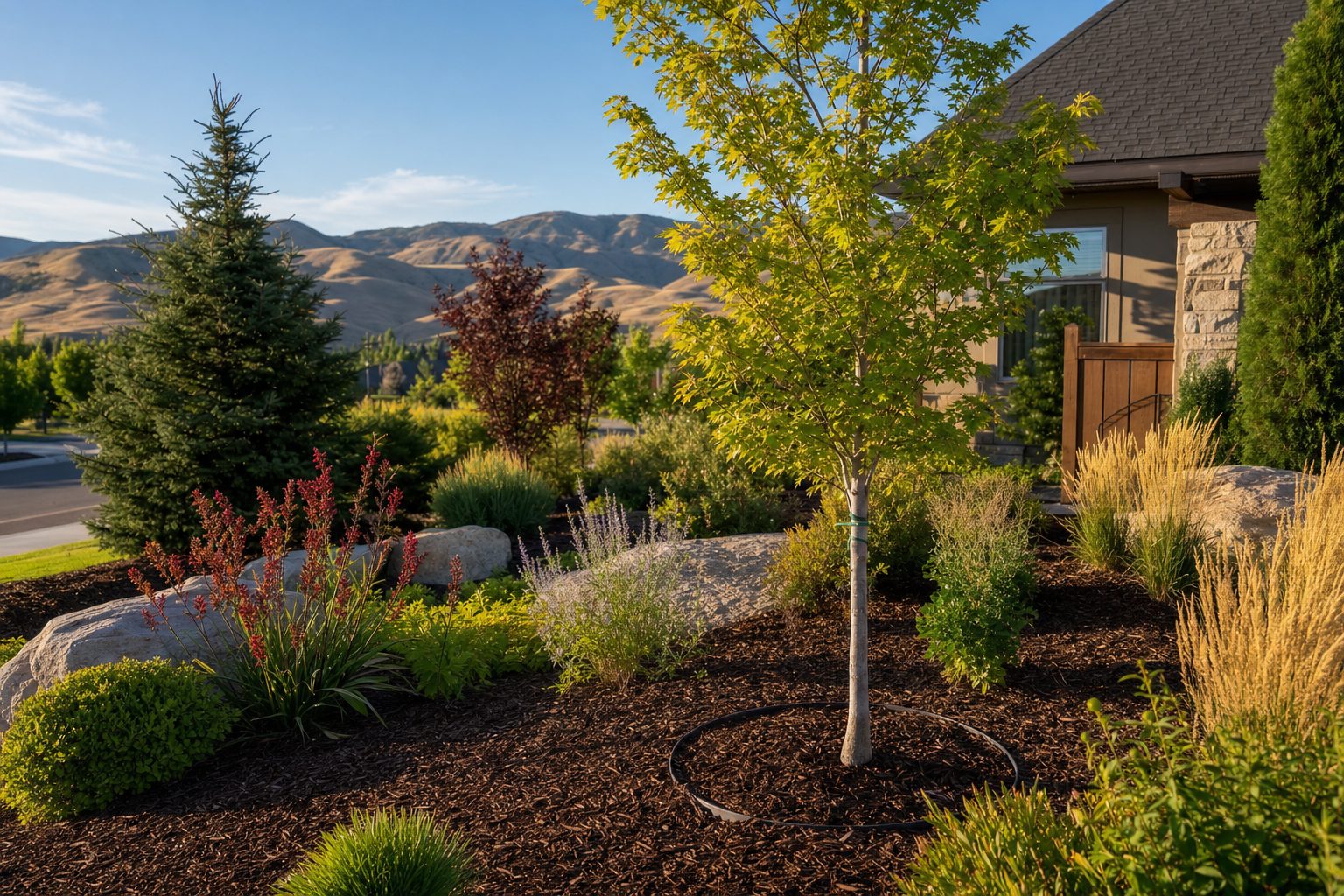
Mulch is the cheapest, fastest, and highest-impact improvement you can make to a Treasure Valley landscape. A 3-inch layer of bark mulch around your trees, shrubs, and garden beds suppresses weeds, holds moisture in our bone-dry summer soil, moderates soil temperature swings that stress plant roots, and slowly builds organic matter in soils that desperately need it. Yet most homeowners in the Boise area either skip mulch entirely, apply it too thin to do any good, or pile it against tree trunks in destructive "mulch volcanoes" that rot bark and invite pests.
This guide covers everything you need to know about mulch in the Treasure Valley: which type to choose (bark, rock, compost, or living mulch), what it costs locally, where to buy it by the cubic yard or by the bag, how to calculate how much you need, proper application technique, seasonal timing, and common mistakes specific to Idaho's dry, alkaline, wind-swept climate.
Why mulch matters in the Treasure Valley
The Treasure Valley sits in a high-desert climate zone, receiving only 12–14 inches of precipitation annually in Boise, with even less toward Nampa and Caldwell to the west. Summer temperatures regularly exceed 95 °F from June through August, and sustained winds — especially in the western valley near Kuna, Star, and Caldwell — accelerate evaporation from bare soil. An unmulched garden bed in July can lose a quarter-inch of moisture per day to evaporation alone, meaning your irrigation system is working overtime just to keep up with what the air is stealing.
A properly mulched bed reduces soil moisture evaporation by 50–70%, according to University of Idaho Extension research. That means a garden that needs 1 inch of water per week without mulch can thrive on a half-inch with mulch. Over a full irrigation season (May through October), that translates to thousands of gallons saved on a typical quarter-acre lot — and lower water bills in a valley where irrigation water is increasingly expensive and scarce.
Mulch also regulates soil temperature. Bare Treasure Valley soil can reach 110–120 °F at the surface on a July afternoon, hot enough to kill fine feeder roots in the top 2 inches of soil. A 3-inch mulch layer keeps the soil surface 15–25 °F cooler, protecting the root zone where most water and nutrient absorption happens. In winter, the same mulch layer insulates roots against freeze-thaw cycles that can heave shallow-rooted perennials out of the ground.
Quick stat: The City of Boise's Waterwise program estimates that mulched landscape beds use 50–70% less water than unmulched beds with the same plant selection. In a valley where the average household uses 20,000–30,000 gallons of irrigation water per month in peak summer, mulch is the single most cost-effective water conservation tool available.
Types of mulch for Treasure Valley landscapes
Not all mulch is created equal, and the right choice depends on where you're putting it, what look you want, and how much maintenance you're willing to do. Here's a breakdown of the mulch types most commonly available in the Treasure Valley, with honest assessments of their pros and cons in our climate.
Organic mulches (bark, wood chips, shredded bark)
Organic mulches are the default choice for most Treasure Valley landscapes, and for good reason. They suppress weeds, retain moisture, moderate soil temperature, and slowly decompose to add organic matter to our typically low-organic soils. They need to be replenished every 1–3 years as they break down, but that decomposition is a feature, not a bug — it's feeding your soil.
| Mulch type | Best for | Local price (per cubic yard) | Lifespan |
|---|---|---|---|
| Shredded bark (cedar or hardwood) | Shrubs, perennial beds, around trees | $22–$65 | 2–3 years |
| Medium bark nuggets | Large shrub beds, pathways | $32–$65 | 2–4 years |
| Small/natural bark (undyed) | Veggie gardens, rose beds, general use | $20–$32 | 1–2 years |
| Dyed mulch (black, brown, red) | Decorative front-yard beds | $32–$46 | 2–3 years |
| Compost (as mulch) | Vegetable gardens, annual beds | $28–$35 | 1 season |
| Playground chips / coarse chips | Play areas, informal paths | $8–$22 | 1–2 years |
Shredded bark — usually cedar or a hardwood blend — is the workhorse mulch for Treasure Valley landscapes. It mats together slightly, which means it resists blowing away in our windstorms better than loose nuggets. Cedar bark has the added benefit of natural insect-repellent compounds, though the effect is modest. You'll find shredded bark at every landscape supply yard in the valley, typically $22–$65 per cubic yard depending on quality and whether you pick it up or have it delivered.
Bark nuggets (medium or small) last longer than shredded bark and have a cleaner, more uniform look. They're a good choice for visible front-yard beds where appearance matters. The trade-off: nuggets don't interlock the way shredded bark does, so in windy areas near Kuna, Star, or the western valley, you may find them scattered across the driveway after a big wind event. Prices run $32–$65 per cubic yard at suppliers like Southern Idaho Landscape Center and Canyon Hardscape.
Dyed mulch (black, brown, red) is popular for its color retention. The dye is typically iron oxide (for red) or carbon black (for black) — both safe for plants and soil. In the Treasure Valley's intense UV, undyed bark fades to a weathered gray within a year, while dyed mulch holds its color for 2–3 seasons. The environmental trade-off: some cheaper dyed mulches are made from recycled pallet wood rather than bark, which decomposes faster and adds fewer nutrients. If you choose dyed mulch, look for "bark-based" or "all-bark" products. Expect $32–$46 per cubic yard locally.
Compost as mulch is an excellent choice for vegetable gardens and annual beds where you're turning the soil each season. It won't suppress weeds as well as bark (it's too fine), but it adds more organic matter and nutrients directly to the root zone. Many Treasure Valley gardeners use a thin 1-inch compost layer topped with 2 inches of bark — the best of both worlds. The City of Boise provides free STA-certified compost (up to 2 cubic yards per household per year) through the Curb It program.
Inorganic mulches (rock, gravel, river rock)
Rock mulch is a common sight in Treasure Valley landscapes, especially in newer subdivisions in Meridian, Nampa, and Kuna where water-wise design is popular. Rock doesn't decompose, doesn't need replenishing, and is fire-resistant — a meaningful advantage in the wildland-urban interface areas of the Boise Foothills and Eagle.
| Rock mulch type | Best for | Local price (per cubic yard) | Notes |
|---|---|---|---|
| Decomposed granite (DG) | Pathways, xeriscape beds, Southwestern look | $45–$80 | Compacts hard, excellent for walkways |
| 3/4-inch crushed rock | Drought-tolerant beds, modern landscapes | $35–$55 | Stays put in wind, reflects heat |
| River rock (smooth, 1–3 inch) | Dry creek beds, accent areas, around boulders | $65–$120 | Expensive but permanent and visually striking |
| Pea gravel | Pathways, informal patios, between flagstone | $40–$70 | Comfortable to walk on, can scatter |
| Lava rock | Succulent beds, desert-themed gardens | $45–$85 | Lightweight, insulates soil well, can look dated |
The heat problem with rock mulch: Rock absorbs and stores solar heat, raising soil temperatures 5–10 °F higher than bark mulch under the same conditions. In the Treasure Valley, where summer soil temperatures are already extreme, this can stress shallow-rooted plants and accelerate moisture loss. Rock mulch is best paired with heat-loving, drought-tolerant plants like Russian sage (Perovskia atriplicifolia), yarrow (Achillea millefolium), and ornamental grasses. It's a poor choice around thirstier plants like hydrangeas, hostas, or vegetable gardens.
Weed barrier fabric under rock: Many Treasure Valley landscapers install woven landscape fabric under rock mulch to prevent weeds. This works initially, but over 3–5 years, organic debris (leaves, dust, grass clippings) accumulates on top of the fabric, decomposes into a thin soil layer, and weed seeds germinate on top of the fabric. At that point, pulling weeds tears the fabric, and you're stuck with rock, fabric, and weeds all layered together. A better approach: skip the fabric under rock in planted beds (weeds can be pulled from bare rock fairly easily), or use a thick (4-inch) layer of rock without fabric and accept occasional hand-weeding.
Living mulch (groundcovers)
The most sustainable mulch in the Treasure Valley is a living one: low-growing groundcover plants that shade the soil, suppress weeds, and add organic matter through root exudates and leaf litter. Good Treasure Valley groundcover options include:
- Woolly thyme (Thymus pseudolanuginosus) — drought-tolerant, stepable, stays under 3 inches
- Creeping phlox (Phlox subulata) — spring-blooming, thrives in Boise's alkaline soil
- Snow-in-summer (Cerastium tomentosum) — silver foliage, white flowers, extremely drought-hardy
- Penstemon (Penstemon caespitosus) — Idaho native, low mat-forming, purple blooms
- Sedum / stonecrop (Sedum spurium) — fleshy leaves hold water, tolerates reflected heat from rock and pavement
Living mulch takes 1–2 growing seasons to fill in, and you'll need to mulch around the young plants with bark while they establish. Once filled in, a groundcover mulch is permanent, self-renewing, and beautiful — but it's not practical for every situation (you can't use it in a vegetable garden, or where you rotate plantings).
Where to buy mulch in the Treasure Valley
The Treasure Valley has an excellent network of landscape supply yards, nurseries, and big-box stores for mulch. Where you buy depends on how much you need and whether you want to pick up or have it delivered.
Bulk mulch suppliers (by the cubic yard)
For anything over 3 cubic yards, buying bulk is significantly cheaper than bagged mulch. Most suppliers offer delivery within the Treasure Valley for $50–$100, often free for orders over 5–10 yards. A standard small dump truck carries 5–10 cubic yards.
| Supplier | Location | Price range (per yd) | Notes |
|---|---|---|---|
| Diamond Street Recycling | Boise (5800 W) | $8–$32 | Recycled wood products, budget-friendly |
| Timmy's Tree Service | Boise (delivers valley-wide) | $22–$35 | Three colors, delivery throughout valley |
| Organic Solutions | Boise / Nampa | $21–$28 | Hardwood mulch, triple-processed premium available |
| Southern Idaho Landscape Center | Boise | $60–$65 | Premium bark products, wide selection |
| Canyon Hardscape | Caldwell | $46+ | Serves western valley, mulch + hardscape supplies |
| Victory Greens | Boise | Varies | Bark, compost, soil blends, expert advice |
Bagged mulch (by the bag)
For small beds or touch-up jobs, bagged mulch from Home Depot, Lowe's, or local nurseries costs $3.25–$6.50 per 2-cubic-foot bag. Each bag covers about 8–10 square feet at a 3-inch depth. That works out to roughly $17–$35 per cubic yard — more expensive than bulk, but convenient for small projects. Watch for seasonal sales at big-box stores in April–May and again in September, when bagged mulch often drops to $3–$4 per bag.
How much mulch do you need? One cubic yard of mulch covers approximately 108 square feet at a 3-inch depth (the recommended depth for most Treasure Valley applications). To calculate: measure your bed area in square feet (length × width), divide by 108, and round up. Example: a 20×10-foot shrub bed = 200 sq ft ÷ 108 = 1.85 cubic yards — order 2 yards.
How to apply mulch properly
The difference between mulch done right and mulch done wrong is the difference between a thriving, low-maintenance landscape and a struggling, disease-prone one. Here's the correct method, step by step.
Step 1: Prepare the bed
Before mulching, clear all weeds from the bed — roots and all. Mulch suppresses weed seeds, but it won't kill established perennial weeds like bindweed (Convolvulus arvensis), which is ubiquitous in the Treasure Valley. If you mulch over living bindweed, it will simply grow through. Dig out or hoe existing weeds, water the bed deeply, and let the soil settle for a day.
If you're mulching for the first time on bare Treasure Valley soil, consider adding a 1-inch layer of compost before the mulch. Our native soils are typically 1–2% organic matter; the compost gives soil biology a jump start under the mulch layer.
Step 2: Install edging (optional but recommended)
If your bed borders a lawn, install metal or plastic landscape edging along the perimeter. This keeps mulch from migrating onto the grass (where the mower will fling it) and prevents grass rhizomes from creeping into the bed. Edging costs $2–$4 per linear foot installed and pays for itself within one season in reduced maintenance.
Step 3: Apply mulch at the correct depth
The ideal mulch depth in the Treasure Valley is 2–4 inches — 3 inches is the sweet spot for most applications. Here's the breakdown by use:
- Around trees and shrubs: 3–4 inches of bark mulch, spread from the trunk to the drip line (or at least a 3-foot radius for young trees)
- Perennial and shrub beds: 2–3 inches of shredded bark or bark nuggets
- Vegetable gardens: 1–2 inches of compost or fine bark, replenished each season
- Pathways: 3–4 inches of coarse chips or decomposed granite
- Over winter (perennial beds):strong> 4–6 inches of loose straw or shredded leaves for insulation, pulled back in spring
Too thin (under 2 inches) and weed seeds will germinate through the mulch — it's barely better than no mulch. Too thick (over 4 inches of bark) and water can't penetrate to the roots, and the soil becomes oxygen-deprived, promoting root rot. More is not better; 3 inches is the target.
Step 4: Keep mulch away from trunks and stems
This is the single most common mulch mistake in the Treasure Valley, and it kills more trees than drought ever does. Piling mulch against a tree trunk — the dreaded "mulch volcano" — traps moisture against the bark, which decays the protective outer bark layer, invites fungal infections and boring insects, and can girdle the tree. The correct technique: pull mulch 3–6 inches away from the trunk, creating a donut shape with the trunk in the center of a flat mulch ring. The root flare (where the trunk widens at the soil line) must be visible and exposed to air.
The same applies to shrub crowns, perennial stems, and the base of woody vines. Mulch should never touch living plant tissue. A gap of 1–2 inches is sufficient for small perennials; 3–6 inches for trees and large shrubs.
Mulch volcanoes: Drive through any newer subdivision in Meridian, Nampa, or Kuna and you'll see mulch piled 6–12 inches high against tree trunks in a cone shape. This is wrong. It's not just a matter of opinion — the International Society of Arboriculture, the University of Idaho Extension, and every reputable tree care authority explicitly warn against it. Mulch volcanoes cause bark decay, fungal cankers, adventitious root growth (roots sprouting from the buried trunk), and eventually structural failure. If your landscaper builds mulch volcanoes, find a new landscaper.
Step 5: Water the mulch in
After spreading mulch, water the bed thoroughly. Dry mulch can initially repel water (hydrophobic), and a newly mulched bed may shed the first irrigation rather than absorbing it. A deep soaking settles the mulch, wets the soil beneath, and gets the moisture-retention benefits working immediately.
Seasonal mulch calendar for the Treasure Valley
| Season | What to do | Why |
|---|---|---|
| Early spring (March) | Inspect mulch depth; top-dress to 3 inches where thin | Catch up winter decomposition before weed seeds germinate |
| Mid spring (April–May) | Apply fresh mulch to beds; edge beds and install new mulch in new beds | Best time for new mulch — soil is warming, nurseries are stocked |
| Summer (June–August) | Maintain mulch; check for thin spots; pull mulch off tree trunks | Mulch is working hard to retain moisture; inspect monthly |
| Fall (October–November) | Top-dress beds with 1–2 inches; add 4–6 inches to perennial beds before hard freeze | Winter insulation; protects roots from freeze-thaw heaving |
| Winter (December–February) | Leave mulch in place; don't disturb frozen beds | Mulch insulates dormant roots and prevents erosion |
Mulch and fire: firewise considerations
For properties in or near the Boise Foothills, the Boise River Wildlife Management Area, or other wildland-urban interface zones, mulch choice has fire-safety implications. Bark mulch is combustible — it ignites relatively easily and burns with a smoky, sustained flame. In a wildfire, burning mulch near a house can ignite siding, fences, and decks.
The National Fire Protection Association's Firewise program recommends non-combustible mulch (rock, gravel, decomposed granite) within 5 feet of any structure in wildfire-risk zones. Bark mulch is acceptable beyond 5 feet but should never touch the house foundation. If you live in the foothills, consider rock mulch for the 0–5-foot zone and bark mulch for garden beds farther out. See our Firewise Landscaping guide for a complete defensible-space plan.
Common Treasure Valley mulch mistakes
1. Mulch too thin
A 1-inch layer of bark looks nice for a week, but it won't suppress weeds or retain moisture meaningfully. Weeds germinate through it, and it dries out within hours. If you're going to mulch, commit to 3 inches. That means roughly one cubic yard per 108 square feet — not one bag per planting.
2. Mulch volcanoes
Covered above, but it's worth repeating: never pile mulch against a tree trunk. The root flare must be visible. If you can't see the flare, gently pull mulch back until you can. You may also need to remove soil that was piled there during planting — many Treasure Valley developers and landscapers plant trees too deep.
3. Using landscape fabric under organic mulch
Landscape fabric under bark mulch seems like a good idea (fewer weeds, right?), but it creates the same problem as fabric under rock: organic matter accumulates on top, weeds germinate above the fabric, and the fabric prevents the mulch from decomposing into the soil below. You lose the soil-building benefit of organic mulch entirely. Skip the fabric under bark; use a thicker mulch layer and hand-pull the occasional weed instead.
4. Mixing old mulch into the soil
If you're refreshing mulch and the old layer has decomposed into a dark, soil-like material, you may be tempted to till it in. Don't — at least not without adding nitrogen. Decomposing wood mulch is high in carbon and will tie up soil nitrogen as microbes break it down, temporarily starving your plants. Either leave the decomposed mulch in place as a layer (and add new mulch on top), or mix in a nitrogen source like blood meal or composted manure if you must till.
5. Dyed mulch in vegetable gardens
The dyes in colored mulch are generally safe, but the wood base of dyed mulch is often recycled pallets or construction debris that hasn't been aged properly. This "raw" wood can rob nitrogen from garden soil as it decomposes. Stick with undyed natural bark or compost for vegetable beds — save the dyed mulch for ornamental beds.
6. Forgetting to water under the mulch
Newly mulched beds can be deceptive: the mulch surface looks moist from dew or light rain, but the soil underneath is bone dry. Always check soil moisture beneath the mulch before assuming the bed is watered. Push a screwdriver into the soil — if it goes in easily to 6 inches, the soil is moist. If it stops, it's dry and needs a deep soak.
Mulch as a water-conservation strategy
In the Treasure Valley, where summer water bills can easily exceed $200–$400 per month for a quarter-acre lot with traditional landscaping, mulch is the cheapest water-conservation investment you can make. A truckload of 5 cubic yards of bark mulch costs roughly $110–$325 delivered and covers about 540 square feet at 3 inches deep. That one-time investment can cut irrigation water use by 50–70% in those beds for 2–3 years — a return that pays for itself in the first season for most households.
Pair mulch with drip irrigation for maximum efficiency. Drip emitters deliver water directly to the root zone beneath the mulch, eliminating the evaporative loss that sprinklers suffer. A mulched bed with drip irrigation is the gold standard for water-wise Treasure Valley gardening — and it's also the lowest-maintenance option, since weeds are suppressed and watering is automated.
For homeowners considering a full landscape conversion — removing lawn and replacing it with mulched, drought-tolerant plantings — see our Lawn Alternatives guide and Boise Xeriscaping guide for design approaches, plant selections, and cost breakdowns specific to the Treasure Valley.
Cost summary: what to budget
| Project size | Mulch needed | Bulk cost (delivered) | Bagged cost |
|---|---|---|---|
| Small bed (50 sq ft) | 0.5 cubic yards | $30–$45 (pickup) | $20–$35 |
| Medium yard (200 sq ft of beds) | 2 cubic yards | $50–$130 + delivery | $70–$130 |
| Large landscape (500 sq ft) | 5 cubic yards | $110–$325 delivered | $175–$325 |
| Full property (1,000 sq ft) | 10 cubic yards | $220–$650 delivered | $350–$650 |
DIY vs. hiring out: Spreading mulch is one of the most DIY-friendly landscaping tasks — no special tools beyond a wheelbarrow, a pitchfork or shovel, and a rake. A homeowner can spread 2–3 cubic yards in a half-day. If you prefer to hire, most Treasure Valley landscape companies charge $60–$100 per cubic yard for mulch installed (including delivery, spreading, and edging), or $30–$50 per cubic yard for labor only if you supply the mulch. For a 5-yard project, that's $300–$500 installed — or about $150–$250 in labor on top of your bulk mulch purchase.