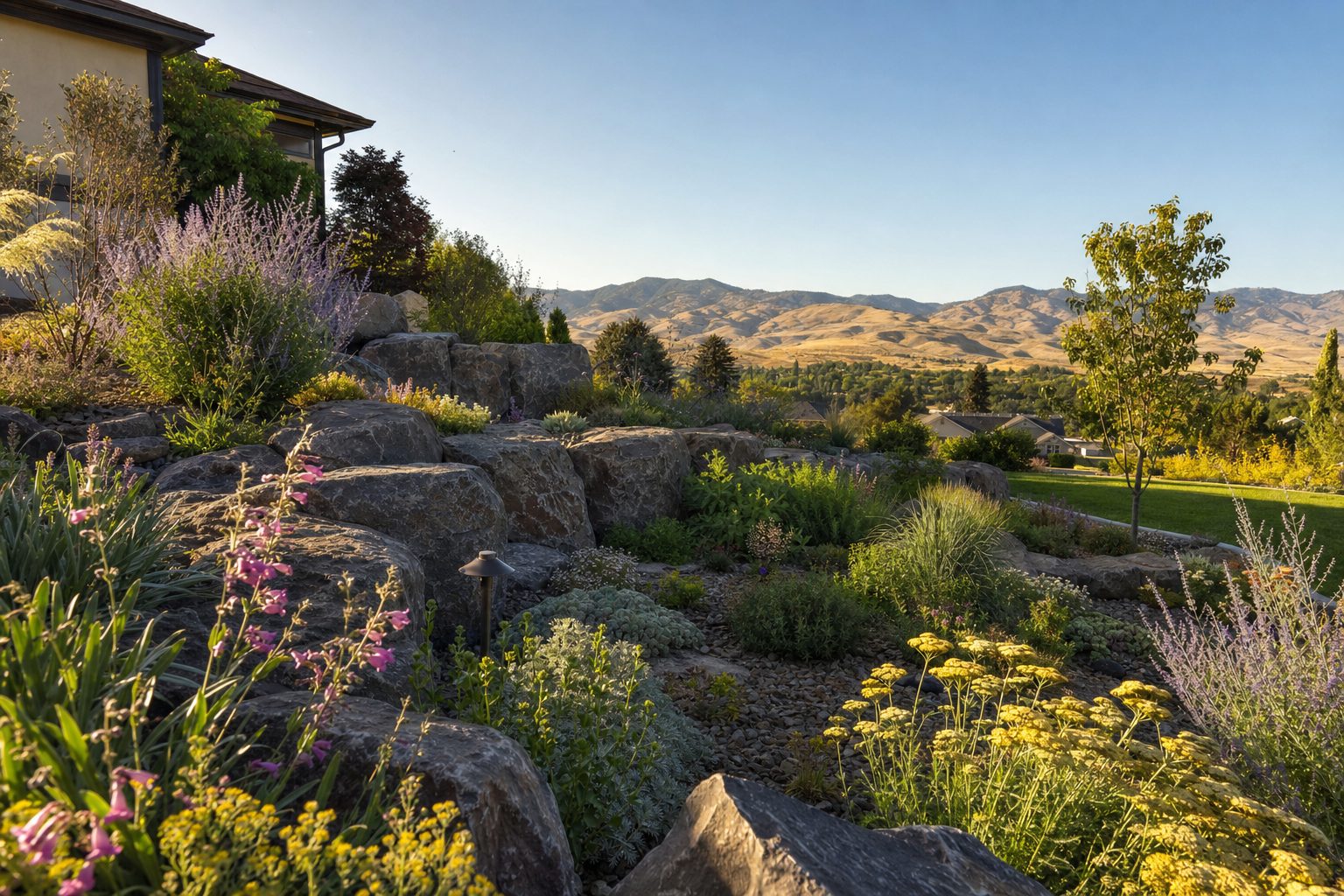
Rock Gardens for the Treasure Valley
The Treasure Valley sits on a foundation of basalt, quartzite, and decomposed granite. Rock gardens take that native geology and make it the centerpiece — building structured beauty out of the same materials the high desert already provides. For homeowners fighting alkaline soil, persistent wind, and 11 inches of annual rainfall, a well-built rock garden is one of the lowest-maintenance, most water-efficient landscape choices available.
This guide covers everything you need to plan and build a rock garden in the Treasure Valley: which stones to use and where to source them locally, which plants thrive in the crevices between rocks, how to handle drainage on flat valley lots and sloped foothills properties, what it costs, and how to maintain it through the seasons.
Why rock gardens work in the Treasure Valley
Rock gardens are not just decorative — they are a practical response to the same conditions that make conventional lawns expensive here. The Treasure Valley receives an average of 11 inches of precipitation annually, with most of it falling between November and May. July and August combined typically deliver less than half an inch of rain. Soils across Boise, Meridian, Eagle, Nampa, and Caldwell trend alkaline (pH 7.5–8.5), and foothills properties often sit on shallow, rocky soils over basalt or caliche layers.
A rock garden turns these challenges into advantages:
- Water efficiency: Once established, a rock garden with drought-tolerant plants needs 70–90% less water than a Kentucky bluegrass lawn of the same footprint. Many rock garden plants survive on natural precipitation alone after their first growing season.
- Soil compatibility: The alkaline, fast-draining conditions that stress turf grass are exactly what Mediterranean and high-desert rock garden plants prefer. Lavender, penstemon, Russian sage, and succulents thrive in alkaline soil with excellent drainage.
- Erosion control on slopes: Foothills properties in Boise, Eagle, and the Harris Ranch area benefit from rock gardens that stabilize slopes and slow water runoff. Boulders and gravel mulch prevent the sheet erosion that strips topsoil during thunderstorms.
- Year-round structure: Unlike perennials that disappear in winter, the stone framework of a rock garden provides visual interest through every season — especially valuable during the long November–March dormant period.
- Fire resistance: Rock gardens with minimal plant density and gravel mulch create natural firebreaks — a significant benefit for foothills and wildland-adjacent properties. See our firewise landscaping guide for defensible space principles.
Choosing stones: what's local, what works, what it costs
The best rock gardens use stone that looks like it belongs in the landscape. In the Treasure Valley, that means basalt, quartzite, granite, and sandstone — all available from local landscape supply yards. Here is what to use and what to expect to pay:
| Stone Type | Source / Color | Best Use | Cost Range* |
|---|---|---|---|
| Basalt boulders | Local volcanic stone; dark gray to charcoal, rounded or angular | Large focal points, retaining edges, slope stabilization | $80–$200 per ton (varies by size; delivery extra) |
| Columnar basalt | Quarried locally; distinctive vertical column shapes, gray-black | Architectural accents, entry features, water features | $200–$400 per ton (premium stone) |
| Quartzite gravel | Idaho quartzite; white, gold, rose, or mixed | Mulch layer (2–3 inch depth), pathways, ground cover | $35–$75 per ton bulk; $5–$8 per bag |
| Decomposed granite (DG) | Foothills material; tan to gold-brown, fine texture | Pathways between rock garden zones, base layer | $40–$60 per ton bulk |
| River rock (cobble) | Boise River and Snake River cobble; smooth, rounded, mixed earth tones | Dry creek beds, drainage swales, decorative ground cover | $60–$120 per ton (varies by size) |
| Limestone slabs | Quarried; flat, light gray, natural cleft surface | Stepping stones, low retaining edges, crevice garden slabs | $100–$180 per ton |
*Cost ranges are estimates based on Treasure Valley landscape supply pricing as of 2026. Bulk pricing requires delivery by dump truck or trailer — most suppliers charge $50–$120 for local delivery within Ada and Canyon counties. Minimum bulk order is typically 1–3 tons depending on the supplier.
Where to buy stone in the Treasure Valley:
- Zamzows — Boise, Eagle, Meridian, Nampa, Caldwell. Bagged decorative stone, smaller boulders, quartzite gravel. Locally owned with knowledgeable staff.
- D&B Supply — Multiple Treasure Valley locations. Bulk gravel, boulders, and landscape stone by the ton or by the bag.
- Eden Stone & Landscape Supply — Nampa. Large selection of boulders, columnar basalt, and bulk gravel for bigger projects.
- Pro Landscape Supply — Boise. Boulders, river rock, decomposed granite, and quartzite in bulk.
- Home Depot / Lowe's — Bagged decorative rock, paver base, and smaller stones. Best for small projects or accents.
Rock garden design patterns for Treasure Valley yards
There is no single rock garden template — the best design responds to your yard's topography, sun exposure, and the architectural style of your home. Here are four proven patterns for Treasure Valley properties:
1. The naturalistic outcrop
The most authentic rock garden style for the Treasure Valley mimics the natural rock outcrops visible along the Boise Foothills and in the Owyhee Mountains. Large basalt boulders (2–4 feet across) are partially buried at natural-looking angles, with smaller stones clustered around them. Plants fill the crevices and gaps, creating the impression that the rocks have always been there.
- Best for: Foothills properties, Harris Ranch, Eagle north of State Street, any yard with natural slope or existing rock
- Stone: 3–7 large basalt boulders, plus 10–15 medium stones (12–18 inches)
- Plants: Native sagebrush, rabbitbrush, penstemon, buckwheat, yarrow, and native bunchgrasses
- Gravel mulch: Quartzite or decomposed granite, 2–3 inch depth
2. The dry creek bed garden
A dry creek bed — a shallow channel lined with river rock and cobble — solves drainage problems while creating a striking visual feature. In the Treasure Valley, where summer thunderstorms can dump an inch of rain in 30 minutes, a dry creek bed channels runoff away from foundations and toward a rain garden or drainage area. Plant the banks with drought-tolerant perennials and ornamental grasses.
- Best for: Flat valley-floor lots with drainage issues, properties with downspout runoff, yards that pool water after storms
- Stone: River rock cobble (2–6 inch) for the channel, larger boulders along the edges, quartzite gravel between plants
- Plants: Karl Foerster grass, blue fescue, Russian sage, yarrow, catmint, sedum along the banks
- Drainage: Line the channel with landscape fabric and 2 inches of crushed fines (quarter-minus) beneath the cobble to slow water and prevent weed growth
3. The crevice garden
Crevice gardens are a specialized rock garden style where thin stone slabs are set vertically in the soil, creating narrow planting pockets between them. This design replicates the conditions plants find in mountain cliff faces — extremely sharp drainage, deep root run, and cool root zones. Crevice gardens are ideal for alpine plants and succulents that rot in conventional garden soil.
- Best for: Small spaces, front yard conversions, homeowners who want a collector's garden of unusual plants
- Stone: Limestone slabs or flat sandstone, set vertically at a slight angle (10–15 degrees from vertical), 2–3 inches apart
- Soil: 50% coarse sand, 30% topsoil, 20% quarter-minus gravel — fast-draining mix packed between the slabs
- Plants: Sempervivum (hens and chicks), sedum, dwarf penstemon, dwarf iris, thyme, saxifrage
4. The xeriscape rock border
Not every rock garden needs to be a full landscape overhaul. A xeriscape rock border replaces a traditional flower bed along a foundation, fence line, or property edge with a mix of boulders, gravel mulch, and a curated selection of drought-tolerant plants. This is the most affordable entry point into rock gardening and the easiest DIY project.
- Best for: Homeowners on a budget, front yard foundation plantings, replacing water-hungry shrub beds
- Stone: 3–5 medium boulders (18–24 inches), quartzite gravel mulch (2–3 inch depth) over the entire bed
- Plants: 5–8 drought-tolerant perennials and small shrubs (Russian sage, lavender, catmint, yarrow, sedum)
- Size: A typical front foundation border runs 30–50 linear feet by 4–6 feet wide
Plants for Treasure Valley rock gardens
Rock garden plants share three traits: they tolerate drought, they thrive in fast-draining soil, and they stay relatively compact. The Treasure Valley's Zone 7a climate, alkaline soils, and intense summer sun narrow the field to plants that are genuinely adapted to high-desert conditions. Here are the most reliable performers:
| Plant | Latin name | Type | Bloom | Water | Notes |
|---|---|---|---|---|---|
| Rocky Mountain Penstemon | Penstemon strictus | Perennial | June–July, blue-purple spikes | Very low | Idaho native; hummingbird magnet; thrives in rocky crevices |
| Palmer's Penstemon | Penstemon palmeri | Perennial | June–August, pink-white fragrant | Very low | Tallest penstemon (3–4 ft); tolerates reflected heat |
| Hens and Chicks | Sempervivum tectorum | Succulent | July (star-shaped pink, but grown for foliage) | None after establishment | Hardy to −30°F; spreads to fill crevices; deer-resistant |
| Autumn Joy Sedum | Hylotelephium 'Herbstfreude' | Succulent perennial | August–October, pink to rust | Low | Late-season color; 18–24 inches tall; drought-tolerant |
| Creeping Thyme | Thymus serpyllum | Ground cover | June–August, pink-purple carpet | Low | Spills over rocks; 2–3 inches tall; foot-tolerant between stepping stones |
| Yarrow | Achillea millefolium | Perennial | June–September, white to red | Very low | Idaho native; flat flower clusters; ferny foliage; deer-resistant |
| Blanket Flower | Gaillardia aristata | Perennial | May–September, red-orange daisy | Very low | Idaho native; long bloom season; thrives in gravel mulch |
| Russian Sage | Perovskia atriplicifolia | Shrub | July–September, lavender-blue | Low | Silver foliage; Boise staple; 3–4 feet tall; behind smaller rock garden plants |
| Lavender | Lavandula angustifolia | Perennial shrub | June–August, purple spikes | Low | Loves Treasure Valley heat and alkaline soil; needs perfect drainage |
| Blue Fescue | Festuca glauca | Ornamental grass | June, buff-colored seed heads | Low | Silver-blue mounds; 8–12 inches; contrasts with stone beautifully |
| Karl Foerster Grass | Calamagrostis × acutiflora | Ornamental grass | June, golden plumes persist through winter | Low–moderate | Vertical accent behind boulders; 4–5 feet; sterile (non-invasive) |
| Rabbitbrush | Chrysothamnus nauseosus | Shrub | September–October, golden yellow | Very low | Idaho native; late-season color when little else blooms; foothills staple |
| Sulfur Buckwheat | Eriogonum umbellatum | Perennial | June–August, sulfur-yellow clusters | Very low | Idaho native; low spreading mats; pollinator powerhouse |
| Catmint | Nepeta × faassenii | Perennial | May–September, blue-purple | Low | Long bloom; deer-resistant; softens hard rock edges |
Sourcing rock garden plants locally: FarWest Landscape on State Street in Northwest Boise is the go-to garden center for drought-tolerant perennials, natives, and succulents. Their 7-acre nursery stocks plants acclimated to Treasure Valley conditions. Zamzows carries a good selection of drought-tolerant perennials at five valley locations. Edwards Greenhouse in Boise is the best source for succulents (sempervivum, sedum) and unusual alpine plants for crevice gardens. For native seed, the Idaho Botanical Garden's annual plant sale (typically April–May) offers native penstemon, buckwheat, and yarrow starts grown from local seed.
Building a rock garden: step-by-step construction
Building a rock garden is a weekend project for a small border, or a multi-day project for a large naturalistic outcrop. The process is the same regardless of scale — the difference is how much stone you move and how much soil you amend.
Step 1: Site selection and preparation
Choose a site that gets at least 6 hours of direct sun — most rock garden plants are sun-lovers. South- and west-facing slopes are ideal. Avoid low spots where water pools after rain; even drought-tolerant plants rot in standing water.
Mark the area with a garden hose or spray paint. For a naturalistic outcrop, aim for an irregular, organic shape rather than a rectangle. Kill existing lawn or weeds by smothering with cardboard (layer 2 sheets thick, overlap edges by 6 inches) or by solarizing with clear plastic for 6–8 weeks in peak summer. Do not use landscape fabric under the entire garden — it prevents plants from rooting deeply and eventually weeds grow through it anyway.
Step 2: Soil amendment for drainage
The single biggest mistake in Treasure Valley rock gardens is planting in unamended clay soil. Rock garden plants need sharp drainage — water should move through the root zone in minutes, not hours. If you have heavy clay (common in Nampa, Caldwell, and parts of the Boise Bench), amend the planting area:
- For existing loam/sandy soil: Add 2–3 inches of quarter-minus gravel or coarse sand and till in to a depth of 8–10 inches.
- For heavy clay: Remove 6–8 inches of clay, replace with a mix of 50% coarse sand, 30% topsoil, 20% quarter-minus gravel. This is more work but essential — clay holds water and rots drought-tolerant plant roots.
- For foothills rocky soil: Minimal amendment needed. Plant directly in existing soil, adding a handful of gravel to each planting hole.
- Raised mounds: If your site is flat, build a gentle mound (6–12 inches higher than surrounding grade) to create drainage and visual elevation. Slope the mound at 5–10 degrees.
See our soil amendment guide for detailed instructions on testing and improving Treasure Valley soils.
Step 3: Place the boulders first
Always place the largest stones before anything else. Boulders define the structure of the garden — everything else is built around them. For a natural look:
- Bury one-third of each boulder in the soil. A boulder sitting on top of the ground looks placed and artificial. Burying it makes it look like the tip of a much larger underground formation.
- Set stones at slight angles, not perfectly upright. Nature does not stack rocks vertically — they tilt, lean, and cluster.
- Group in odd numbers (3, 5, 7) for a natural feel. Avoid evenly spaced rows.
- Create planting pockets between boulders — gaps of 12–24 inches where soil is deeper and plants can establish.
- Use a pry bar and wheeled dolly for stones under 100 lbs. For boulders over 200 lbs, rent a mini-skid steer (e.g., Dingo or Boxer) from Home Depot or Diamond Turf & Rental in Boise ($150–$200/day).
Step 4: Plant in the crevices
Once boulders are set, plant into the amended soil between and around them. The best planting technique for rock gardens:
- Plant in fall (September–October) or early spring (April–May). Fall is ideal in the Treasure Valley — warm soil and cooler air let roots establish before winter. See our fall planting guide for timing.
- Dig planting holes twice as wide as the pot but no deeper. In rock gardens, shallow planting is better than deep — the crown of the plant should sit slightly above grade to prevent rot.
- Add a handful of gravel to the bottom of each planting hole for extra drainage, especially for succulents and penstemons.
- Space plants 12–18 inches apart for ground covers and small perennials; 24–36 inches for larger perennials and shrubs. They will fill in within 2–3 growing seasons.
- Water thoroughly after planting, then apply gravel mulch around (not touching) the plant crowns.
Step 5: Apply gravel mulch
Gravel mulch is the finishing layer that ties a rock garden together and provides practical benefits: it suppresses weeds, retains soil moisture, moderates soil temperature, and prevents soil splash onto plant foliage during rain or irrigation. Apply 2–3 inches of quartzite gravel or decomposed granite across the entire garden surface, pulling it back 2–3 inches from plant crowns to prevent rot.
Avoid organic mulch (bark, wood chips) in rock gardens — it holds moisture against plant crowns, breaks down into nitrogen-robbing material, and looks wrong against stone. Gravel mulch is permanent, weed-suppressing, and visually consistent with the stone aesthetic. See our mulching guide for a comparison of mulch types.
Step 6: Install drip irrigation (optional but recommended)
Even drought-tolerant plants need regular water during their first growing season. Install a simple drip irrigation system with emitters at each plant — 0.5–1 gallon per hour emitters for perennials, 1–2 gph for shrubs. Run the system for 30–60 minutes twice weekly during the first summer, then taper to once weekly or less in the second year. By the third year, most established rock garden plants need no supplemental irrigation. See our irrigation guide for drip system design.
What a rock garden costs in the Treasure Valley
Rock garden costs vary enormously depending on size, stone selection, and whether you do the work yourself. Here are realistic ranges for Treasure Valley projects:
| Project Type | Size | DIY Cost | Professional Cost |
|---|---|---|---|
| Xeriscape rock border (foundation bed) | 40 ft × 5 ft (200 sq ft) | $500–$1,200 | $2,000–$4,500 |
| Naturalistic outcrop (front yard feature) | 15 ft × 20 ft (300 sq ft) | $1,200–$3,000 | $4,500–$9,000 |
| Dry creek bed with plantings | 30 ft long, 3 ft wide | $600–$1,500 | $2,500–$5,000 |
| Crevice garden (raised bed) | 8 ft × 4 ft (32 sq ft) | $300–$700 | $1,500–$3,000 |
| Full front yard rock garden conversion | 1,000 sq ft | $2,500–$6,000 | $8,000–$20,000+ |
The biggest cost variable is stone. Boulders delivered in bulk cost $80–$200 per ton, but the same stone purchased individually at a garden center can cost 2–3 times more. For any project requiring more than 1 ton of stone, buy from a landscape supply yard with delivery service rather than bagged stone from a big-box store. For a detailed breakdown of all Treasure Valley landscaping costs, see our cost guide.
Maintaining a rock garden through the seasons
One of the greatest advantages of a rock garden is how little maintenance it requires compared to a lawn or perennial border. But “low maintenance” is not “no maintenance.” Here is what to do through the year:
March–April
Cut back last year's dead growth on perennials (Russian sage, butterfly bush, sedum) to 4–6 inches. Pull any weeds that germinated over winter. Check gravel mulch depth — top up thin areas. Inspect drip irrigation lines for winter damage.
May–June
Plant new additions. Water newly installed plants twice weekly. Apply a light top-dressing of compost around established plants (a thin handful, not a heavy layer). Watch for aphids on new growth — blast off with a hose jet.
July–August
Peak bloom season for penstemon, blanket flower, yarrow, and Russian sage. Deep water established plants once every 2–3 weeks only if temperatures exceed 100°F for extended periods. Pull weeds after monsoon thunderstorms. Deadhead spent blooms to extend flowering.
September–October
Best time to plant new rock garden specimens. Rabbitbrush blooms golden yellow — a highlight of the fall rock garden. Reduce watering as temperatures drop. Do not cut back fall-blooming plants until spring — seed heads feed birds and add winter interest.
November–February
Dormant season. No watering needed (natural precipitation is sufficient). Leave dried seed heads and grass plumes standing for winter interest and wildlife. Brush heavy snow off delicate succulents to prevent crushing. Plan next year's additions.
Weeds in gravel mulch: The most common maintenance complaint with rock gardens is weeds growing through the gravel. Prevention is easier than cure: (1) pull weeds when they are small — a 2-inch weed comes out with a gentle tug, a 6-inch weed requires digging and disturbs the gravel, (2) apply a pre-emergent herbicide (corn gluten meal for organic approach, or Snapshot T&V for chemical) in early spring before weed seeds germinate, (3) re-top gravel mulch every 2–3 years to maintain a 2–3 inch depth that blocks light to weed seeds. Never use landscape fabric under gravel in a planted rock garden — it prevents plants from self-seeding and blocks the deep root growth that makes drought-tolerant plants drought-tolerant.
Rock gardens for specific Treasure Valley neighborhoods
The right rock garden approach depends on where you live in the valley. Soil, slope, and microclimate vary significantly:
- Boise Foothills & Harris Ranch: Naturalistic outcrop with native basalt boulders. Soil is already rocky and well-drained — minimal amendment needed. Deer pressure is high, so choose deer-resistant plants (Russian sage, penstemon, yarrow, catmint, lavender). Firewise spacing is essential — keep plants sparse near the home. See our Boise landscaping guide and Boise xeriscaping guide for neighborhood-specific details.
- Meridian & South Boise (flat valley floor): Build raised mounds for drainage if soil is heavy. Dry creek beds work well on flat lots to handle storm runoff. Xeriscape rock borders are the easiest conversion from lawn. Soil may need significant amendment (sand and gravel) for drainage.
- Eagle (north of State Street): Larger lots with sandy loam — excellent drainage already. Naturalistic outcrops with basalt boulders fit the rural character. Room for large specimen boulders and sprawling plant communities. See our Eagle landscaping guide.
- Nampa & Caldwell: Heavier clay soils (especially Caldwell's sandy loam over clay) require more drainage amendment. Raised crevice gardens and mounded outcrops work better than in-ground planting. Wind exposure is greater on the west valley — use larger boulders as windbreaks and choose wind-tolerant plants (Karl Foerster grass, Russian sage, rabbitbrush). See our Caldwell landscaping guide.
- Kuna & Star: Sandy loam with excellent drainage — ideal for rock gardens with minimal soil work. Wind is a major factor in these exposed areas. Use dense plantings of ornamental grasses between boulder clusters to slow wind and trap blowing soil. See our Kuna & Star landscaping guide.
Common rock garden mistakes in the Treasure Valley
- Using landscape fabric under the entire garden. It blocks deep root growth, prevents self-seeding (how many rock garden perennials naturally spread), and weeds grow through it anyway within 2 years. Use cardboard for initial weed suppression instead — it breaks down and feeds the soil.
- Planting in unamended clay. Drought-tolerant plants in clay soil get wet feet in winter and rot. Always amend for drainage in heavy soil areas.
- Setting boulders on top of the ground. A boulder sitting on the surface looks like it was dropped from a truck. Bury one-third of every large stone for a natural, anchored appearance.
- Overwatering. Rock garden plants are adapted to drought. Once established, they prefer dry conditions. Overwatering kills more rock garden plants than underwatering in the Treasure Valley.
- Choosing the wrong gravel mulch. Rounded river rock mulch rolls and shifts, exposing soil. Use angular quartzite or decomposed granite that locks in place. Avoid white marble chips — they glare in the sun, look artificial, and reflect heat that can scorch nearby plants.
- Ignoring deer. In foothills and rural areas, deer will browse many rock garden plants. Choose deer-resistant species or accept that some protective measures (fencing, repellent) will be needed. See our deer-resistant plants guide.