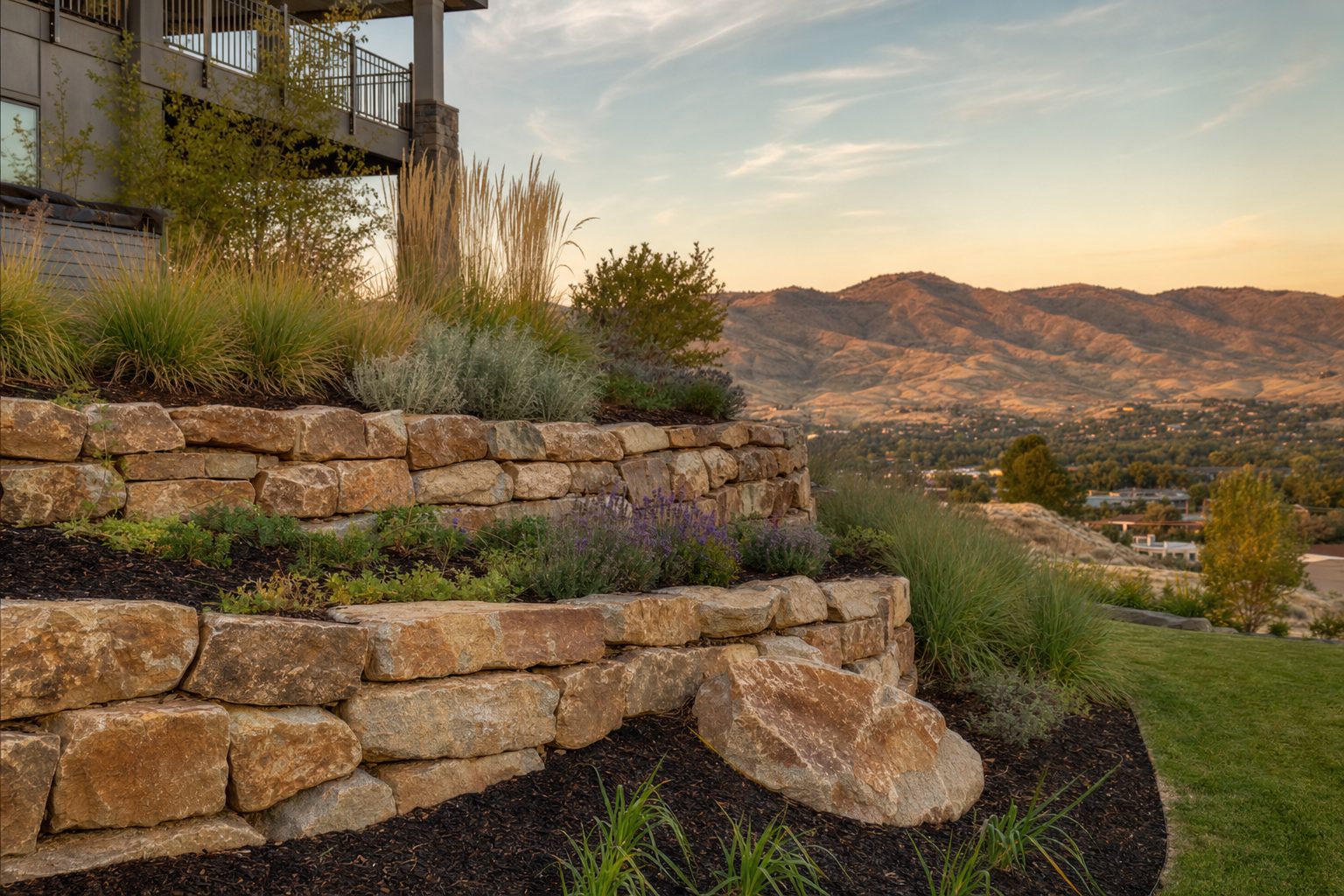
From the sloped lots of the Boise Foothills to the gradual grades of Eagle and Meridian, retaining walls are one of the most common and most critical hardscape features in Treasure Valley landscapes. A well-built wall creates usable yard space on sloped terrain, manages stormwater, and adds structural beauty that lasts decades. A poorly built one leans, cracks, or collapses within five years — usually because of one missing element: drainage.
Why retaining walls are everywhere in the Treasure Valley
The Treasure Valley sits on a gentle alluvial slope rising from the Boise River north toward the foothills. Neighborhoods in North Boise, the Foothills, Eagle Hills, and parts of Meridian and Star have significant grade changes — lots that drop 4–10 feet from front to back. In these areas, retaining walls are not decorative; they are structural necessities that create level space for patios, lawns, and driveways.
Even in flatter areas like Nampa and Caldwell, low retaining walls (18–36 inches) are commonly used to define planting beds, create raised patios, and manage the gradual slopes that direct stormwater toward foundations if left unchecked.
Idaho-specific challenge: frost heave. The Treasure Valley experiences 100–140 freeze-thaw cycles per year. Soil moisture freezes and expands, pushing walls outward. Without proper drainage and a compacted base, even a beautifully constructed wall will shift within 2–3 winters. This is why drainage is not optional — it is the single most important factor in wall longevity.
Wall types and when to use them
Natural stone walls
Stacked natural stone — basalt, granite, sandstone, and quartzite — is the most visually distinctive retaining wall material in the Treasure Valley. Local stone blends naturally with the high-desert landscape and weathers beautifully. Basalt is the most common local stone, quarried from the Snake River Plain and available in shades from charcoal to warm grey.
Best for: Walls up to 4 feet tall, landscape beds, and aesthetic features visible from patios or living areas. Dry-stacked stone walls (no mortar) allow water to drain through naturally, eliminating the need for pipe drainage behind the wall.
Cost: $25–55 per square foot of wall face, installed. Stone is the most expensive material but also the most durable and visually striking.
Local sourcing: D&L Rock & Landscape Supply (Nampa), Whitehead Brothers Mineral Materials (Boise), and Edgemere Landscape Supply (Boise) all carry local Idaho stone. Expect to pay $180–350 per ton depending on stone type and cut.
Concrete segmental retaining wall (SRW) blocks
Interlocking concrete blocks (Allan Block, Belgard, Pavestone, Techo-Bloc) are the most popular retaining wall material in the Treasure Valley — and for good reason. They are engineered for structural performance, come in colors that complement Idaho's earth tones, and their pin-and-lip system makes installation straightforward for both DIYers and professionals.
Best for: Walls from 2 to 6 feet tall. Walls over 4 feet typically require engineering and a building permit in Ada County and Canyon County. SRW blocks handle freeze-thaw well because the joints flex slightly and the system allows for drainage through the wall face.
Cost: $15–30 per square foot of wall face, installed. DIY material cost is $8–15 per square foot (blocks, gravel, pipe, fabric, base material).
Local sourcing: SiteOne Landscape Supply (Boise), D&L Rock & Landscape Supply (Nampa), Home Depot, and Lowe's all carry SRW systems. Allan Block is the most widely available brand in the valley.
Poured concrete walls
Poured-in-place concrete is the strongest retaining wall option and is required for walls over 6 feet, basement foundations, and critical structural applications. In the Treasure Valley, poured concrete walls are common in hillside subdivisions in the Foothills and along roadway cuts.
Best for: Walls over 6 feet, structural retaining near foundations, and modern architectural designs where clean concrete faces complement the home's aesthetic.
Cost: $30–60 per square foot, installed. Requires formwork, rebar, concrete delivery, and finishing — this is a professional-only installation.
Permit requirement: All poured concrete retaining walls over 4 feet require a building permit and engineered drawings in Ada County. Check with your city's building department — Boise, Meridian, and Eagle all have specific setback requirements for structural walls.
Timber walls
Treated lumber (6×6 or 8×8 Douglas fir pressure-treated for ground contact) is the most affordable retaining wall material. Timber walls are common in rural areas of Canyon County, Kuna, and Star — particularly for agricultural and rural residential properties where cost matters more than aesthetics.
Best for: Walls up to 4 feet, garden terraces, and rural properties. Not recommended for front yards in HOA neighborhoods — most HOAs in Meridian, Eagle, and Star prohibit timber retaining walls visible from the street.
Cost: $10–20 per square foot, installed. DIY-friendly — a 20-foot, 3-foot-tall timber wall can be built in a weekend for under $400 in materials.
Lifespan: 15–25 years in Idaho's dry climate. The arid Treasure Valley is gentler on treated wood than humid climates — posts set in gravel (not concrete) drain well and resist rot.
Boulder walls
Large boulders (1–4 tons each) stacked along a slope create a naturalistic retaining wall that blends seamlessly with foothills landscapes. Boulder walls are common in the Boise Foothills, Eagle Hills, and rural properties in Star and Kuna where the aesthetic is rustic and the terrain is irregular.
Best for: Walls 2–5 feet tall on natural slopes. Boulders require excavation equipment (mini-excavator or skid steer) to place — this is not a DIY project.
Cost: $20–40 per square foot, installed. Boulder cost is $80–200 per ton delivered, plus equipment rental for placement.
The five critical construction details
Most retaining wall failures in the Treasure Valley trace back to the same five mistakes. Whether you are building a 2-foot garden wall or a 6-foot structural wall, these details determine whether your wall stands for 30 years or 3:
1. Base preparation
Excavate to a depth of 6–8 inches below the wall's bottom course. Fill with 3/4-inch crushed gravel (not pea gravel — it does not compact). Tamp every 2 inches with a plate compactor until the base is firm and level. The base should extend 6–12 inches in front of the wall for the first course to sit on. A level base prevents the wall from settling unevenly — the most common cause of visible lean within the first year.
2. Drainage layer and pipe
Behind every retaining wall — whether stone, block, or timber — place 12 inches of clean 3/4-inch crushed gravel. At the base of this drainage layer, install a 4-inch perforated drain pipe (SDR 35 or corrugated) sloped 1 inch per 20 feet toward a daylight outlet or storm drain. Wrap the gravel in landscape fabric to prevent soil from clogging the drainage layer.
This is the detail most DIY installations skip — and it is the #1 cause of wall failure. Without drainage, hydrostatic pressure from wet soil pushes the wall outward. In Idaho's freeze-thaw cycle, trapped water behind the wall expands by 9% when it freezes, exerting enormous force. A wall that looks fine in summer can lean 2 inches over a single winter if drainage is absent.
3. Buried first course
The bottom row of blocks or stones should be buried so that at least half the block height is below finished grade. For a 6-inch-tall block, that means 3 inches buried. This prevents the wall from sliding forward under lateral pressure and creates a mechanical key into the soil. Many DIYers place the first course on top of the ground — the wall then slides forward within the first wet season.
4. Geogrid reinforcement (walls over 3 feet)
For walls taller than 3 feet, geogrid — a synthetic mesh that ties the wall into the soil behind it — is essential. Geogrid is laid between courses of SRW blocks, extending 3–6 feet back into the excavated soil, and is sandwiched between compacted soil layers. This creates a composite mass that resists overturning. Most SRW manufacturers (Allan Block, Belgard) publish geogrid spacing charts based on wall height and soil type.
For walls over 4 feet, consult a licensed engineer. In Ada County, walls over 4 feet require a building permit and engineered plans. The city of Boise's building department reviews retaining wall plans as part of residential permits.
5. Proper backfill material
Never backfill a retaining wall with native clay soil. Treasure Valley soils in many areas — particularly the bench areas of Boise and Nampa — contain expansive clays that swell when wet and shrink when dry. This creates cyclic pressure that destroys walls over time. Always backfill with clean, free-draining gravel for the first 12–18 inches behind the wall, then use compacted native soil beyond that.
Cost breakdown for Treasure Valley retaining walls
| Wall type | Height | Material/sq ft | Installed/sq ft | 20 ft × 3 ft wall |
|---|---|---|---|---|
| Natural stone (dry stack) | 2–4 ft | $12–25 | $25–55 | $1,500–3,300 |
| Concrete SRW blocks | 2–6 ft | $8–15 | $15–30 | $900–1,800 |
| Poured concrete | 4–8 ft | $15–25 | $30–60 | $1,800–3,600 |
| Treated timber | 2–4 ft | $5–10 | $10–20 | $600–1,200 |
| Boulder | 2–5 ft | $10–20 | $20–40 | $1,200–2,400 |
These are installed costs for a straight wall with standard conditions. Curves, corners, stairs, and integrated lighting add 20–40%. Walls requiring engineering, permits, or excavation of hardpan (common in the Boise Bench area) add $500–2,000 depending on site conditions.
DIY vs professional installation
A retaining wall under 3 feet tall, on level ground, with good soil, is a realistic DIY project for a homeowner with basic construction skills. You will need a plate compactor (rent $60/day from Home Depot or Sunbelt Rentals), a level, a rubber mallet, a shovel, and a wheelbarrow. Budget a full weekend for a 20-foot wall.
DIY is appropriate when:
- Wall height is under 3 feet
- The wall is not supporting a driveway, structure, or slope above it
- You have good access for material delivery and equipment
- Soil is stable (not expansive clay or fill dirt)
- The wall is straight — curves and corners require more skill
Hire a professional when:
- Wall height exceeds 4 feet (permit and engineering required)
- The wall supports a driveway, patio, or is near a property line
- You need a terraced system (multiple walls in series)
- Excavation requires heavy equipment or hits hardpan/rock
- The wall is part of a larger landscape project (patio, outdoor kitchen, pool)
For professional installation, the companies in our local landscaper directory can handle retaining walls as part of a full landscape project. For standalone wall construction, look for hardscape specialists with ICPI (Interlocking Concrete Paver Institute) certification or NCMA (National Concrete Masonry Association) certification.
Permit requirements in the Treasure Valley
Retaining wall permit rules vary by city but generally follow the International Building Code (IBC) threshold of 4 feet:
- Boise City: Permit required for walls over 4 feet (measured from bottom of footing to top of wall). Setback from property line: 3 feet minimum. Boise Planning & Development.
- Meridian: Permit required for walls over 4 feet. Setback varies by zoning — check with Meridian Building Department.
- Eagle: Permit required for walls over 4 feet. Foothills properties may have additional hillside ordinance requirements.
- Nampa & Caldwell: Permit required for walls over 4 feet. Canyon County building permits apply outside city limits.
- Kuna & Star: Check with Ada County Development Services for unincorporated areas.
Always call 811 (Idaho One Call) before digging — buried utilities are the most common cause of construction delays and damage. The service is free and required by Idaho law for any excavation deeper than 16 inches.
Common retaining wall problems in Idaho
Leaning and bowing
If a wall is leaning outward at the top, the cause is almost always inadequate drainage or insufficient base preparation. Hydrostatic pressure from wet soil pushes the wall forward. A wall leaning more than 1 inch in 4 feet of height is a structural concern — at 2 inches, the wall is approaching failure and should be evaluated by a professional.
Fix: Excavate behind the wall, install proper drainage (gravel + pipe), and rebuild. Catch this early — a leaning wall only gets worse with each freeze-thaw cycle.
Cracking in poured concrete
Hairline cracks in poured concrete walls are normal — concrete shrinks as it cures. Cracks wider than 1/8 inch, or cracks that are growing, indicate settlement or soil pressure issues. In the Treasure Valley, expansive clay soils beneath footings can cause differential settlement that cracks concrete walls.
Fix: Inject epoxy crack filler for cracks under 1/4 inch. For larger cracks, consult a foundation specialist — the wall may need reinforcement or helical tiebacks.
Bulging in timber walls
Treated timber walls fail when the deadmen (horizontal timbers extending into the soil behind the wall) rot or were never installed. Without deadmen, the wall relies on friction alone and will push outward under soil pressure. Timber walls should have deadmen every 16–24 square feet of wall face, extending 2–3 feet back into the soil.
Efflorescence on concrete block
White mineral deposits on the face of concrete block walls indicate water is moving through the wall and evaporating, leaving dissolved salts behind. While not structurally dangerous, it is a sign that drainage behind the wall may be inadequate. Clean with a wire brush and muriatic acid solution (1 part acid to 10 parts water), then address the drainage issue.
Integrating retaining walls with your landscape
A retaining wall is rarely a standalone feature — it should integrate with the rest of your landscape design. Common pairings in Treasure Valley yards:
- Wall + patio: A raised patio retained by a low wall creates usable outdoor living space on sloped lots. See our fire pit and outdoor living guide for ideas.
- Wall + planting beds: The top of a retaining wall is a natural planting bed. Drought-tolerant plants like Russian sage (Perovskia atriplicifolia), ornamental grasses, and creeping phlox soften the hardscape and add seasonal color. See our native plants guide for species that thrive in Treasure Valley conditions.
- Wall + steps: Integrated steps in a retaining wall connect upper and lower yard levels. Plan step width at 48 inches minimum for comfortable passage, with 6–7 inch risers and 12–14 inch treads.
- Wall + lighting: Recessed step lights in the wall face improve safety and extend usability into the evening. See our landscape lighting guide for fixture types and placement.
Local suppliers and resources
- SiteOne Landscape Supply (Boise, 5365 W Irving St) — Allan Block, Belgard, and Pavestone SRW systems, geogrid, drain pipe, base material. Trade-oriented but open to homeowners.
- D&L Rock & Landscape Supply (Nampa, 320 W Garrity Blvd) — local stone, boulders, SRW blocks, and bulk gravel. Best prices on basalt boulders in the valley.
- Whitehead Brothers Mineral Materials (Boise, 4401 W State St) — natural stone, crushed gravel, and base material. Family-owned since 1932.
- Edgemere Landscape Supply (Boise, 7400 W State St) — stone, boulders, and hardscape materials. Carries a good selection of Idaho-sourced flagstone and wall stone.
- Home Depot & Lowe's (multiple locations) — Pavestone and Oldcastle SRW blocks for small DIY walls. Limited color selection compared to specialty suppliers.