Winterization Checklist for Treasure Valley Lawns & Gardens
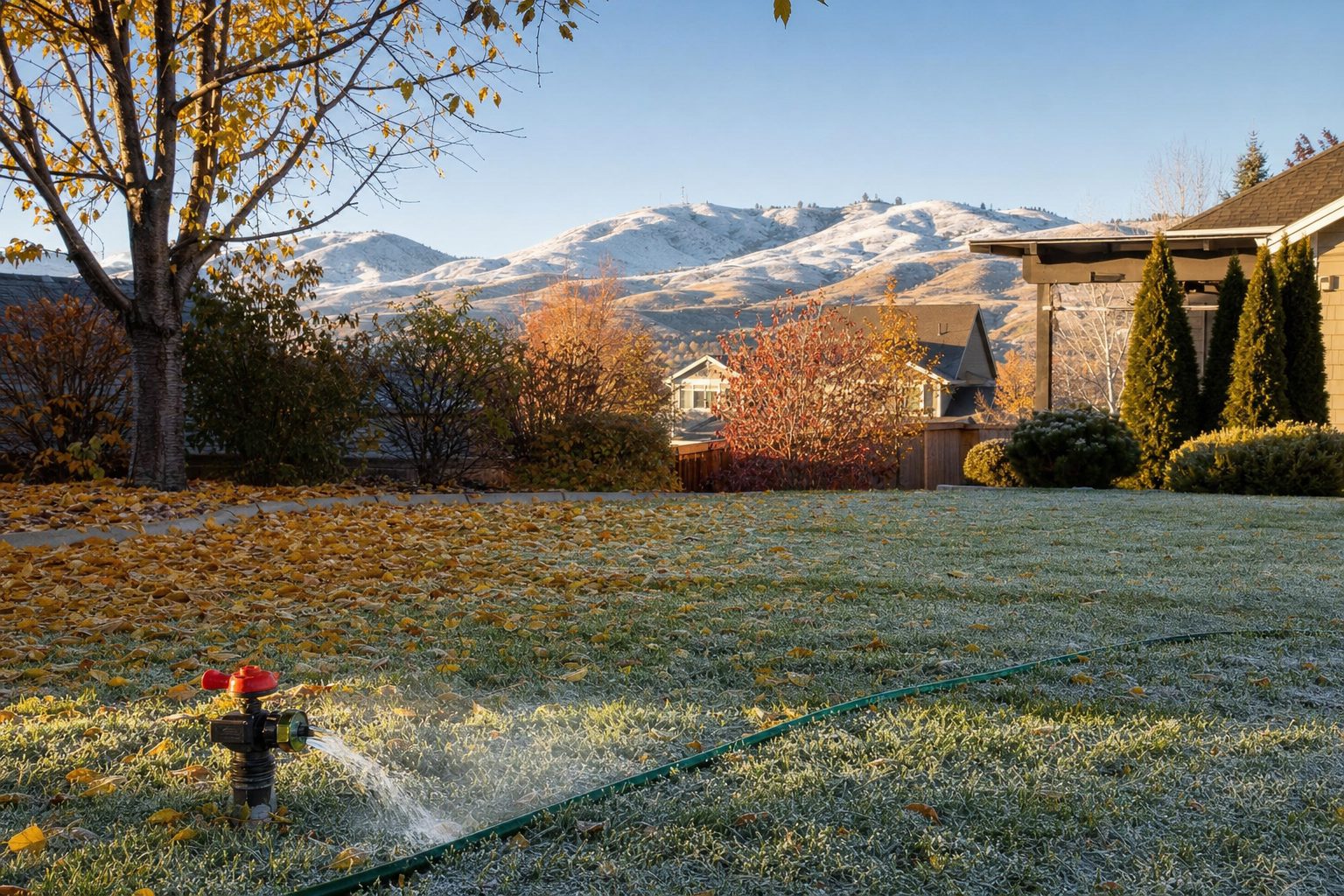
The Treasure Valley's first hard freeze typically arrives between October 7 and October 20, depending on your elevation and microclimate. Everything in this checklist works backward from that date — because once the ground freezes, your options narrow dramatically. This guide gives you a week-by-week plan from late September through mid-November, with specific tasks, local timing, and real cost ranges for doing it yourself or hiring a pro.
Whether you're in Boise's North End with mature shade trees, on a newer lot in Meridian with a pressurized irrigation system, or out in Star with an acre and a half of pasture, the same principles apply: protect your irrigation system from freeze damage, give your lawn one last round of root-building nutrients, wrap vulnerable shrubs and young trees, and put your garden beds to sleep properly so they wake up healthy in March.
The Treasure Valley frost & freeze calendar
Timing is everything in winterization. Do it too early and your lawn misses its fall growth window. Do it too late and you risk cracked irrigation pipes, dead perennials, and frost-damaged shrubs. Here are the key dates for the Boise area, based on NWS Boise freeze data and the 1991–2020 NOAA Climate Normals:
| Milestone | Typical date (Boise) | What it means for your yard |
|---|---|---|
| First light frost (36°F) | Late September – early October | Tender annuals finish; start bringing potted plants indoors |
| First freeze (32°F) | October 7–14 (avg. Oct 14) | Stop watering; drain outdoor hoses and faucets |
| First hard freeze (28°F) | October 15–25 | Sprinkler blowout deadline — pipes at risk after this |
| Ground freezes solid | Mid-to-late November | Root growth stops; mulch should already be in place |
| Last spring frost (32°F) | April 30 (avg.) | Plan backward — protect new growth from late cold snaps |
Elevation matters — the Foothills freeze first
If you live in the Boise Foothills, Eagle north of State Street, or the higher benches in North Boise, expect your first frost 5–10 days earlier than the valley floor. Conversely, properties near the Boise River or in low-lying areas of Nampa and Caldwell may see cold air pool and create earlier, harder freezes than the airport weather station suggests. When in doubt, schedule your sprinkler blowout for the first week of October — it's cheaper than replacing a cracked manifold.
Week-by-week winterization plan
Here's a structured timeline you can follow from late September through mid-November. Tasks are grouped by priority so you never miss a critical window.
Week of September 23 – October 1: Lawn recovery & prep
Your cool-season lawn (Kentucky bluegrass, perennial ryegrass, tall fescue) is entering its best growth window right now. Cool nights, warm soil, and shorter days signal the grass to store energy in its roots. This is the time to invest in next spring's lawn.
- Aerate — core aerate to relieve compaction from summer foot traffic and irrigation. Many Treasure Valley lawns have clay-heavy or compacted soils that limit water infiltration. Cost: $45–$80 DIY rental (4-hour), $75–$150 professional service. Best window: late September through early October.
- Overseed thin areas — spread seed 45 days before first frost (by ~September 1 in cooler microclimates, by ~September 15 in warmer valley-floor areas). Use a blend of Kentucky bluegrass and perennial ryegrass, or tall fescue for shady areas. Seed-to-soil contact is critical — aerate first, then broadcast seed.
- Apply fall fertilizer — the most important feeding of the year. A fall application with slow-release nitrogen supports root development and early spring green-up. Apply around mid-October, after aeration. Cost: $25–$50 for a quality fertilizer bag covering 5,000–10,000 sq ft. Look for a 3-2-1 or similar N-P-K ratio; Boise soils are already high in phosphorus, so don't over-apply.
- Soil test — if you haven't tested in 3–5 years, send a sample to the University of Idaho Analytical Sciences Laboratory ($35–$50). You'll get a certified report within 15 business days showing pH, nutrient levels, and amendment recommendations specific to Idaho soils.
- Spot-treat weeds — perennial weeds like dandelion, field bindweed, and broadleaf plantain are pulling carbohydrates into their roots right now. A post-emergent herbicide (2,4-D, dicamba, or triclopyr) applied between mid-August and October 15 will be translocated to the roots and kill the entire plant. Cost: $15–$30 for a ready-to-use spray bottle. Do not apply herbicide to newly overseeded areas.
Week of October 1 – October 15: Sprinkler blowout & system shutdown
This is the single most time-sensitive winterization task in the Treasure Valley. If water freezes inside your irrigation lines, valves, or backflow preventer, the expanding ice can crack PVC and poly pipe, split fittings, and destroy sprinkler heads. A professional blowout costs $55–$85 for most residential systems — a fraction of the $500–$2,000+ you'll spend repairing freeze damage.
DIY vs. professional blowout
| Option | Cost | Pros & cons |
|---|---|---|
| Professional blowout (1–5 zones) | $55–$75 | Safest option; insured; takes 15–30 min. Book early — schedules fill by mid-October. |
| Professional blowout (6–10 zones) | $75–$100 | Add $5–$6 per additional zone. Be present to show location of all valves. |
| DIY with rented compressor | $40–$60 rental | Risk of over-pressurizing and damaging heads. Requires an air compressor rated 10–50 CFM at 50 PSI — not a standard home shop compressor. Eye protection required. |
| Drain-only (manual/auto drain system) | $0 | Only works if your system has manual drain valves or auto-drain heads. Most Treasure Valley systems need a blowout. |
Local blowout services: Treasure Valley Repairs, Beeline Sprinkler Repair ($75 flat for first 5 zones, $6 per zone after), Mike's Backflow, and All Done Services all serve the Boise metro area. Many use online scheduling because fall demand is intense — book by early October to get your preferred date.
Blowout steps (if doing it yourself)
- Shut off the main water supply to the irrigation system at the shutoff valve (usually in the basement, crawl space, or in a valve box near the meter).
- Open all manual drain valves to let gravity remove what it can.
- Connect an air compressor (rated 10–50 CFM) to the blowout port — typically a hose bib or a dedicated fitting on the backflow preventer.
- Set the compressor pressure to 50 PSI maximum. Higher pressure will crack pipes and destroy sprinkler heads.
- Open one zone at a time. Run compressed air until water stops coming out of the heads — usually 2–3 minutes per zone. Don't run a zone dry for more than 5 minutes; the friction can melt the plastic gears in rotor heads.
- Shut down the controller. Turn it off or set it to "off" mode. Some pros recommend leaving the controller powered on but in off mode to preserve programming; others simply disconnect and reconnect in spring.
- Disconnect and drain the backflow preventer. If it's a pressure vacuum breaker (PVB) — the most common type in Treasure Valley homes — remove the internal components, drain them, and store indoors, or insulate the assembly if it can't be removed.
Pressurized irrigation note for Meridian & Nampa
Many neighborhoods in Meridian, Nampa, and Kuna receive pressurized irrigation water through a separate system (not city water). These systems are typically shut off by the irrigation district in mid-October. You still need to blow out your lateral lines — the district shutting off the supply doesn't drain water from your underground pipes. Check with your local irrigation district for the exact shutoff date. Check the current provider-specific shutdown status before you schedule the blowout. Then schedule your blowout within a few days of that date. Our pressurized irrigation districts guide covers how to find your district and its shutoff schedule.
Week of October 7 – October 20: Trees, shrubs & perennials
Once the first frost hits, your trees and shrubs need protection. The specific tasks depend on what you're growing — hardy natives like rabbitbrush (Ericameria nauseosa) and big sagebrush (Artemisia tridentata) need nothing, but marginally hardy plants, young trees, and grafted roses need real attention.
Young trees (planted within the last 1–3 years)
- Deep water one last time — give newly planted trees a slow, deep soak before the ground freezes. This is critical for trees that haven't developed deep root systems yet. Water to a depth of 12–18 inches. Stop watering after the first hard freeze.
- Wrap the trunk — young thin-barked trees (maples, honeylocust, ash, fruit trees) are vulnerable to sunscald, a condition where winter sun warms the south-facing bark, which then cracks when temperatures plunge at night. Wrap the trunk from the base to the first branches with tree wrap paper or white plastic tree guards. Cost: $8–$15 per roll. Remove wraps in spring to prevent girdling and insect problems.
- Mulch the root zone — apply a 2–4 inch layer of wood chip mulch in a 3-foot radius around the base, keeping mulch 2–3 inches away from the trunk. This insulates roots from freeze-thaw cycles and conserves late-fall moisture. Free wood chips are available from local tree services or through the ChipDrop service.
Roses — the grafted-hybrid exception
- Do not prune in fall — pruning stimulates tender new growth that will be killed by the next freeze. Wait until late winter (late February to early March in the Treasure Valley) to prune roses. The exception: remove any dead, diseased, or crossing branches now to prevent winter storm damage.
- Mound the graft union — if you're growing grafted hybrid teas, floribundas, or grandifloras, mound 8–12 inches of loose soil or compost over the crown to protect the graft union (the swollen bump where the scion meets the rootstock). This is the most cold-vulnerable part of the plant. Do this after the first hard freeze but before the ground freezes solid. Unmound in mid-to-late April.
- Own-root roses need less protection — many newer landscape and shrub roses (Knock Out series, drift roses, and most own-root varieties) are hardy enough to survive Treasure Valley winters without mounding. A 2–3 inch mulch layer is sufficient.
Shrubs and perennials
- Cut back perennials — after the first hard freeze kills the tops, cut back herbaceous perennials (peony, coneflower, black-eyed Susan, daylily) to 2–3 inches above the soil line. Leave ornamental grasses standing — they provide winter interest, catch snow for insulation, and protect the crown.
- Don't cut back subshrubs — plants with woody stems that are borderline hardy (lavender, Russian sage / Perovskia atriplicifolia, caryopteris) should NOT be cut back in fall. Pruning removes the insulation and exposes the crown. Wait until spring, then prune to live wood.
- Mulch tender perennials — apply 2–4 inches of mulch over the crown of marginally hardy perennials. Fall-planted perennials are especially vulnerable — their root systems haven't had time to establish before winter.
Wrap vulnerable evergreens
- Burlap wind screen — if you have arborvitae, boxwood, or newly planted evergreens exposed to prevailing southwest winds, wrap with burlap or install a burlap wind screen on the windward side. The Treasure Valley's dry winter winds cause more damage than cold temperatures alone — they desiccate foliage faster than frozen roots can replace moisture. Cost: $10–$20 for burlap rolls.
- Anti-desiccant spray — an optional step for broadleaf evergreens (boxwood, holly, rhododendron). Wilt-Pruf and similar products coat leaves with a biodegradable film that reduces moisture loss. Apply when temperatures are above 40°F, typically in late November. Cost: $15–$25 per bottle. Not necessary for junipers, pines, or spruce.
Week of October 15 – November 1: Garden cleanup & final mow
Vegetable garden
- Pull dead annuals and vegetable plants — remove all plant debris from the vegetable garden to reduce overwintering habitat for pests and diseases. Compost healthy plant material; bag and trash any diseased plants (especially tomatoes with late blight, which overwinters on infected tissue).
- Leave roots in the ground — cut annuals at soil level rather than pulling them out. The roots decompose over winter and add organic matter. This is especially beneficial for legumes (beans, peas), which fix nitrogen in root nodules.
- Spread compost — apply a 1–2 inch layer of compost over the entire vegetable bed. It will break down over winter, improving soil structure and fertility by spring. Cost: $25–$40 per cubic yard (covers ~100 sq ft at 2 inches). Source locally from compost suppliers like Soil Building Systems in Boise or Flying Heart Nursery in Nampa.
- Plant garlic — October is the ideal time to plant garlic in the Treasure Valley. Plant cloves 2–3 inches deep, 6 inches apart, pointy end up. Mulch with 3–4 inches of straw. They'll root before the ground freezes, overwinter, and produce bulbs by July. Hardneck varieties (Music, German Extra Hardy) perform well in our climate.
- Cover empty beds — if you're not planting a cover crop or garlic, cover bare soil with straw mulch, shredded leaves, or a cover crop like winter rye (seed by early October). Bare soil loses organic matter, compacts under winter rain, and is prone to early-spring weed germination.
Final lawn mow
- Keep mowing until growth stops — cool-season grass continues growing until daytime temperatures consistently fall below 50°F, typically early November in Boise. Don't stop mowing just because it's October.
- Lower the final cut — for your last mow of the season, set the blade to 2–2.5 inches (down from the 2.5–3 inch summer height). A slightly shorter final cut reduces matting under snow and lowers the risk of snow mold, a fungal disease that can damage lawns under prolonged snow cover. Don't scalp — never cut below 2 inches.
- Follow the one-third rule — never remove more than one-third of the grass blade in a single mowing. If the grass is 3.5 inches tall, don't cut below 2.3 inches in one pass.
- Mulch the leaves — if you have a light layer of leaves, mow over them with a mulching mower. The shredded leaves decompose and add nutrients to the soil. If leaves are thick enough to block sunlight (you can't see grass through them), rake and compost them.
Week of November 1 – November 15: Hoses, containers & finishing touches
- Disconnect and drain hoses — remove all garden hoses from outdoor faucets. Drain them and store coiled in a garage or shed. A hose left connected can trap water in the faucet, which freezes and cracks the pipe inside the wall — one of the most common (and expensive) winter plumbing repairs.
- Install faucet covers — place foam faucet covers (cost: $2–$5 each) on all outdoor hose bibs. If your home has freeze-proof sillcocks, this is optional insurance; if you have standard faucets, it's essential.
- Bring containers indoors — terracotta, ceramic, and glazed pots will crack if left outside with moist soil that freezes and expands. Empty them and store in a shed, or move non-frost-proof containers into a garage. Plastic and fiberglass containers can stay outside but should be emptied of soil to prevent cracking.
- Winterize water features — drain fountains, pond pumps, and water features. Store pumps indoors. If you have a pond with fish, install a de-icer or aerator to keep a hole open for gas exchange. Cost: $30–$80 for a pond de-icer.
- Clean and store tools — wipe down shovels, pruners, and hoes. Apply a light coat of oil to metal surfaces to prevent rust. Sharpen blades now so they're ready in spring. Drain gas from power equipment (mowers, string trimmers) or add fuel stabilizer.
- Mark pathways — if you use a snow shovel or snow blower, place reflective markers along the edges of driveways, sidewalks, and raised beds so you can see them under snow cover. Cost: $15–$25 for a pack of fiberglass driveway markers.
Fall 2026 leaf drop-off and curbside pickup
Leaf collection is separate from irrigation shutoff. Programs are for each city's own residents, so check your own city's page before you rake and haul.
| City | Leaf collection | Source |
|---|---|---|
| Meridian | City of Meridian with Republic Services, "Recycle the Fall": curbside collection Monday, Nov. 2 to Friday, Dec. 4, 2026, on your regular trash day, leaves only, in paper leaf bags or your yard-debris cart, limit 10 bags per week, no plastic bags. Drop sites at Meridian parks Tuesday, Oct. 20 to Thursday, Dec. 10, 2026, Meridian residents only. | Recycle the Fall |
| Eagle | City of Eagle: leaf drop-off dumpsters Oct. 5 to Dec. 13 at West Eagle Park & Ride (1890 W State St) and Eagle Sports Complex (3151 E Greenbrook St); curbside pickup Nov. 2 to Nov. 27 on your regular trash day; paper bags only. | City of Eagle |
| Nampa | City of Nampa Parks & Recreation: loose leaves only (no bags, limbs or brush) at Kohlerlawn Cemetery, 76 6th Street North, weekdays Oct. 5 to Dec. 11, 2026, 8:30 a.m. to 4:30 p.m., plus Saturdays from Nov. 7, 10 a.m. to 2 p.m.; Nampa residents only. | City of Nampa Parks & Recreation |
| Boise | No dated 2026 leaf schedule is listed here; use the City's Curb It drop-off map. | Curb It drop-off map |
| Kuna | No separate dated leaf event is listed here; check the City's sanitation page. | City of Kuna sanitation |
| Star | Check your address-specific schedule with Republic Services. | Republic Services schedule |
| Caldwell and other cities | No verified 2026 date yet; check your city's current notice and don't use a neighboring city's dates. | — |
Leaf pickup dates last checked Oct. 23, 2026.
Cost summary: what does winterizing a Treasure Valley yard cost?
Here's a realistic cost breakdown for a typical 7,000–10,000 sq ft lot in the Treasure Valley, comparing DIY to professional service:
| Task | DIY cost | Professional cost |
|---|---|---|
| Sprinkler blowout (5–8 zones) | $40–$60 (compressor rental) | $55–$85 |
| Lawn aeration | $45–$80 (rental) | $75–$150 |
| Fall fertilizer application | $25–$50 (product) | $50–$100 (product + labor) |
| Tree wrap (3–5 young trees) | $15–$30 (materials) | $75–$150 (labor + materials) |
| Rose mounding (5–10 roses) | $0 (using existing soil/compost) | $50–$100 |
| Garden cleanup & compost top-dressing | $25–$50 (compost) | $150–$300 |
| Faucet covers & hose storage | $10–$25 | — |
| Total (full winterization) | $160–$300 | $455–$885 |
The $55 that saves $2,000
If you do only one thing on this list, get your sprinkler system blown out before the first hard freeze. A professional blowout is the cheapest insurance you can buy. A cracked underground pipe costs $300–$800 to locate and repair. A damaged backflow preventer costs $200–$500. A split valve manifold can run $500–$2,000+ if it's buried under a finished landscape. The math is simple: schedule the blowout.
Common winterization mistakes in the Treasure Valley
- Waiting too long for the blowout — the biggest mistake. Homeowners watch the forecast, see no immediate freeze, and delay. Then a cold front drops in and the temperature plunges from 45°F to 18°F overnight. By the time you call a pro, they're booked out two weeks and your pipes have already frozen. Schedule in late September, not mid-October.
- Pruning everything in fall — spring-blooming shrubs (lilac, forsythia, flowering quince, mock orange) set their flower buds the previous summer. If you prune them in fall, you're cutting off next spring's blooms. Wait until immediately after they finish flowering to prune.
- Fertilizing too late — if you apply nitrogen fertilizer after the grass has stopped growing (November+), the nutrients wash away or leach into groundwater without being used. The ideal fall fertilization window is mid-October, when the grass is still actively taking up nutrients but top growth has slowed.
- Leaving heavy leaf cover on the lawn — a thick mat of leaves left over winter blocks light, traps moisture, and creates ideal conditions for snow mold and voles. If you can't see grass through the leaves, rake them off. Light leaf cover can be mulched in place with the mower.
- Over-watering in fall — as temperatures cool, lawns need less water. Keep watering until the first hard freeze, but reduce your run times. Over-watering in October promotes fungal diseases and wastes water (and money). Your irrigation controller should be dialed back progressively in September and October, not left on summer settings.
- Wrapping too early or too late — tree wrap applied in warm September weather can trap moisture and invite insects under the wrap. Apply after the first frost but before hard freezes. Remove wraps in early April — leaving them on through spring can girdle the trunk as it expands.
What NOT to do in fall
Some landscaping tasks are better left for spring. Doing them in fall can actually harm your yard:
- Don't fertilize trees and shrubs with nitrogen in fall — it stimulates late-season growth that won't harden off before winter, making the plant more vulnerable to cold damage. Phosphorus and potassium are okay; nitrogen is not.
- Don't plant most trees and shrubs after mid-October — the window for fall planting in the Treasure Valley closes around October 15. Roots need 4–6 weeks of soil above 40°F to establish before the ground freezes. The exception: container-grown perennials and hardy shrubs can be planted into early November if you mulch heavily.
- Don't cut back ornamental grasses — their dried foliage catches snow, protects the crown, and looks striking against a winter landscape. Cut them back in March before new growth emerges.
- Don't leave diseased plant material in the garden — tomato vines with late blight, rose canes with black spot, and apple leaves with scab should all be bagged and trashed, not composted. Home compost piles rarely reach temperatures high enough to kill plant pathogens.
- Don't apply pre-emergent herbicide in fall — pre-emergents are a spring tool for crabgrass prevention. A fall application is wasted product unless you're specifically targeting winter annual weeds like cheatgrass (downy brome), which germinate in fall.
Quick-reference winterization checklist
Print this out, tape it to the fridge, and check items off as you go:
Late September
- ☐ Aerate the lawn
- ☐ Overseed thin areas (if needed)
- ☐ Apply post-emergent herbicide to perennial weeds
- ☐ Order a soil test (if overdue)
- ☐ Plant garlic
Early October
- ☐ Schedule sprinkler blowout (book now!)
- ☐ Apply fall fertilizer
- ☐ Wrap young tree trunks
- ☐ Mulch root zones (2–4 inches)
- ☐ Plant spring-blooming bulbs
Mid-October
- ☐ Complete sprinkler blowout
- ☐ Mound graft unions on grafted roses
- ☐ Cut back herbaceous perennials
- ☐ Pull dead annuals and vegetable plants
- ☐ Top-dress garden beds with compost
Early November
- ☐ Final mow (lower to 2–2.5 inches)
- ☐ Disconnect and drain all hoses
- ☐ Install faucet covers
- ☐ Bring containers indoors
- ☐ Wrap evergreens with burlap (if needed)
Mid-November
- ☐ Drain and store water features / pond pumps
- ☐ Clean and oil garden tools
- ☐ Add fuel stabilizer to power equipment
- ☐ Mark pathway edges for snow removal
- ☐ Apply anti-desiccant to broadleaf evergreens
Done for winter
- ☐ Review the season — what worked, what didn't
- ☐ Plan next year's projects while memory is fresh
- ☐ Order seeds for spring (January–February)
- ☐ Browse local nursery catalogs for new plants
- ☐ Schedule irrigation startup for April
Preparing for spring: the winter advantage
Winterization isn't just about preventing damage — it's about setting up a stronger spring. Lawns that are aerated, fertilized, and put to bed clean will green up 1–2 weeks earlier than neglected lawns. Trees that are watered deeply before the ground freezes emerge healthier. Garden beds that are composted in fall are ready to plant the moment the soil can be worked in March.
Use the quiet winter months to plan. If you've been thinking about a new patio, a fire pit, or replacing your lawn with drought-tolerant alternatives, winter is the perfect time to research designs, compare costs, and line up contractors for early-spring installation — before their schedules fill up in May.