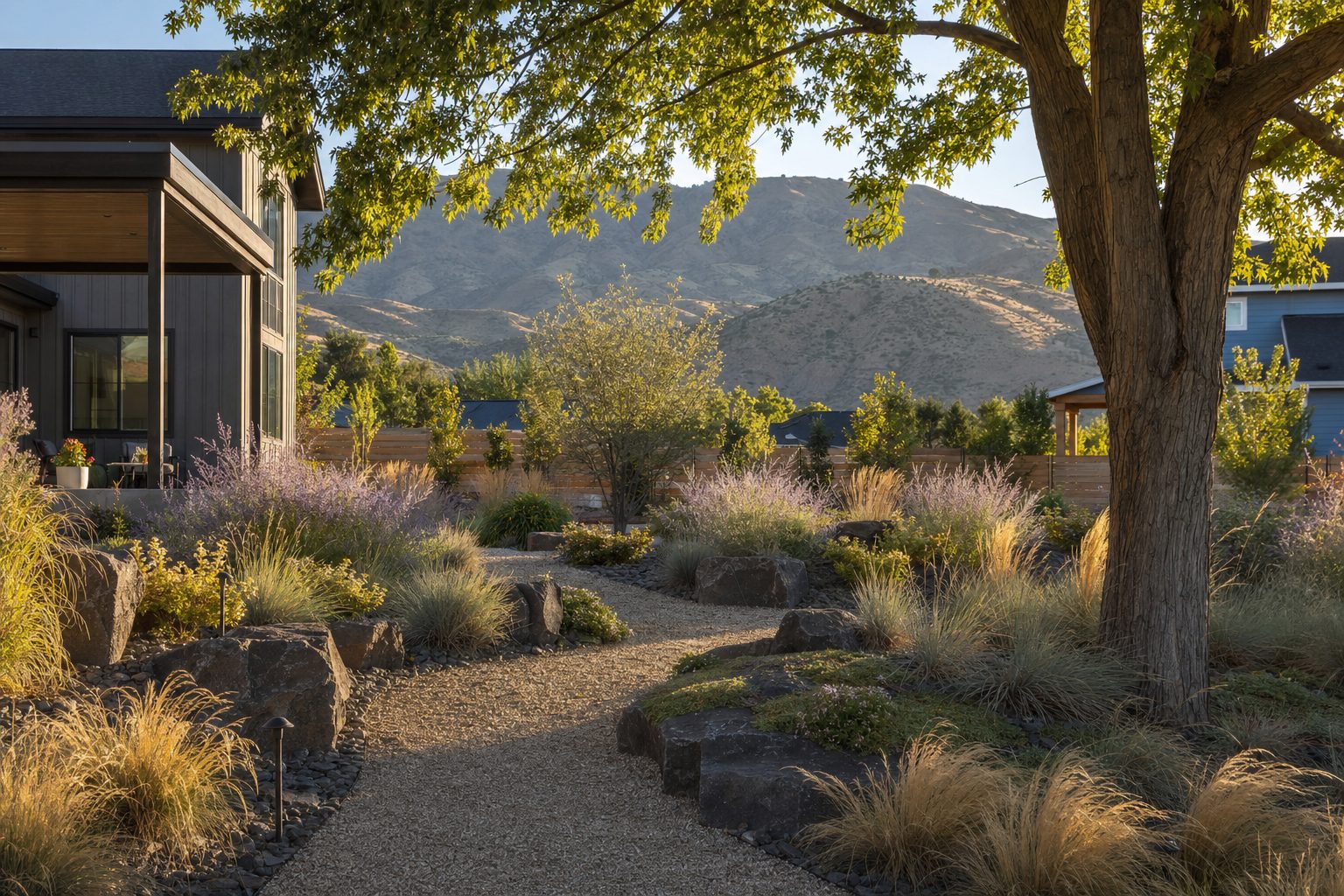
Low-Maintenance Landscaping for the Treasure Valley
A low-maintenance yard is not a zero-maintenance yard — every landscape needs some care. But a well-designed Treasure Valley landscape can cut your weekly yard work from hours to minutes, reduce your summer water bill by 50–70%, and look better than the lawn-and-hedges it replaced. This guide covers the design principles, plant choices, hardscape strategies, and irrigation setups that make low-maintenance landscaping work in Boise's high-desert climate.
What "low-maintenance" actually means in the Treasure Valley
The Treasure Valley sits in USDA Hardiness Zone 7a, with average annual precipitation of just 11 inches — less than half the national average. Summers are hot and dry (average July high of 93°F, frequent stretches above 100°F), winters are cold but relatively short, and the growing season runs roughly from mid-May to early October. The soil in most subdivisions is alkaline (pH 7.5–8.5), compacted construction fill with little organic matter.
In this climate, "low-maintenance" means designing a yard that works with these conditions rather than fighting them. A traditional Treasure Valley yard — Kentucky bluegrass lawn, water-hungry shrubs, annual flower beds — requires 20–30 inches of supplemental irrigation per year, weekly mowing from April through October, regular fertilizer applications, and ongoing pest management. A well-designed low-maintenance yard reduces all of these dramatically.
The maintenance pyramid. Think of yard work as a pyramid: the base is watering (60% of the effort), the middle is mowing and edging (20%), the upper middle is pruning and weeding (15%), and the tip is fertilizing and pest control (5%). A low-maintenance design attacks the base of the pyramid first — if you eliminate the need for frequent watering and mowing, everything above it shrinks automatically.
The five pillars of low-maintenance design
1. Right plant, right place
The single most effective low-maintenance strategy is choosing plants that are naturally adapted to the Treasure Valley's climate, soil, and water availability. A plant that evolved in a similar climate — cold winters, hot dry summers, alkaline soil — will thrive with minimal intervention. A plant that evolved in a different climate will need constant help to survive.
This means favoring:
- Native and regional natives — plants that evolved in the Intermountain West or Great Basin. These are adapted to our rainfall patterns, soil chemistry, and temperature swings.
- Drought-tolerant non-natives from similar climates — plants from the Mediterranean, Central Asia, and other dry-summer regions that can handle our summers without supplemental irrigation once established.
- The right size plant for the space — the #1 source of pruning work is plants that outgrow their location. A shrub that matures at 4 feet, planted in a space that only allows 3 feet, will need pruning every year. Choose plants whose mature size fits the space and you eliminate 90% of pruning work.
2. Hardscape over softscape
Patios, pathways, boulders, gravel beds, and other hardscape elements require zero watering, zero mowing, and zero pruning. They are the ultimate low-maintenance landscape component. A yard that is 40% hardscape and 60% planted beds will require roughly half the maintenance of a yard that is 100% lawn and planting beds.
Effective hardscape strategies for the Treasure Valley:
- Crushed granite or decomposed granite paths — $4–8 per square foot, weed-barrier fabric underneath, stable surface that drains well and needs no upkeep beyond occasional raking.
- Flagstone or concrete paver patios — $10–20 per square foot installed, permanent, maintenance-free for 20+ years.
- Boulder and rock features — local basalt boulders ($50–150 per ton delivered) add visual interest, require zero maintenance, and look at home in the Treasure Valley landscape.
- Gravel mulch beds — 3/4-inch crushed gravel in landscape beds suppresses weeds better than organic mulch, does not decompose, and needs replenishing only every 5–7 years vs. annually for bark mulch.
3. Drip irrigation with smart controllers
Hand-watering is the most time-consuming yard task and the most wasteful. A well-designed drip irrigation system with a smart controller delivers water directly to plant roots, eliminates overspray and evaporation, and adjusts automatically based on weather data. Once installed, the only maintenance is a spring start-up, a fall blow-out, and occasional emitter checks.
A typical Treasure Valley drip system costs $800–2,000 for a quarter-acre lot (installed by a professional), or $200–500 in materials for a DIY install. Smart controllers (Rain Bird ESP-Me, Hunter Hydrawise, Rachio) cost $150–350 and connect to local weather stations to skip watering before rain or during high-wind events. See our Treasure Valley Irrigation Guide for a complete system design walkthrough.
4. Mulch everything
Bare soil grows weeds. Every square foot of exposed soil in your yard is an invitation for wind-blown seeds, particularly in the Treasure Valley's windy spring season. A 2–3 inch layer of mulch suppresses 90% of weed germination, retains soil moisture (reducing watering frequency), and moderates soil temperature swings.
For low-maintenance beds, choose one mulch type and stick with it:
- Bark nuggets or shredded cedar — $35–50 per cubic yard, decomposes over 2–3 years, needs refreshing. Good for perennial and shrub beds.
- Crushed gravel (3/4-inch minus) — $45–65 per cubic yard, permanent, excellent for xeriscape and rock-garden beds. Pair with landscape fabric underneath.
- Arborist wood chips — often free from local tree services, decompose slowly, feed the soil. Best informal look, not ideal for manicured front yards.
5. Group plants by water need
The most common mistake in Treasure Valley landscapes is mixing high-water and low-water plants in the same irrigation zone. When you plant a thirsty hydrangea next to a drought-tolerant Russian sage on the same drip line, you either overwater the sage (it declines) or underwater the hydrangea (it crisps). Group plants into hydrozones — clusters of plants with similar water needs — and run separate drip lines to each zone. This eliminates the guesswork and reduces water waste.
Best low-maintenance plants for the Treasure Valley
These plants thrive in Boise's climate with minimal water, no pruning, and no fertilizer. All are available at local nurseries (Edwards Greenhouse, Northland Nursery, Zamzows, Franz Witte Nursery). Choose the right plant for the right spot and maintenance drops to near zero after the establishment year.
Trees
| Tree | Mature size | Water need | Why it's low-maintenance |
|---|---|---|---|
| Hackberry (Celtis occidentalis) | 40–50 ft H × 30–40 ft W | Low | Tolerates alkaline soil, drought, and wind. No serious pests. Deep roots — no surface rooting. |
| Bur Oak (Quercus macrocarpa) | 50–60 ft H × 40–50 ft W | Low | Once established, needs no supplemental water. Slow grower — no frequent pruning. Handles clay soil. |
| Honeylocust, thornless (Gleditsia triacanthos var. inermis) | 35–45 ft H × 30–40 ft W | Low–medium | Small leaves — no raking needed (they sift into the lawn or beds). Open canopy allows underplanting. |
| Western Redbud (Cercis occidentalis) | 12–15 ft H × 10–12 ft W | Low | Native to the Intermountain West. Pink spring flowers, no pruning needed. Slow, controlled growth. |
Shrubs
| Shrub | Mature size | Water need | Why it's low-maintenance |
|---|---|---|---|
| Russian Sage (Perovskia atriplicifolia) | 3–4 ft H × 3–4 ft W | Very low | Peak bloom in August when everything else is struggling. Cut back to 6 inches in March — that's the only annual care. Deer-resistant. |
| Apache Plume (Fallugia paradoxa) | 4–6 ft H × 4–6 ft W | Very low | Native to the high desert. Silvery foliage, white flowers, pink seed plumes. No pruning, no fertilizer, thrives on neglect. |
| Curl-leaf Mountain Mahogany (Cercocarpus ledifolius) | 6–10 ft H × 4–6 ft W | Very low | Idaho native. Evergreen, extremely long-lived, needs no pruning. Slow grower — plant a larger specimen for instant impact. |
| Blue Mist Spirea (Caryopteris x clandonensis) | 2–3 ft H × 2–3 ft W | Low | Late-summer blue flowers when pollinators need them most. Cut to 8 inches in spring — only annual task. Deer-resistant. |
| Dwarf Mugo Pine (Pinus mugo var. mugo) | 3–5 ft H × 3–6 ft W | Low | Evergreen, no pruning, no pest issues in the Treasure Valley. Slow growth means it stays where you put it. |
Ornamental grasses
| Grass | Mature size | Water need | Why it's low-maintenance |
|---|---|---|---|
| Blue Oat Grass (Helictotrichon sempervirens) | 2–3 ft H × 2–3 ft W | Very low | Silver-blue foliage, drought-tolerant. One annual cutback in March. Never needs dividing. |
| Feather Reed Grass (Calamagrostis x acutiflora 'Karl Foerster') | 4–5 ft H × 2 ft W | Low | Vertical accent, stays upright in wind and snow. One cutback in March. Sterile — no self-seeding. |
| Little Bluestem (Schizachyrium scoparium) | 2–4 ft H × 18–24 in W | Very low | Native prairie grass. Blue-green summer foliage turns copper-red in fall. No watering once established. |
Ground covers and perennials
| Plant | Mature size | Water need | Why it's low-maintenance |
|---|---|---|---|
| Creeping Thyme (Thymus serpyllum) | 2–3 in H × 12–18 in W | Low | Replaces lawn in small areas. Pink-purple summer flowers. No mowing. Needs well-drained soil — amend clay or plant on a berm. |
| Woolly Thyme (Thymus pseudolanuginosus) | 1–2 in H × 12–18 in W | Low | Soft gray-green mat, no flowers. Perfect between flagstone. Handles light foot traffic. |
| Coneflower (Echinacea purpurea) | 3–4 ft H × 2 ft W | Low | Deadhead for rebloom or leave seedheads for winter birds. Clumps expand slowly — divide every 4–5 years (or don't). |
| Beardtongue (Penstemon spp.) | 1–3 ft H × 1–2 ft W | Very low | Native to the Intermountain West. Dozens of species and cultivars. Tubular flowers attract hummingbirds. Needs no care once established. |
Designing your low-maintenance yard
Zone your yard by use and water
The hydrozone approach divides your yard into three water-use zones:
- High-water zone (oasis zone) — small, visible areas near patios, entryways, and windows where you want lush green and seasonal color. This is where you put a few thirstier plants (a hydrangea, a perennial border, a small turf area for kids or pets). Keep this zone to 10–15% of your total yard.
- Medium-water zone (transition zone) — the majority of your yard. Drought-tolerant shrubs, ornamental grasses, and perennials that need occasional deep watering in July and August but nothing the rest of the year. 60–70% of the yard.
- Low-water zone (natural zone) — areas far from the house, along property lines, on slopes. Plants here survive on natural rainfall alone after establishment. Use native shrubs, ornamental grasses, and rock mulch. 15–30% of the yard.
Eliminate or shrink the lawn
A traditional Kentucky bluegrass lawn needs 1–1.5 inches of water per week from June through September — that's 20–30 inches of irrigation over a season, the single biggest water use (and time investment) in most Treasure Valley yards. If you want the lowest maintenance possible, eliminate the lawn entirely and replace it with hardscape, gravel mulch beds, and drought-tolerant plantings.
If you want some lawn for kids, pets, or aesthetics, shrink it to the minimum functional size and choose a lower-maintenance grass:
- Buffalo grass — native to the Great Plains, needs 50% less water than Kentucky bluegrass, grows slowly (mow every 2–3 weeks instead of weekly), goes dormant (tan) in winter. See our Lawn Alternatives guide for sourcing.
- Tall fescue blend — deeper roots (3–4 feet) than bluegrass, needs 25–30% less water, stays green longer into summer. Available at most Treasure Valley nurseries.
- Microclover blend — clover fixes nitrogen from the air, eliminating fertilizer needs. Stays green with less water. Mix with fine fescue for a self-feeding lawn.
Use steel edging for clean, permanent borders
Steel edging ($6–12 per linear foot installed) creates a crisp, permanent separation between lawn, beds, and gravel paths. Unlike plastic edging (which heaves and cracks within 2–3 years), steel edging lasts decades, does not warp in the Treasure Valley's freeze-thaw cycles, and eliminates the need to re-cut bed edges each spring. It is the single highest-ROI hardscape detail for reducing maintenance.
Design for mature size, not current size
The most common mistake that creates future maintenance is spacing plants for their current size rather than their mature size. A 1-gallon Russian sage looks tiny in a 4-foot-wide bed — but within 3 years it fills that space. If you plant two of them 18 inches apart, one will crowd out the other and you'll be digging one out in year 2. Read the plant tag, trust the mature size, and space accordingly. Your yard will look sparse for the first year (fill the gaps with annuals or mulch) and full from year 3 onward — with zero pruning needed because nothing is crowded.
Seasonal care for a low-maintenance yard
Even a low-maintenance yard needs some seasonal attention. Here's the full annual calendar — roughly 8–10 hours total per year for a quarter-acre lot:
March
- Cut back ornamental grasses and perennials to 2–3 inches
- Prune Russian sage and blue mist spirea to 6–8 inches
- Check drip lines for leaks before turning on the system
April
- Turn on irrigation system, set controller for spring schedule
- Refresh mulch in beds that need it (usually every 2–3 years)
- Pre-emergent weed control in gravel beds (if needed)
May–June
- Adjust irrigation controller for summer (deep, infrequent cycles)
- Hand-pull any weeds that got through mulch
- Deadhead early-blooming perennials if you want rebloom
July–August
- Monitor irrigation — check emitter output during hottest weeks
- Let dormant lawns stay dormant — do not force green
- Enjoy the yard — this is when low-water plants shine
September–October
- Reduce irrigation frequency as temperatures drop
- Leave seedheads for winter birds and visual interest
- Blow out irrigation system before first hard frost (mid-October)
November–February
- No active maintenance — the yard is dormant
- Enjoy the structure: grasses, seedheads, evergreens
- Plan any additions or changes for next spring
Real numbers. A quarter-acre Treasure Valley yard with Kentucky bluegrass lawn and traditional shrubs typically requires 80–120 hours of maintenance per year (mowing, edging, watering, fertilizing, pruning, weeding). A well-designed low-maintenance yard with the same square footage — hardscape, gravel beds, drip-irrigated drought-tolerant plantings, minimal lawn — requires 8–15 hours per year. That's a 90% reduction.
Cost comparison: traditional vs. low-maintenance
| Cost factor | Traditional yard | Low-maintenance yard | Annual savings |
|---|---|---|---|
| Water (summer irrigation) | $600–1,200/yr | $150–400/yr | $450–800 |
| Mowing service | $1,200–2,400/yr | $0–400/yr (minimal lawn) | $800–2,000 |
| Fertilizer and chemicals | $200–400/yr | $0–50/yr | $200–350 |
| Pruning and cleanup | $300–600/yr | $0–100/yr | $300–500 |
| Total annual cost | $2,300–4,600 | $150–950 | $1,750–3,650 |
The upfront cost of converting to a low-maintenance landscape is higher — expect $8,000–25,000 for a professional conversion of a quarter-acre lot, or $2,000–5,000 for a DIY approach (primarily hardscape materials, drip irrigation, and plants). At the annual savings above, a professional conversion pays for itself in 3–7 years, and a DIY conversion in 1–2 years. After that, it's pure savings — every year, for as long as you own the home.
Common mistakes to avoid
- Zero-maintenance is a myth. Every landscape needs some care. "Low-maintenance" means 8–15 hours per year, not zero. If you never touch your yard, even a low-maintenance design will look unkempt within 2–3 years.
- Skipping the establishment year. Even drought-tolerant plants need regular water for their first growing season. Drip every 2–3 days from May through September, then taper off. Skipping establishment watering is the #1 reason low-maintenance plantings fail.
- Using landscape fabric under organic mulch. Fabric under bark mulch prevents the mulch from decomposing into the soil, creating a sterile layer where nothing can grow — including your plants' roots. Use fabric only under gravel mulch, never under organic mulch.
- Overplanting for instant effect. If you fill every gap with plants at their mature size, the yard looks great for one season and then becomes an overgrown, disease-prone mess that needs constant pruning. Space for mature size, fill gaps with mulch, and be patient.
- Ignoring drainage. Treasure Valley clay soil holds water. If you create low spots with heavy mulch and no drainage, plants will rot in winter. Grade beds to drain away from the house and toward the street or a dry creek feature.
- Choosing rocks over plants entirely. A "rock garden" with no plants is not low-maintenance — it's a heat island. Bare rock radiates heat, kills soil biology underneath, and looks sterile. Always include at least 30% plant coverage, even in xeriscape zones.
Getting started
If you're not ready for a full yard conversion, start with the highest-impact, lowest-effort changes:
- Replace your park strip. That hot strip between the sidewalk and street is the hardest part of a lawn to maintain and the easiest to convert. Pull the sod, lay weed fabric, plant 3–5 drought-tolerant shrubs or ornamental grasses, and cover with gravel mulch. One weekend, $200–400 in materials, and you've eliminated the most annoying 50 square feet of lawn care.
- Install drip irrigation in one bed. Convert one sprinkler zone to drip and set a smart controller. You'll see the difference immediately and gain confidence to expand.
- Sheet-mulch a problem area. If you have a weedy patch you're tired of maintaining, lay cardboard (no tape, overlapping edges) over the area, cover with 4 inches of arborist wood chips, and leave it for 6 months. The weeds die, the soil improves, and you have a clean slate for fall planting.
- Plant three Russian sages. They are the gateway drug to low-maintenance landscaping — bulletproof, beautiful, and they bloom in August when you're most tired of the heat. Once you see how easy they are, you'll want more.
For a full yard conversion, see our Landscapers of the Treasure Valley directory — several listed companies specialize in water-wise and low-maintenance landscape design. Also see our guide to choosing a landscape contractor for tips on vetting bids and avoiding the common pitfalls of contractor selection.