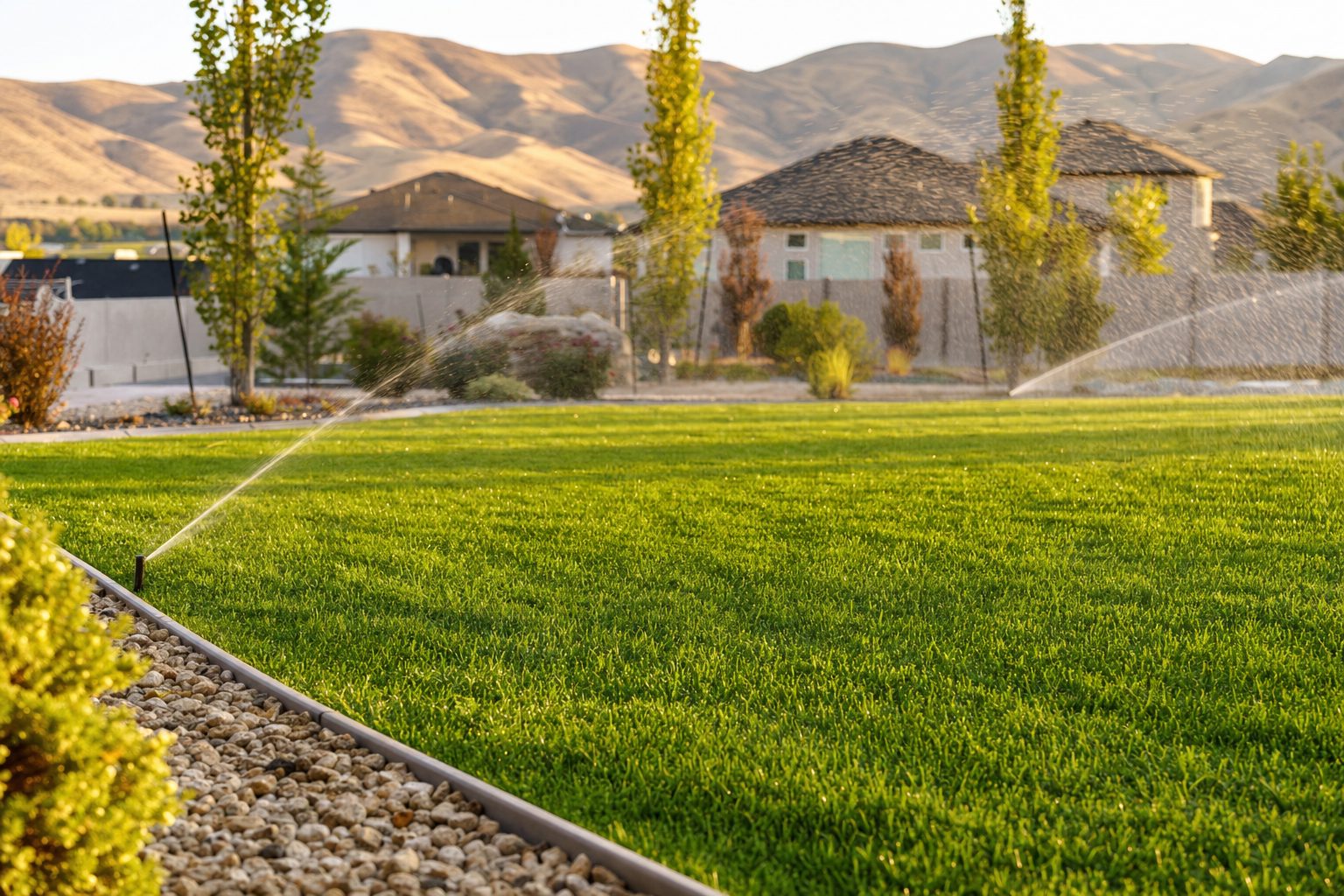
Pressurized Irrigation Districts in the Treasure Valley
If your Treasure Valley yard has a second water meter, a second backflow device, or a second line item on your property tax assessment, you're probably on pressurized irrigation — a separate, non-drinkable water system delivered by an irrigation district, not the city's drinking water utility.
That system is one of the odder and better things about living here. Water diverted from the Boise River is carried through more than a century of canals and laterals, pressurized at a pump station, and delivered to your sprinkler valves for a fraction of what potable water costs. In most of Meridian, Nampa, and newer Boise subdivisions, pressurized irrigation is required by ordinance in new development. In older neighborhoods, whether you have it depends entirely on which side of an invisible district boundary your lot sits on.
The catch: most homeowners have never dealt with an irrigation district before, and the system operates on its own calendar and its own rules. Water arrives in April when the canals fill — not when your lawn needs it — and disappears in October, whether your lawn is ready or not. This guide explains who delivers your water, how the system works, when the season actually runs, and exactly what to do at spring startup and fall shutdown.
The one-sentence version: find your district from your irrigation assessment bill, watch for water in mid-to-late April, flush your filter after startup, and expect shutoff between October 1 and mid-October. Everything below is the detail.
First: is your yard on irrigation water at all?
Pressurized irrigation is a completely separate water system from the drinking water supply (operated in Boise by Veolia Water or Capitol Water Company, and by municipal utilities elsewhere). If your neighborhood has it, your property has two water systems: potable water inside the house, and non-potable irrigation water for the yard.
You're most likely on pressurized irrigation if:
- You pay a separate irrigation assessment — on your property tax bill, a city utility bill, or an annual invoice from a district. That assessment is for the water right that runs with the land, and it exists whether or not you ever turn on a sprinkler.
- You have a second valve or backflow assembly near the street or sidewalk, distinct from the domestic water meter. Many homes have a brass valve or curb stop labeled "IRRG" or painted purple — purple is the standard color code for reclaimed and non-potable water.
- Your sprinkler system was built with the subdivision rather than retrofitted. Pressurized-irrigation homes typically can't also tap drinking water for outdoor spigots — the two systems are legally and physically separate.
If none of that sounds like your property, you may be on drinking water for irrigation (more common in older Boise neighborhoods, parts of Eagle, and rural acreage), or on raw canal water delivered to a ditch — more on that below. Subdivisions built in roughly the last three decades in Nampa, Meridian, and Boise are typically required to include pressurized urban irrigation systems; many cities adopted those ordinances in the early 1990s.
Which district serves your property?
The Treasure Valley is carved into a patchwork of irrigation districts and canal companies, most of them older than the cities they serve. The Boise Project — a federal Bureau of Reclamation project operated since 1926 by the Boise Project Board of Control — supplies storage water from reservoirs like Arrowrock, Anderson Ranch, and Deadwood through five member districts: Big Bend, Boise-Kuna, Nampa & Meridian, New York, and Wilder. Around those sit independent districts and canal companies, municipal systems, and private ditch associations.
| Area | District or provider | System type |
|---|---|---|
| Meridian (most subdivisions) | Nampa & Meridian Irrigation District (NMID) | Pressurized urban system; city and district split responsibilities by subdivision |
| Nampa (most subdivisions) | NMID water via City of Nampa Waterworks Division pump stations | Pressurized urban system; city operates pumps and mains |
| Boise (city-operated subdivisions) | City of Boise Public Works | Pressurized system in 14 named subdivisions (Azure, Bradford, Graystone, Steamboat, Linshire, and others) |
| West Boise & Garden City | Settlers Irrigation District and other canal companies | Pressurized and canal-delivered, varies by subdivision |
| East Boise & Barber Valley | New York Irrigation District (New York Canal) | Pressurized subdivisions plus canal deliveries |
| Kuna & Star | Boise-Kuna Irrigation District, NMID, New York Irrigation District | Pressurized city systems and rural canal deliveries |
| Caldwell | Caldwell Municipal Irrigation District (CMID); Pioneer Irrigation District supplies water | Pressurized pump stations; city bills and maintains |
| Canyon County rural | Pioneer Irrigation District, plus Caldwell Lateral, Canyon Hill, Riverside, Wilder, and Golden Gate districts | Canal, lateral, and pressurized systems |
| Eagle (older and rural properties) | Farmers' Union Ditch Company and others | Raw canal water — you provide the pump and filtration |
Three reliable ways to pin down your exact district:
- Read your irrigation bill. The annual assessment always names the district that bills you, with contact information. This is the fastest method and it works in every city.
- Use a lookup tool. NMID has a "which district am I in" lookup at nmid.org, the City of Boise publishes a district map where you can search your address, and the City of Caldwell publishes the subdivision list served by CMID.
- Call the district. Office staff identify your parcel's service quickly. The three you're most likely to need: NMID at (208) 466-7861, the Boise Project Board of Control at (208) 344-1141, and Pioneer Irrigation District at (208) 459-3617.
Subdivisions complicate everything. In pressurized systems, the water supplier (the district) and the system operator (often the city) are usually different organizations. Pioneer, for example, delivers water to pump stations that serve City of Caldwell and City of Nampa subdivisions — but if you have no water or a pressure problem, the city that operates your pump station is the one to call, not Pioneer. Your assessment bill and your city's website will tell you which side of that split you're on.
How the system works, from river to sprinkler
Pressurized irrigation here is gravity and geography, plus a pump at the end:
- Storage. Winter snowpack fills the Boise Project's mountain reservoirs — Arrowrock, Anderson Ranch, and Deadwood among them. A dry snowpack year means a shorter or restricted season (more on that below).
- Diversion. In April, districts divert water from the Boise River into main canals. The Ridenbaugh Canal, which carries NMID water through Meridian and Nampa, has been running since the district's founding — 2026 marks its 122nd consecutive year of deliveries. The New York Canal, built in the early 1900s, carries Boise River water across the south side of the valley.
- Lateral delivery. Main canals feed smaller laterals that run along subdivision edges and property lines. Those strips of land beside the canal are rights-of-way: the district uses them to operate and maintain the channel, and keeping them clear of fences, sheds, and landscaping is part of your responsibility if one borders your lot.
- Pressurization. A pump station pressurizes the distribution main that serves your subdivision. This is why pressure varies — the pump station was sized for the neighborhood's expected demand, and the system can typically support only a handful of houses watering at full flow simultaneously. That's why cities publish watering schedules instead of letting everyone run at once.
- Your valve. The district or city maintains everything up to the delivery point — main lines and the service valve at your property line. From the valve onward — your backflow preventer, solenoid valves, zones, and sprinkler heads — maintenance is yours.
If you live on an older or rural property, especially in Eagle, Star, or Canyon County, you may instead receive lateral ditch water: raw water delivered by gravity flow through a community ditch, often on a rotation schedule managed by a water users association or a ditch rider. You pressurize it yourself with a pump, and you filter it before it touches any sprinkler head. You also generally need to order water on and off with your ditch rider rather than opening a valve whenever you like. If you've bought a property with a headgate and a concrete ditch along the fence line, introduce yourself to the ditch rider before irrigation season — they'll tell you your rotation, your delivery days, and the local rules.
The water season, start to finish
Irrigation water in the Treasure Valley follows a season set by the districts, not by the weather. The pattern is consistent every year, though exact dates shift with water supply:
| When | What happens | What you should do |
|---|---|---|
| Early April | Districts begin filling and testing canals. NMID has said Ridenbaugh flows could start as early as April 1. Filling and testing the full system takes roughly two weeks. | Close your valve (if you closed it in fall), inspect your backflow assembly, and clean or replace your filter. Don't open anything yet. |
| Mid-to-late April | Water reaches pressurized systems. City pump stations come online — Caldwell Municipal Irrigation District expects to turn pumps on between April 15 and 30. Kuna's city system typically pressurizes the third or fourth week of April. | Once your city or district announces pressure is on: open your valve slowly, check for leaks at the backflow, and run each zone briefly. |
| May–September | Full service. Follow your city's watering schedule to avoid pressure drops during peak evening demand. | Deep, infrequent watering; clean the filter monthly; watch for district notices about restrictions in dry years. |
| October | Districts drain the canals and shut systems down, typically between October 1 and mid-October. Recent examples: Nampa's city system closed October 6 to match NMID; Pioneer and Boise-Kuna closed October 7 the same year. | Drain and winterize before your district's shutoff date — not after. Once the canals drain, outdoor water is gone until April. |
| November–March | Systems empty; freeze protection matters. Assessments for the coming year are billed (Pioneer, for example, bills the first half by December 20 and the second half by June 20). | Leave the system drained. Pay assessments — the water right runs with the land. |
Season dates change every year. The ranges above are the normal pattern, but shutoff timing depends on reservoir storage and snowpack. In dry years districts can shorten the season or curtail deliveries — Canyon County and Eagle properties on canal systems have seen reduced allocations in drought years. Your district's website and your city's irrigation page publish the actual turn-on and shutoff dates each season. Check them in April and again in late September.
Spring startup checklist
Do these in late March or early April, before water arrives:
- Confirm the season start. Check your district's website or call. Filling the canal network takes about two weeks, and pressurized delivery lags the main canals.
- Find and close your isolation valve. If you closed it last fall, leave it closed until your system is pressurized. If it's open and your zone valves held, you may have quietly flooded your lines during fill — check the meter box for standing water.
- Clean or replace your filter. Most pressurized homes have a Y-strainer or cartridge filter at the valve. NMID explicitly asks patrons to clean or replace filters before the season. Canal water carries sediment, and a clogged filter is the most common cause of weak zones in May.
- Inspect the backflow preventer. Look for cracks from winter freezing, confirm test cocks are closed, and make sure the assembly wasn't damaged by snow load or lawnmowers.
- Check the controller. Replace the backup battery, confirm the program matches the season (start with 2–3 days per week in April, not July's schedule), and verify the rain sensor is plugged in.
- Flush before you drink. Never connect a hose or drip line meant for irrigation water to a drinking faucet, and never drink from the irrigation system. It is not treated water.
- After pressurization, ease in. Open the isolation valve slowly. Run each zone for two or three minutes, watching for blown fittings, and only then set your full schedule.
If your first month's pressure seems low, remember the system's limits: a pressurized main sized for a subdivision can only support six to eight houses watering at the same time. If everyone waters at 6 p.m. on a July evening, pressure drops for everyone. Watering during off-peak hours — early morning is best in our climate anyway — keeps pressure up and reduces evaporation.
Fall shutdown checklist
Do these between mid-September and your district's shutoff date:
- Find your district's shutoff date. It varies by district and year — early-to-mid October is typical, and your city will usually announce a matching date for its pump stations. City of Caldwell, for instance, shuts off between October 1 and 15 in a normal year.
- Stop fertilizing and taper watering. Lawns need less water as September cools. Two waterings a week is usually enough by late September.
- Drain the system. Close your isolation valve, then drain at the low points. Gravity-drain what you can before freeze; a professional blowout handles the rest. See our winterization checklist for the full procedure.
- Flush and clean the filter one last time. Sediment left in the filter all winter corrodes the screen and housing.
- Open the backflow test cocks and leave the shutoffs at 45 degrees. A backflow assembly full of trapped water will crack during the first hard freeze — the single most expensive sprinkler failure we see.
- Insulate above-ground components. Foam covers on the backflow, tape or bags on exposed pipe. Don't seal drain outlets — trapped water needs somewhere to go.
- Reprogram the controller for next year. Set it to "off" (not "rain delay," which times out and restarts watering into an empty system), and note your program on tape inside the door.
- Cap or remove end-of-season emitters on drip lines that sit above grade, so spring fill doesn't weep water into your window wells.
One Treasure Valley specific: because shutoff dates are set by water supply, not the calendar, the last week of irrigation water can arrive with little warning. If your September is hot and dry, don't assume water runs through October 15 — confirm the date with your district and schedule your blowout before it.
Looking for the current provider notice? Check the 2026 irrigation shutdown status by district.
Rules worth knowing
Irrigation districts are private operations with statutory authority, and a few of their rules catch new homeowners by surprise:
- Water is non-potable. Never drink it, never fill kiddie pools with it, and keep play sets and pet bowls out of overspray. It's river and reservoir water — untreated and unfiltered.
- Canals are not for recreation. Canals carry cold, fast water with constantly changing levels. They're private property, recreation is illegal, and playing in or along a canal is trespassing under Idaho law. Keep children and pets away from the water's edge, especially during April fill when currents are strongest.
- Never dump in a ditch. Grass clippings, branches, paint, tires, trash — it's all illegal to throw in a canal or ditch under Idaho Code, and it collects at downstream structures where it causes flooding. Yard waste goes in your city's compost cart, not the ditch.
- Keep rights-of-way clear. Fences, sheds, rock walls, and trees planted on the canal easement can block maintenance equipment. Districts have the right to remove obstructions in the right-of-way — put your landscaping inside your property line.
- Assessments follow the land, not the owner. The annual assessment is billed whether or not you use the water, and unpaid assessments become a lien on the property. If you buy a house with irrigation water, you inherit the assessment — and the water right.
Quick reference: who to call
| District | Serves | Contact |
|---|---|---|
| Nampa & Meridian Irrigation District | Meridian, Nampa, parts of Boise, Kuna & Star | (208) 466-7861 · nmid.org |
| City of Nampa Waterworks Division | Nampa pressurized system operations | (208) 468-5860 · cityofnampa.us/irrigation |
| Boise Project Board of Control | Water supply for the five Boise Project districts | (208) 344-1141 · boiseproject.net |
| New York Irrigation District | East Boise, south-valley lands along the New York Canal | (208) 378-1023 · nyid.org |
| City of Boise Public Works | Boise's 14 city-operated subdivisions | cityofboise.org (search "pressure irrigation") |
| Settlers Irrigation District | West Boise and Garden City areas | (208) 344-2471 · settlersirrigation.org |
| Boise-Kuna Irrigation District | Established Kuna-area properties | Look up via Boise Project or kunacity.id.gov |
| Caldwell Municipal Irrigation District | Caldwell pressurized subdivisions | (208) 455-3070, opt. 2 · cityofcaldwell.org |
| Pioneer Irrigation District | Canyon County canals and pressurized supply | (208) 459-3617 · pioneerirrigation.com |
| Farmers' Union Ditch Company | Eagle canal deliveries (raw water) | Ditch rider dispatch via cityofboise.org irrigation contacts |
Phone numbers and service areas change occasionally — if a call doesn't connect, your annual assessment bill names the current district of record for your parcel, and that bill is always the right starting point.