Browse all six Treasure Valley city guides →
Eagle is the Treasure Valley's most affluent city — a community of estate lots, golf-course neighborhoods, riverfront properties, and foothills subdivisions that wraps around the north and west edges of Boise. With a population of roughly 34,600 as of 2025, Eagle has grown from a small farming town into a sought-after address where landscaping budgets are higher, lots are larger, and the natural setting — the Boise River, the foothills, and the agricultural heritage of the valley floor — shapes every design decision.
This guide covers Eagle's unique microclimates, soil variations from river bottom to foothills, the irrigation systems that serve different parts of the city, neighborhood-by-neighborhood design strategies, plant recommendations suited to Eagle's conditions, cost expectations, and local resources for getting projects done right.
Eagle's geography and microclimates
Eagle sits at approximately 2,599 feet elevation, ten miles northwest of downtown Boise, at the junction where the Boise River splits into its north and south channels. The city spans from the flat valley floor along the river corridor to the rolling foothills that rise to the north and west. This geographic diversity creates more distinct microclimates than you will find in Meridian or Nampa, and it is the single most important factor in Eagle landscape design.
Key climate facts for Eagle:
- USDA Plant Hardiness Zone: 7a (0°F to 5°F average minimum), with foothills edges dipping to Zone 6b in colder pockets
- Average last spring frost: April 30 (using Boise Air Terminal data, 10 miles southeast)
- Average first fall frost: October 14
- Growing season: ~166 days on the valley floor; shorter at higher foothills elevations
- Annual precipitation: ~10–12 inches, mostly November through May
- July average high: ~90°F; foothills areas slightly cooler
- January average low: ~25°F; foothills pockets can drop 5–8° colder on clear nights
- Elevation: 2,599 feet at city center; foothills subdivisions reach 2,800–3,200 feet
- Köppen climate classification: Csb (dry-summer Mediterranean)
The three microclimate zones that matter most for Eagle homeowners:
- The valley floor (downtown Eagle, State Street corridor, river-adjacent neighborhoods): Flat, warmer, and more protected from wind. This is where the Boise River creates a riparian corridor with slightly higher humidity and later frost dates. Most of Eagle's older neighborhoods and newer in-town subdivisions sit here. Growing conditions are similar to Boise and Meridian.
- The foothills (north and west Eagle — Dry Creek Ranch, Avimor, High Plains Estates, Saddle View, Shadow Valley): Higher elevation, more wind exposure, colder winter nights, and shorter growing seasons. Foothills lots often have rocky, thinner soils with less organic matter. Deer pressure is significant. Designs here need hardier plants, windbreaks, and deer-resistant strategies. Expect to lose a week or more of growing season compared to the valley floor.
- The river corridor (Two Rivers, Banbury, Island Woods, Mace River Ranch, Lakeland, Riverstone): Properties along the Boise River and its side channels have higher water tables, richer alluvial soils, and more humidity. These sites support a wider plant palette — including moisture-loving species that struggle elsewhere in the valley — but also face flooding risk during high-water years and invasive species pressure from reed canary grass and Russian olive.
Soil types in Eagle
Eagle's soils are more varied than anywhere else in the Treasure Valley because the city spans river bottom, agricultural land, and foothills slopes. The USDA Natural Resources Conservation Service maps the Eagle soil series — well-drained alluvial silt loams on stream terraces at 748–869 meters elevation — as the dominant type on the valley floor. Here is what you will actually encounter:
- River bottom and canal-adjacent (Two Rivers, Island Woods, Mace River Ranch): Deep alluvial silt loam with high organic content from periodic flooding and decades of riparian vegetation. Excellent fertility and water retention. Some pockets have heavier clay near old river channels. Water tables can be high — avoid deep-rooted plants that dislike wet feet, and test drainage before installing retaining walls or patios.
- Downtown and older Eagle (Heritage Park area, Old Town, Eagle Road corridor): Established silt loam with accumulated organic matter from decades of lawns and gardens. Well-drained, good fertility, and the easiest soils to work in Eagle. Mature trees in older neighborhoods create root competition — plan plantings around existing canopy.
- Valley floor subdivisions (Eagle Hills, Eagle Meadows, Brookwood, The Preserve): Sandy to silty loam, often compacted during construction. Newer subdivisions (built 2000–2020) typically have a thin topsoil layer over compacted subsoil. Core aeration and 3–4 inches of compost amendment dramatically improve results.
- Foothills subdivisions (Avimor, Dry Creek Ranch, High Plains, Saddle View): Rocky, gravelly loam with thin topsoil over decomposed granite or sandstone. Drainage is often too fast — water runs through before plants can absorb it. Amendments with compost and a light clay blend improve water retention. Large rocks are both a challenge (excavation) and an asset (natural landscape boulders).
- Acreage estates (Buckhorn, Buckskin, Canterbury, Triple Ridge): Variable soils depending on location. North Eagle acreage often has sandy loam with good drainage. Foothills acreage has rocky soils. Always test before planting on acreage — conditions can vary across a single 5-acre lot.
All Eagle soils trend alkaline (pH 7.5–8.5), consistent with the Snake River Plain. Acid-loving plants (blueberries, rhododendrons, azaleas) require raised beds with acidified soil. The good news: most native and adapted plants thrive in these conditions, and the alkaline soils suppress certain diseases that plague gardens in wetter, more acidic regions.
Irrigation in Eagle: three different systems
Eagle's irrigation landscape is more complex than Meridian's uniform pressurized system or Boise's mix of canal and potable. Depending on where you live in Eagle, you may have pressurized irrigation, canal-delivered irrigation water, or potable-only supply. Knowing which system serves your property is essential before planning any landscape that depends on summer watering.
Eagle's three irrigation systems:
- Pressurized irrigation (newer subdivisions): Per Eagle city code, all residential subdivisions and common areas must be provided with pressurized irrigation systems served by irrigation water rights. If you live in a subdivision built since the late 1990s, you likely have pressurized irrigation — a separate, low-cost water supply for landscape watering that operates from approximately April through October.
- Canal-delivered irrigation (older properties, acreage): The Farmers' Union Ditch Company delivers raw irrigation water via canals and laterals to properties with water rights, particularly in older and rural areas of Eagle. Water typically starts at full capacity in spring and tapers through the season. You will need a pump and filtration to use canal water for sprinklers.
- Potable water only (some foothills and newer developments): Some foothills communities and developments without irrigation water rights use potable (city) water for all landscape irrigation. This is the most expensive option — plan for drought-tolerant plants, drip irrigation, and xeriscape strategies to minimize water bills.
For the valley-wide picture — which district serves which area, how pressurized systems work, and season dates — see our pressurized irrigation districts guide.
If you are unsure which system serves your property, check your title report for irrigation water rights, contact the City of Eagle Public Works Department, or look for a separate irrigation meter and valve box (typically near the street, separate from your potable water meter). Properties with pressurized irrigation pay a fraction of what potable-only properties pay for summer watering — a significant factor in landscape budget planning.
Outside the irrigation season (October–April), all watering must use potable water — typically only needed for new plantings and winter-established evergreens during dry spells. Foothills properties should plan for hand-watering new trees and shrubs through their first two winters, as winter desiccation is the leading cause of new plant failure in exposed locations.
Neighborhood landscaping guide
Eagle's real estate market has produced a remarkable range of neighborhood types — from gated luxury enclaves to semi-rural acreage to walkable in-town pockets. Each calls for a different landscape approach:
The foothills estates (Avimor, Dry Creek Ranch, High Plains, Saddle View, Shadow Valley)
The foothills communities north and west of downtown Eagle represent the frontier of Eagle's growth. Avimor, with its extensive trail system and community center, and Dry Creek Ranch, with its equestrian facilities and community farm, are the largest. Higher up, gated communities like High Plains Estates and Saddle View offer 10-acre view lots bordering BLM land.
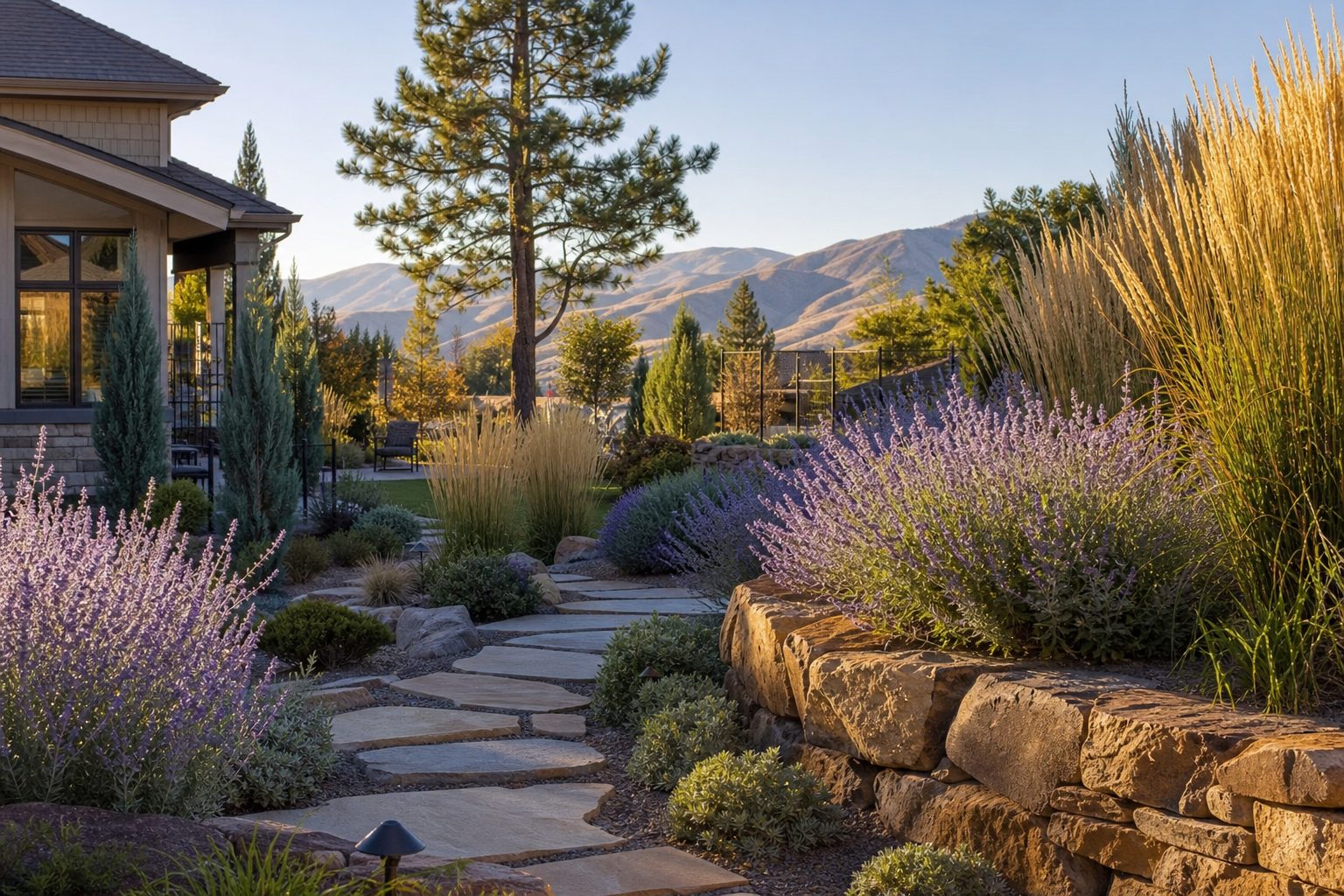
- Design approach: Naturalistic landscapes that embrace the foothills setting rather than fighting it. Native and drought-adapted plants, ornamental grasses for movement, landscape boulders that look like they belong on the hillside, and permeable pathways that blend with the terrain. Outdoor living spaces take advantage of views — patios oriented toward the valley, fire pits for cool foothills evenings.
- Challenges: Rocky soils make planting labor-intensive. Deer are a constant presence — fencing or deer-resistant plant selection is essential. Wind exposure dries out new plantings rapidly. Winter desiccation kills marginally hardy species. Wildfire defensible space is a real consideration at higher elevations.
- Opportunities: Dramatic views, natural rock outcroppings, and a setting that makes even simple landscapes look intentional. The foothills aesthetic — native grasses, sage, juniper, Ponderosa pine — is both beautiful and low-maintenance. Trail access from your backyard is a lifestyle feature few other Treasure Valley locations offer.
- Plant picks: Ponderosa Pine for native character, Serviceberry for multi-season interest and wildlife, Bitterbrush and Rabbitbrush for true-native foothills color, Blue Fescue and Blue Oat Grass for texture, Russian Sage for deer-resistant bloom, Sulphur Flower for low groundcover. Avoid tender species, broadleaf evergreens exposed to wind, and anything deer love (tulips, hostas, roses without protection).
The river-corridor luxury neighborhoods (Two Rivers, Banbury, Island Woods, Mace River Ranch)
Between the north and south channels of the Boise River lies Eagle's most prestigious territory. Two Rivers — 245 acres of estate-sized custom homes with 17 lakes — is the subdivision by which other luxury communities are measured. Banbury wraps around the BanBury Golf Course. Island Woods sits among trees, ponds, and the river itself. Mace River Ranch offers riverfront and waterfront lots with a 40-acre nature preserve.
- Design approach: Estate-scale landscaping that matches the architecture and setting. Layered plantings with mature trees, structured shrub borders, and manicured perennial beds. Water features that complement the natural waterways. Outdoor kitchens, pergolas, and pool areas designed for entertaining. Professional design and installation are the norm — these are not DIY budgets.
- Challenges: High water tables in some areas limit plant choices (avoid plants that need dry roots). Flood risk during high-water years — avoid placing valuable hardscape or specimen plants in low-lying areas. HOA design review is typically rigorous in these communities. Mature tree canopies create shade that limits what grows beneath.
- Opportunities: Rich alluvial soils support an exceptional plant palette. Natural water features provide reflected light, humidity, and wildlife. Mature trees create instant established character. Property values support landscape investments that would be impractical elsewhere — a $50,000–$100,000 landscape budget is common.
- Plant picks: Bigleaf Hydrangea for water-edge color, Japanese Maples for understory elegance, Hostas and Ferns for shaded beds, Columnar Aspen for vertical accents near water, Daylilies for reliable bloom, Ornamental Onion for architectural interest. Riversides can support Willows and Dogwoods for wildlife habitat.
The golf-course communities (Eagle Hills, Banbury Golf Course, Spurwing, Wedgewood)
Eagle's golf communities offer a specific landscape opportunity: homes that back to fairways have open views and no rear neighbors, but also face golf-course maintenance standards, errant golf balls, and HOA requirements for fence styles and landscape visibility.
- Design approach: Front yards that meet HOA standards for polish and curb appeal. Backyards oriented toward the fairway view — lower plantings that preserve sightlines, with taller shrubs and trees at the property edges for privacy from adjacent lots. Patios and outdoor living spaces positioned to take advantage of the open vista.
- Challenges: Golf balls — consider netting or accept the risk. HOA guidelines may limit fence heights, plant types, and landscape changes visible from the course. Turf grass adjacent to the course may face pest and disease pressure from the course's turf management.
- Opportunities: Open views, established trees, and a manicured setting that makes even modest landscapes look polished. Golf-course lots tend to hold value well, making landscape investment a good return.
- Plant picks: Columnar evergreens (Blue Arrow Juniper, Columnar Norway Spruce) for privacy without blocking views. Knock Out roses for continuous, HOA-friendly color. Karl Foerster grass for vertical texture. Autumn Blaze Maple for fast shade. Boxwood for formal hedging.
The in-town neighborhoods (downtown Eagle, Heritage Park area, Old Town)
Within walking distance of Eagle's downtown — the restaurants, shops, Heritage Park, and the Eagle Public Library — are a mix of older homes, new townhome communities, and patio-home developments like Winding Creek, Eastfield, and Paddy Row. These neighborhoods offer walkable convenience and a more modest lot size.
- Design approach: Compact, intentional landscapes that maximize small lots. Front yards that contribute to street appeal and neighborhood character. Backyards designed as outdoor rooms — patios, raised beds, container gardens, and vertical plantings on fences and trellises. Low-maintenance choices suit lock-and-leave lifestyles.
- Challenges: Small lots leave little room for large trees or expansive lawns. Parking and access constraints during landscape construction. Some older homes have outdated irrigation and drainage. Proximity to downtown means landscape choices are visible — neighbors notice.
- Opportunities: Walkable to parks, dining, and the Boise River Greenbelt. Mature street trees in older areas. Established soils with good organic content. Smaller lots mean lower landscape budgets can still transform the space. Strong neighborhood identity rewards thoughtful design.
- Plant picks: Dwarf conifers for year-round structure in small spaces. Hydrangeas for shade tolerance and long bloom. Lavender and Catmint for drought-tolerant color. Creeping Thyme for park-strip lawn alternatives. Columnar trees (Columnar Aspen, Sky Rocket Juniper) for vertical accent without spreading.
The acreage estates (Buckhorn, Buckskin, Canterbury, Triple Ridge, Lockwood)
North Eagle's acreage communities offer 1–10 acre lots where horses, shops, RV parking, and large-scale landscape projects are possible. These are Eagle's most rural neighborhoods — places where a property can include a pasture, an orchard, a large vegetable garden, and a polished landscape around the home.
- Design approach: Zone-based planning that separates the polished landscape around the home from the functional areas (pastures, shops, gardens, paddocks). Windbreaks and shelterbelts using evergreen rows. Large specimen trees for scale. Driveway and entry landscaping that sets the tone. Irrigation design that waters the landscape efficiently while leaving pasture on natural rainfall or flood irrigation.
- Challenges: Large properties require proportionally larger budgets for irrigation, hardscape, and maintenance. Wind exposure on open acreage is severe. Weed pressure from adjacent open land is constant. Deer and wildlife browse freely. Water availability varies — some acreage has irrigation water rights, some does not.
- Opportunities: Room for everything — orchards, vegetable gardens, horse facilities, large workshops, and expansive lawns. The space allows for mature canopy trees that would overwhelm a standard subdivision lot. Privacy is inherent. Rural character is a feature, not a bug.
- Plant picks: Ponderosa Pine and Austrian Pine for windbreaks. Crabapple and Serviceberry for spring bloom. Aspen groves for naturalistic screening. Lavender hedges for long borders. Native wildflower seed mixes for large open areas. Orchard varieties: Honeycrisp apple, Bartlett pear, Lapins cherry — all reliable in Eagle's Zone 7a.
Recommended plants for Eagle yards
Eagle's Zone 7a climate, alkaline soils, and range of microclimates support a broad plant palette — broader than anywhere else in the Treasure Valley. The river corridor supports moisture-loving species; the foothills demand hardy natives; the valley floor suits the standard Treasure Valley plant list. Here are reliable performers across Eagle's conditions:
| Plant | Latin name | Type | Sun | Water | Notes |
|---|---|---|---|---|---|
| Ponderosa Pine | Pinus ponderosa | Tree | Full sun | Low | Idaho native; foothills character; drought-hardy once established; large — needs room |
| Autumn Blaze Maple | Acer × freemanii | Tree | Full sun | Moderate | Fast-growing shade; reliable fall color; popular in valley-floor subdivisions |
| Columnar Aspen | Populus tremuloides 'Erecta' | Tree | Full sun to part shade | Moderate | Vertical accent for small lots and water-edge settings; brilliant gold fall color |
| Serviceberry | Amelanchier alnifolia | Tree/shrub | Full sun to part shade | Low–moderate | Idaho native; white spring flowers; edible berries; deer-resistant; four-season interest |
| Crabapple | Malus spp. | Tree | Full sun | Moderate | Spectacular spring bloom; many cultivars; reliable in Eagle; wildlife value |
| Blue Arrow Juniper | Juniperus scopulorum 'Blue Arrow' | Shrub | Full sun | Very low | Columnar form; silvery-blue; drought-tolerant; privacy screen for tight spaces |
| Russian Sage | Perovskia atriplicifolia | Shrub | Full sun | Low | Silver foliage, lavender blooms July–September; deer-resistant; Eagle staple |
| Bigleaf Hydrangea | Hydrangea macrophylla | Shrub | Part shade | Moderate–high | Best in river-corridor and shaded settings; needs consistent moisture; long summer bloom |
| Red Twig Dogwood | Cornus sericea | Shrub | Part shade | Moderate–high | Idaho native; red winter stems against snow; loves river-edge conditions; wildlife value |
| Karl Foerster Grass | Calamagrostis × acutiflora | Grass | Full sun to part shade | Low–moderate | Vertical accent; golden plumes all winter; sterile (non-invasive); works everywhere in Eagle |
| Blue Oat Grass | Helictotrichon sempervirens | Grass | Full sun | Low | Steel-blue mounds; excellent in foothills xeriscapes; drought-tolerant |
| Lavender | Lavandula angustifolia | Perennial | Full sun | Low | Loves alkaline soil and dry heat; needs excellent drainage; deer-resistant; fragrant |
| Coneflower | Echinacea purpurea | Perennial | Full sun | Low–moderate | Heat-tolerant; pollinator magnet; long summer bloom; sturdy in Eagle's climate |
| Blanket Flower | Gaillardia aristata | Perennial | Full sun | Low | Idaho native; red-orange daisy blooms May–September; deer-resistant |
| Penstemon | Penstemon spp. | Perennial | Full sun | Low | Native; many varieties; hummingbird magnet; thrives in foothills rocky soils |
| Creeping Thyme | Thymus serpyllum | Groundcover | Full sun | Low | Lawn alternative for park strips; tolerates foot traffic; pink summer bloom |
For a full plant list with bloom times and detailed growing notes, see our Native Plants for Treasure Valley Yards guide. For lawn replacement ideas suited to Eagle's water-conscious subdivisions, see our Lawn Alternatives for the Treasure Valley article.
Eagle landscaping costs
Eagle landscape project costs run higher than Meridian or Nampa, reflecting larger lot sizes, higher-end material expectations, and the prevalence of professional design and installation. The range is wide — a simple front-yard refresh in an in-town neighborhood costs a fraction of an estate-scale installation in Two Rivers. Here are realistic ranges for Eagle:
- Front yard landscape design + installation (standard subdivision lot): $8,000–$20,000, including design, soil amendment, plants, sod or xeriscape, and basic hardscape.
- Estate-scale landscape design + installation (acreage or luxury lot): $30,000–$150,000+, including extensive hardscape, mature trees, irrigation systems, lighting, and outdoor living features.
- Paver patio (400 sq ft, standard): $5,000–$10,000 installed, including base preparation and edge restraints.
- Natural stone patio (flagstone, 400 sq ft): $8,000–$16,000 — Eagle homeowners often prefer natural stone over concrete pavers.
- Retaining wall (50 linear feet, 4 feet tall, segmental block): $6,000–$12,000. Foothills properties with slope changes need more wall work.
- Dry-stack stone wall (natural stone, 30 linear feet, 3 feet tall): $5,000–$10,000 — a hallmark of Eagle estate landscapes.
- Fire pit (gas, stone surround, built-in): $4,000–$8,000 installed.
- Outdoor kitchen (built-in grill, countertop, base): $8,000–$25,000 depending on scope and materials.
- Landscape lighting (full property, LED, transformer, 15–25 fixtures): $3,000–$8,000 installed.
- Sprinkler system (quarter-acre lot, standard): $3,000–$6,000. Foothills properties with rocky soils cost more.
- Sod installation: $1.50–$2.50 per square foot (sod + prep + installation).
For detailed pricing across all project types, see our Treasure Valley Landscaping Cost Guide.
Local resources for Eagle landscaping
- Old Valley Nursery — A family-owned perennial plant nursery in Eagle at 10550 W Hill Road (the same location as Madeline George). Specializes in perennials suited to Treasure Valley conditions. oldvalleynurseryidaho.com · (208) 939-1526
- Madeline George Garden Design Nursery — A boutique garden shop and nursery at 10550 W Hill Road, Eagle. Curated collection of outdoor plants, garden design services, and landscape consultation. madelinegeorge.com
- Franz Witte Garden Center — Full-service nursery and landscape company on State Street north of Eagle. Wide selection of trees, shrubs, grasses, and edibles, many grown on-site. A short drive from anywhere in Eagle. franzwitte.com
- FarWest Landscape — 7-acre garden center on State Street in Northwest Boise, 15 minutes from Eagle. The region's largest local plant and landscape supply source. farwestlandscape.net · (208) 853-4057
- City of Eagle Parks & Recreation — Maintains Eagle's parks, trails, and pathways. Reid W. Merrill Sr. Community Park and Stephen C. Guerber Park are good places to see mature landscape plantings that thrive in Eagle conditions. cityofeagle.org
- Eagle Island State Park — 545-acre state park bordered by the Boise River, with swimming, trails, disc golf, and equestrian trails. A living reference for riparian and native plant communities. parksandrecreation.idaho.gov
- Ada Soil & Water Conservation District — Free soil testing guidance and conservation resources for Ada County residents, including Eagle. adaswcd.org
- University of Idaho Extension — Ada County — Research-based gardening and landscaping information specific to Idaho conditions. Master Gardener program, plant clinics, and publications. uidaho.edu/extension/landscapes
- Idaho Botanical Garden — 50+ acres of display gardens in Boise, 20 minutes from Eagle. The best local reference for seeing mature plants in designed settings. Classes, plant sales, and educational programs. idahobotanicalgarden.org
When to plant in Eagle
March–April
Plant bare-root trees and shrubs while dormant. Direct sow cool-season crops. Start tomato and pepper seeds indoors. Prune fruit trees and dormant deciduous shrubs before bud break. In foothills locations, wait until late April — soil thaws later at higher elevations. Pressurized irrigation typically starts mid-April.
May
Safe to plant most perennials, trees, and shrubs after May 15. In foothills areas, wait until Memorial Day — late frost is a real risk above 2,800 feet. Harden off seedlings before transplanting. Set irrigation timers for early morning watering. Apply pre-emergent to beds to reduce summer weeding.
June–July
Heat-loving plants go in the ground. Install or adjust drip irrigation. Mulch beds deeply (2–3 inches) to conserve moisture — critical in foothills properties with fast-draining rocky soils. Avoid planting new trees during the hottest weeks. Deer browsing peaks — use cages on new plantings and apply repellent.
August–September
The best time to plant trees and shrubs in Eagle. Soil is warm, air temperatures moderate, and fall rains begin. Plants establish root systems before winter dormancy. River-corridor properties with higher water tables have an easier fall planting window. Seed new lawns in early September while irrigation water is still available.
October
Last call for tree and shrub planting. Plant spring-blooming bulbs (tulips, daffodils, alliums) — but protect tulips from deer with netting or plant daffodils, which deer avoid. Irrigation shuts down — winterize sprinkler systems before first hard freeze. Apply winter mulch to tender perennials. Foothills properties: winterize earlier.
November–February
Dormant pruning season for deciduous trees. Protect young trees from sunscorch with trunk wrap — essential in foothills and acreage properties with full sun exposure. Plan next year's projects. Avoid walking on frozen lawns. Hand-water new evergreens during dry winter spells — winter desiccation is the #1 killer of new foothills plantings.
Eagle's landscape identity
What sets Eagle apart from the rest of the Treasure Valley is not just lot size or home value — it is the relationship between the built landscape and the natural setting. The Boise River corridor, the foothills, and the agricultural heritage of the valley floor all converge here. The most successful Eagle landscapes do not try to recreate a generic suburban yard; they respond to where they sit.
A foothills home in Avimor that uses native grasses, landscape boulders, and Ponderosa pine looks like it grew there. A river-corridor estate in Two Rivers that uses hydrangeas, dogwoods, and aspen along the water's edge feels like an extension of the riparian landscape. An in-town home near Heritage Park with a crisp patio, raised beds, and street trees contributes to the walkable character of Old Town Eagle. The common thread is intention — choosing plants and materials that belong to the place.
If you are planning a landscape project in Eagle, start by understanding your microclimate, your soil, and your irrigation water. Then choose a design that fits your neighborhood's character and your property's natural setting. The result will be a landscape that looks better in five years than it did the day it was installed — and one that adds lasting value to your home.