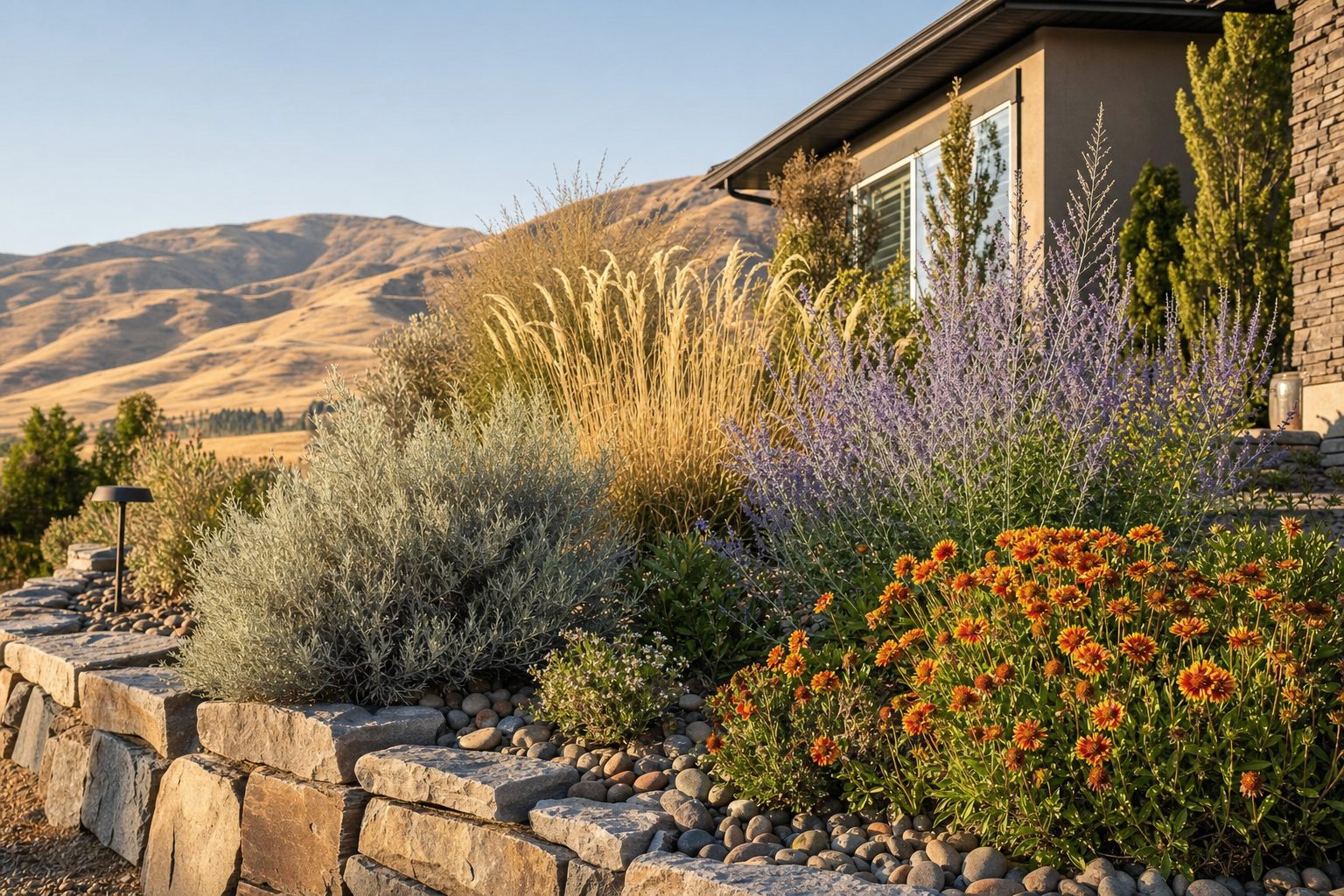
The Treasure Valley gets about 11 inches of precipitation a year — less than Phoenix. Yet many homeowners water their landscapes as if they live in Seattle. Switching to drought-tolerant plants doesn't mean a yard of rocks and cactus. It means choosing species that look lush and colorful while surviving on a fraction of the water.
Boise's semi-arid high-desert climate (USDA Zone 6b–7a) is perfect for a wide range of water-wise plants. Summers regularly hit 95–100°F, winters can dip below zero, and soils are typically alkaline (pH 7.5–8.5) with lean sandy loam or clay. The plants in this guide are proven performers in those conditions — they thrive on deep, infrequent watering once established and many bloom for months with almost no irrigation.
What "drought-tolerant" really means
Drought-tolerant plants survive dry periods through one of three strategies:
- Deep roots — plants like Russian sage (Perovskia atriplicifolia) and butterfly weed (Asclepias tuberosa) send roots several feet down, tapping moisture beyond the topsoil layer.
- Silver or hairy leaves — plants like lamb's ear (Stachys byzantina) and dusty miller (Senecio cineraria) reflect sunlight and trap humidity near the leaf surface.
- Fleshy or waxy leaves — sedums and yuccas store water in their tissues or seal it in with a waxy cuticle.
The critical word is established. Every drought-tolerant plant needs regular watering for its first growing season — typically April through September of year one. By year two, you taper off. By year three, most of these plants can go weeks between watering in summer, and many need zero supplemental water once their roots are deep.
Quick start: 5 easiest drought-tolerant plants for beginners
If you're new to water-wise gardening, start with these foolproof choices:
- Russian Sage (Perovskia atriplicifolia) — purple-blue blooms July–October, 3–4 ft tall, thrives in Boise heat
- Blanket Flower (Gaillardia aristata) — orange-red daisies June–September, Idaho native, 18–24 in
- Blue Fescue (Festuca glauca) — silvery-blue clumps year-round, 10–12 in, no watering once established
- Stonecrop (Sedum 'Autumn Joy') — pink-to-rust blooms August–October, 18–24 in, bulletproof
- Yarrow (Achillea millefolium) — flat-topped blooms June–September, Idaho native, 2–3 ft
Perennials for color and low water
Perennials are the workhorses of a drought-tolerant landscape. They come back year after year, and many bloom for 8–12 weeks with minimal water. Here are the best choices for Treasure Valley gardens:
| Perennial | Sun | Water | Bloom | Mature size | Why it works |
|---|---|---|---|---|---|
| Russian Sage Perovskia atriplicifolia | Full sun | Very low | Jul–Oct | 3–4 ft × 3 ft | Lavender-blue spikes for 4 months. Deer-resistant. Cut back to 6 in in March. |
| Blanket Flower Gaillardia aristata | Full sun | Low | Jun–Sep | 18–24 in × 18 in | Idaho native. Orange-red daisials bloom nonstop. Deadhead for rebloom. |
| Yarrow Achillea millefolium | Full sun | Low | Jun–Sep | 2–3 ft × 2 ft | Flat-topped clusters in yellow, pink, red, white. Idaho native. Pollinator magnet. |
| Stonecrop Sedum 'Autumn Joy' | Full sun | Very low | Aug–Oct | 18–24 in × 18 in | Succulent leaves, pink-to-rust flowers. Late-season star when little else blooms. |
| Butterfly Weed Asclepias tuberosa | Full sun | Low | Jun–Aug | 2–3 ft × 2 ft | Orange milkweed for monarchs. Deep taproot = drought champion. Slow to emerge in spring. |
| Penstemon Penstemon palmeri | Full sun | Very low | May–Jul | 3–4 ft × 2 ft | Fragrant white-to-pink tubular flowers. Idaho native. Hummingbird favorite. |
| Coreopsis Coreopsis verticillata | Full sun | Low | Jun–Aug | 18–24 in × 18 in | Feathery foliage, golden-yellow daisies. Long bloom, deer-resistant. |
| Agastache Agastache rupestris | Full sun | Low | Jul–Oct | 2–3 ft × 18 in | Orange tubular flowers with licorice-scented leaves. Hummingbird magnet. |
| Coneflower Echinacea purpurea | Full sun | Low–Med | Jul–Sep | 3–4 ft × 2 ft | Pink-purple daisies with central cones. Tolerates clay. Bird seed heads in winter. |
| Beardtongue Penstemon strictus | Full sun | Very low | Jun–Jul | 18–24 in × 12 in | Electric-blue spikes. Rocky Mountain native. Thrives in lean, alkaline soil. |
Shrubs that thrive on neglect
Drought-tolerant shrubs provide structure, screening, and year-round interest with almost no maintenance. These are the backbone of a water-wise Treasure Valley landscape:
| Shrub | Sun | Water | Mature size | Why it works |
|---|---|---|---|---|
| Sagebrush Artemisia tridentata | Full sun | Very low | 3–8 ft × 4 ft | Idaho's signature plant. Silvery foliage, deep roots, zero water once established. Iconic sagebrush scent. |
| Rabbitbrush Ericameria nauseosa | Full sun | Very low | 3–5 ft × 4 ft | Golden-yellow fall blooms light up the landscape. Idaho native. Late-season pollinator food. |
| Winterfat Krascheninnikovia lanata | Full sun | Very low | 2–4 ft × 3 ft | Silvery foliage with fuzzy seed heads. Underrated native shrub. Extremely cold-hardy. |
| Apache Plume Fallugia paradoxa | Full sun | Low | 4–6 ft × 4 ft | White rose-like flowers, pink feathery seed heads. Two seasons of interest, drought-tough. |
| Mahonia Mahonia aquifolium | Part shade | Low | 3–6 ft × 4 ft | Idaho state flower. Evergreen holly-like leaves, yellow spring flowers, blue berries. Shade-tolerant. |
| Bitterbrush Purshia tridentata | Full sun | Very low | 3–6 ft × 4 ft | Idaho native, pale yellow spring flowers. Critical winter browse for wildlife. |
| Blue Mist Spirea Caryopteris × clandonensis | Full sun | Low | 2–3 ft × 3 ft | Blue-purple late-summer blooms when little else flowers. Butterfly magnet. Cut back hard in spring. |
| Dwarf Burning Bush Euonymus alatus 'Compactus' | Full sun | Low–Med | 6–8 ft × 5 ft | Crimson-red fall color. Tolerates drought once established. Use for hedges or accents. |
Ornamental grasses for year-round texture
Ornamental grasses are among the most drought-tolerant plants you can grow. Their deep root systems access moisture far below the surface, and their texture adds movement and winter interest when everything else has gone dormant.
| Grass | Sun | Water | Mature size | Why it works |
|---|---|---|---|---|
| Blue Fescue Festuca glauca 'Elijah Blue' | Full sun | Very low | 10–12 in × 12 in | Tight silvery-blue clumps. No watering once established. Divide every 3–4 years. |
| Blue Oat Grass Helictotrichon sempervirens | Full sun | Low | 2–3 ft × 2 ft | Spikey blue-gray arching clumps. More drought-tolerant than fescue. Great with Russian sage. |
| Little Bluestem Schizachyrium scoparium | Full sun | Low | 2–4 ft × 18 in | Idaho native. Blue-green summer foliage turns copper-red in fall. Stunning winter silhouette. |
| Bluebunch Wheatgrass Pseudoroegneria spicata | Full sun | Very low | 2–3 ft × 12 in | Idaho state grass. Found on dry hillsides throughout the valley. Soft seed heads catch light. |
| Indian Ricegrass Achnatherum hymenoides | Full sun | Very low | 1–2 ft × 12 in | Idaho native bunchgrass. Delicate golden seed heads dance in the wind. Important for dry slopes. |
| Maiden Grass Miscanthus sinensis 'Gracillimus' | Full sun | Low–Med | 5–7 ft × 4 ft | Tall, arching silver-green foliage with feathery plumes in fall. Needs occasional water in hottest weeks. |
Groundcovers that replace thirsty lawns
If you're reducing lawn area, drought-tolerant groundcovers fill the space with color and texture at a fraction of the water cost. They won't tolerate foot traffic like turf, but they're perfect for front yards, slopes, and areas where grass struggles.
| Groundcover | Sun | Water | Height | Why it works |
|---|---|---|---|---|
| Creeping Thyme Thymus serpyllum | Full sun | Very low | 2–3 in | Pink-purple flowers in June, fragrant foliage. Withstands light foot traffic. Great between pavers. |
| Sedum Sedum spurium | Full sun | Very low | 4–6 in | Mat-forming succulent. Pink flowers in summer. Spreads quickly, survives on rainfall alone. |
| Woolly Thyme Thymus pseudolanuginosus | Full sun | Very low | 1–2 in | Soft silver-gray carpet. Non-flowering, stepable. Perfect for between flagstone. |
| Ice Plant Delosperma cooperi | Full sun | Low | 3–6 in | Magenta daisy-like flowers June–September. Spreads fast. May need winter protection in coldest spots. |
| Kinnikinnick Arctostaphylos uva-ursi | Part shade | Low | 4–6 in | Evergreen glossy leaves, red berries. Idaho native. Best in part shade with some afternoon relief. |
| Soapwort Saponaria ocymoides | Full sun | Low | 6–9 in | Pink flowers cascade over edges in May–July. Self-seeds politely. Great for rock walls. |
Designing with drought-tolerant plants
A drought-tolerant landscape doesn't have to look like a desert. Here are design principles for creating a lush, colorful yard on minimal water:
Hydrozoning — the key principle
Group plants by water needs. Put the thirstiest plants near the house where you'll see them most, and the driest plants at the property edges and on slopes. This way, you can water the high-need zone regularly and leave the dry zone alone. Most irrigation waste comes from watering the whole yard to satisfy the thirstiest plant in it.
Layer for structure and color
Start with structural shrubs (sagebrush, mahonia, rabbitbrush) placed 4–6 feet apart. Fill between them with ornamental grasses (blue fescue at the front, little bluestem mid-border). Add perennial color in drifts of 3–5 plants (blanket flower, yarrow, Russian sage). Groundcovers fill the gaps and suppress weeds. The result looks full and lush but uses 60–80% less water than a traditional landscape.
Use mulch, not rock
Bark mulch (2–3 inches) keeps soil cool and moist. Rock mulch absorbs heat and radiates it at night — fine for true desert plants but tough on perennials that prefer cooler roots. Use rock in small areas for accent, but prefer bark for the main landscape. River rock works well around the driest plants (sedums, yuccas, cacti) where it complements the aesthetic.
Plan for four seasons
Many drought-tolerant plants are late-season stars. Russian sage blooms July–October. Sedum peaks in September. Rabbitbrush explodes with yellow in October. Little bluestem turns copper in November and holds its shape through winter. Combine these with early-blooming penstemons (May–July) and yarrows (June–September) for continuous color from spring through fall.
Water-wise myth: drought-tolerant means no maintenance
Drought-tolerant plants still need care — just different care. In the first year, water weekly (April–September). In year two, water every 2–3 weeks. By year three, most need water only during 90°F+ heat waves. But you still need to: cut back grasses and perennials in March, deadhead spent blooms, divide crowded clumps every 3–5 years, and refresh mulch annually. The payoff: a yard that looks great with 10% of the water and half the mowing.
Where to buy drought-tolerant plants in the Treasure Valley
Local nurseries carry a much better selection of drought-adapted species than big-box stores, and their staff can advise on what works in your specific area:
- Edwards Greenhouse — 4106 N. Garden St., Boise. Excellent selection of native perennials and grasses. Best selection in April–June.
- FarWest Landscape & Nursery — 5728 W. State St., Boise. Large shrub and tree selection, knowledgeable staff on water-wise species.
- Franson Nursery — 15600 N. Linder Rd., Meridian. Good source for native shrubs and ornamental grasses.
- Idaho Botanical Garden Plant Sale — Held each May and September. The best source for true Idaho natives and hard-to-find drought-tolerant species. Check their website for dates.
- Zamzows — Multiple locations across the Treasure Valley. Reliable for common drought-tolerant perennials like Russian sage, yarrow, and sedum. Good prices, helpful staff.
Cost expectations
Converting a 1,000 sq ft front yard from lawn to drought-tolerant landscaping costs roughly:
- DIY with small starts (4-inch pots): $300–$600 for plants + $150–$300 for mulch and soil prep = $450–$900 total. Takes 2–3 years to fill in.
- DIY with 1-gallon pots: $600–$1,200 for plants + $200–$400 for mulch and prep = $800–$1,600 total. Fills in 1–2 years.
- Professional design + install: $3,000–$8,000 for a typical front yard, including design, plant selection, irrigation conversion, mulch, and labor.
The water savings typically pay back the DIY cost in 3–5 years. A Boise homeowner watering 1,000 sq ft of turf spends about $40–$80/month on irrigation water June–September. A drought-tolerant landscape in the same space costs $5–$15/month — a 70–85% reduction.
Getting started this fall
September and October are the best months to plant drought-tolerant perennials and shrubs in the Treasure Valley. Cooler air temperatures reduce transplant shock while warm soil encourages root growth before winter. Plants installed in fall get a head start on root establishment and are much better equipped to handle their first Boise summer.
- Start small — convert one section of your yard (a strip along the sidewalk, a corner that always turns brown). Success builds confidence.
- Kill the lawn first — solarize with clear plastic for 6 weeks (June–July) or sheet mulch with cardboard + 4 inches of mulch. Don't plant into living turf.
- Amend only if needed — most drought-tolerant plants prefer lean soil. Add compost only to the planting hole, not broadcast across the area.
- Plant in clusters — groups of 3, 5, or 7 of the same species look more natural and fill in faster than single specimens scattered around.
- Water deeply once a week through the first summer. Use a drip line or soaker hose — overhead sprinkling wastes water and encourages leaf disease.