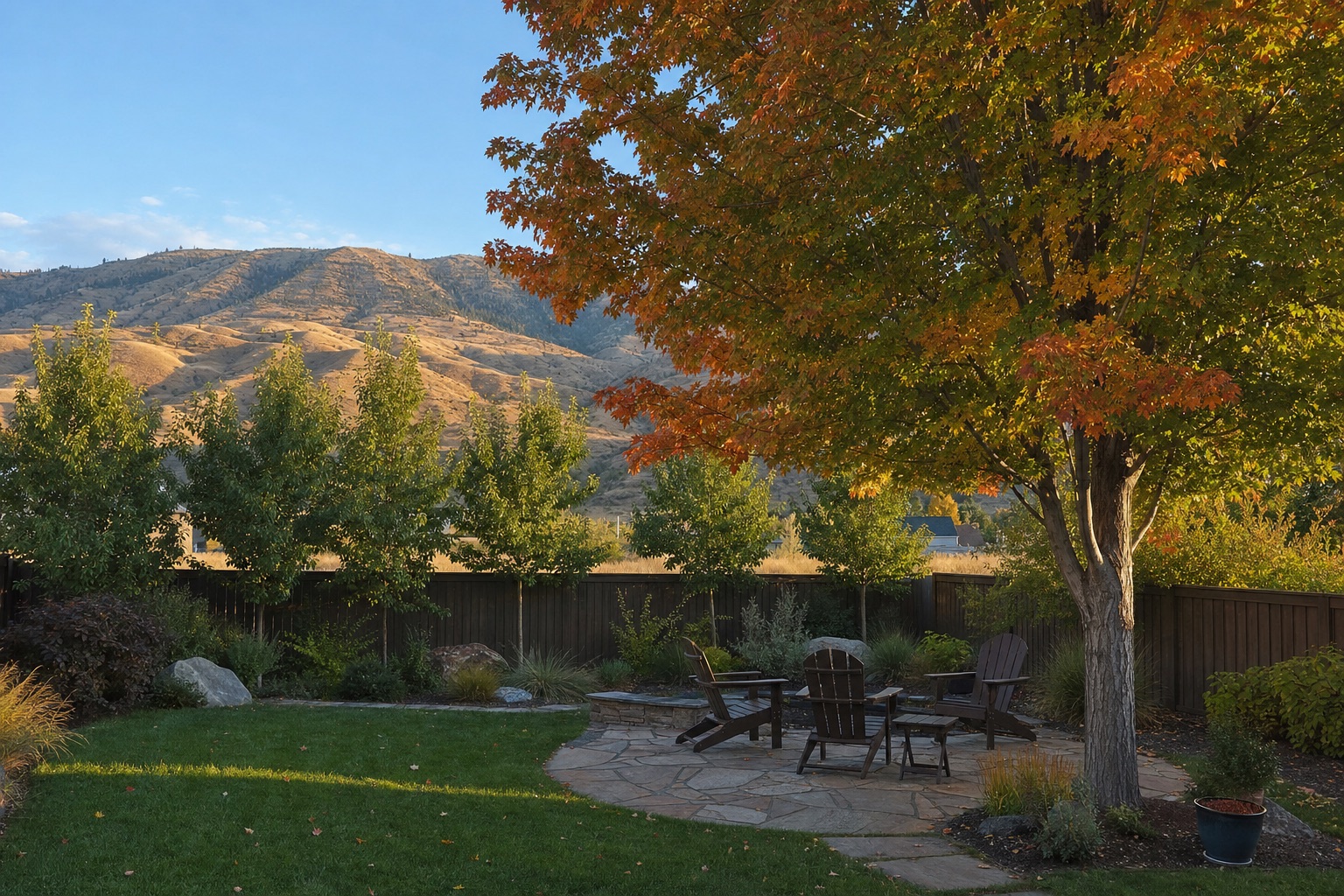
Best Trees for the Treasure Valley
A well-chosen tree is the most valuable plant in your landscape. It shades your house in July, drops cooling leaf litter in October, screens neighbors year-round, and can add 7–15% to your property value. But the wrong tree in the Treasure Valley means cracked sidewalks, broken irrigation lines, or a dead sapling after its first winter. Here's how to choose correctly for Boise, Meridian, Eagle, Nampa, Caldwell, Kuna, and Star.
The Treasure Valley's growing conditions are specific: USDA hardiness zone 6b–7a (winter lows of 0 to −5°F), alkaline soils with pH typically 7.5–8.5, annual rainfall of only 11–13 inches (most of it in winter and spring), summer highs routinely above 95°F, and a freeze-thaw cycle that heaves shallow-rooted plants out of the ground. Trees that thrive here are drought-tolerant once established, alkaline-adapted, and hardy to at least zone 6.
Shade trees for Treasure Valley yards
Shade trees are the backbone of a Treasure Valley landscape. A mature deciduous shade tree on the west side of a house can reduce afternoon indoor temperatures by 6–10 degrees, cutting July air conditioning costs significantly. These are the species that consistently perform in our climate:
| Tree | Mature size | Growth rate | Fall color | 5-gal cost |
|---|---|---|---|---|
| Autumn Blaze Maple (Acer × freemanii 'Jeffersred') | 50 ft × 40 ft | Fast (2–3 ft/yr) | Brilliant red | $120–180 |
| Bur Oak (Quercus macrocarpa) | 60 ft × 50 ft | Medium (1–2 ft/yr) | Yellow-brown | $100–150 |
| Western Hackberry (Celtis occidentalis) | 50 ft × 40 ft | Medium-fast | Yellow | $80–120 |
| Green Ash (Fraxinus pennsylvanica) | 50 ft × 35 ft | Fast | Yellow | $90–140 |
| Honeylocust, thornless (Gleditsia triacanthos var. inermis) | 45 ft × 35 ft | Fast | Yellow | $100–160 |
| Linden, American (Tilia americana) | 60 ft × 40 ft | Medium | Pale yellow | $110–170 |
Autumn Blaze Maple — the reliable workhorse
If you see a brilliant red tree in a Treasure Valley yard in October, it's probably an Autumn Blaze Maple. This hybrid of silver maple and red maple combines the fast growth and adaptability of silver maple with the fall color and cold-hardiness of red maple. It tolerates our alkaline soils better than pure red maples (which often develop iron chlorosis — yellow leaves with green veins — in high-pH soils), and it grows 2–3 feet per year once established.
Where to plant: At least 15 feet from the house foundation and 10 feet from any sidewalk or driveway (roots are aggressive). Needs full sun. Water deeply once a week for the first two growing seasons; after that, it's remarkably drought-tolerant.
Drawbacks: Weak branch angles can split in heavy snow or ice storms. Prune when young to develop a strong central leader. Surface roots may lift sidewalks if planted too close.
Bur Oak — the legacy tree
If you have room for a large tree and want something that will outlive your house, plant a Bur Oak. This native of the Midwest prairie thrives in Treasure Valley conditions: alkaline soil, drought, extreme temperature swings, and wind. It develops a massive trunk and deep taproot, making it virtually indestructible once established. The acorns feed wildlife, and the rough, corky bark adds winter interest.
Where to plant: Needs at least a 30-foot clearance from structures, sidewalks, and other trees. Slow to establish (may only grow 6–12 inches per year for the first 2–3 years), but then accelerates. Worth the wait — a Bur Oak planted today will be a landmark in 50 years.
Honeylocust — the dappled-shade specialist
The thornless Honeylocust is a go-to tree for Treasure Valley yards where you want shade but not deep, dark shade. Its fine, feathery leaves cast a light dappled shadow that lets turf grass and perennials grow beneath it. The tiny leaflets break down quickly in fall (no raking required), and the open canopy doesn't block winter sun when you need it for passive solar heating.
Caution: Honeylocust is susceptible to the honeylocust plant bug, which causes deformed leaves in spring. Damage is cosmetic, not fatal. Choose named cultivars like 'Shademaster' or 'Skyline' for better form and disease resistance.
Iron chlorosis alert: Many maples (especially red and silver maples), pin oaks, and birch trees develop iron chlorosis in the Treasure Valley's high-pH soils. Leaves turn yellow with green veins, growth stunts, and the tree can die within 3–5 years. If you want a maple, choose Autumn Blaze (a hybrid with better alkaline tolerance) or Amur Maple (Acer ginnala, a smaller tree that handles alkaline soil well). Avoid pin oak entirely. If your tree shows chlorosis, treat with iron chelate (EDDHA form) applied to soil in early spring.
Ornamental trees for smaller spaces
Not every yard has room for a 50-foot shade tree. Ornamental trees — those that mature at 15–30 feet — provide spring flowers, summer shade for patios, and fall color without overwhelming a smaller property. These are the best choices for Treasure Valley conditions:
| Tree | Mature size | Best feature | 5-gal cost |
|---|---|---|---|
| Serviceberry (Amelanchier alnifolia) | 15–25 ft | White spring flowers, edible berries, orange fall color | $60–90 |
| Western Redbud (Cercis orbiculata) | 12–20 ft | Magenta spring flowers on bare branches | $80–130 |
| Hawthorn, Washington (Crataegus phaenopyrum) | 25–30 ft | White flowers, red fall berries, persistent into winter | $70–110 |
| Amur Maple (Acer ginnala) | 15–20 ft | Brilliant red fall color, alkaline-tolerant, can be shrub or tree | $50–80 |
| Crabapple (Malus 'Prairifire' or 'Royal Rain') | 20–25 ft | Pink/red spring flowers, persistent fruit, disease-resistant | $70–120 |
| Smoke Tree (Cotinus coggygria) | 10–15 ft | Pinkish "smoke" plumes in summer, purple foliage varieties | $50–80 |
Serviceberry — the native multi-season star
Serviceberry (also called Saskatoon or Juneberry) is an Idaho native that belongs in every Treasure Valley yard where space is tight. White flowers in April, edible blue-purple berries in June (if you can beat the birds to them), clean green summer foliage, and orange-red fall color. It grows as a multi-stemmed small tree or large shrub, handles drought, and is one of the few ornamentals that truly thrives without coddling.
Where to plant: 8–10 feet from the house, in full sun or light shade. Excellent as a specimen near a patio or as a screen along a property line. Multiple stems create a natural privacy screen faster than a single-trunk tree.
Western Redbud — spring spectacle
The Western Redbud (Cercis orbiculata, formerly classified as Cercis occidentalis) is a small California-native tree that performs well in the Treasure Valley. Magenta flowers cover bare branches in April before leaves emerge — a stunning display against a clear spring sky. Heart-shaped leaves follow, turning light yellow in fall.
Care note: Less cold-hardy than Eastern redbud (Cercis canadensis). In Boise's zone 6b–7a it's generally fine, but in colder pockets (Caldwell, Kuna, valley-floor areas that get inversions), it may die back in a hard winter. Plant in a protected spot with southern exposure. Mulch heavily around the base.
Evergreen trees for year-round structure and screening
Evergreens are the bones of a winter landscape. When deciduous trees are bare from November through April, evergreens provide windbreaks, privacy screens, and visual weight. In the Treasure Valley, choose species that handle our dry climate and alkaline soils:
| Tree | Mature size | Best for | 5-gal cost |
|---|---|---|---|
| Austrian Pine (Pinus nigra) | 50 ft × 30 ft | Windbreak, screening, deep green | $80–130 |
| Ponderosa Pine (Pinus ponderosa) | 60 ft × 30 ft | Native, drought-tolerant, long-lived | $80–140 |
| Rocky Mountain Juniper (Juniperus scopulorum) | 20–30 ft × 10–15 ft | Narrow screening, silvery-blue foliage | $60–100 |
| Arizona Cypress (Cupressus arizonica) | 30–40 ft × 15–20 ft | Drought-tolerant, steely blue-gray | $70–110 |
| Bosnian Pine (Pinus heldreichii) | 20–30 ft × 15–20 ft | Compact pine, slow-growing, dense | $90–150 |
| Colorado Blue Spruce (Picea pungens) | 40–60 ft × 20–25 ft | Statement tree, silvery-blue, needs more water | $80–140 |
Ponderosa Pine — Idaho's native giant
Nothing says Idaho like a mature Ponderosa Pine. These natives grow throughout the Boise Foothills and perform equally well in valley-floor yards. They're extraordinarily drought-tolerant once established (deep taproot), live for centuries, and develop distinctive orange-brown puzzle-piece bark as they mature. The long needles (5–10 inches) give them a soft, flowing look that contrasts beautifully with the rigid form of spruce or fir.
Caution: Ponderosa Pine is susceptible to mountain pine beetle, though outbreaks in urban Treasure Valley areas are rare. Keep trees healthy with deep monthly watering during drought years — stressed trees are beetle magnets.
Austrian Pine — the tough screen
If you need a fast-growing evergreen screen along a property line, Austrian Pine is hard to beat. Dense, dark green needles, rapid growth (1–2 feet per year), and tolerance for wind, drought, pollution, and alkaline soil make it a reliable workhorse. It's widely planted in Treasure Valley developments for exactly this purpose.
Drawback: Susceptible to Diplodia tip blight, which kills new growth tips. Prune out infected branches and avoid overhead watering. If you have a choice, Bosnian Pine (Pinus heldreichii) is a close relative with better disease resistance and a more compact form.
Where to buy trees locally: Edwards Greenhouse (4106 Sand Creek St, Boise), FarWest Landscape (5728 W State St, Boise), Franz Witte Garden Center (2445 S Ten Mile Rd, Meridian), and Webb Landscape (Boise and Ketchum) all carry a strong tree selection suited to Treasure Valley conditions. For larger specimen trees (15-gallon and balled-and-burlapped), contact Ada Tree Farm (4615 S Cloverdale Rd, Boise) or Western Tree Company (Nampa). Expect to pay $60–$180 for a 5-gallon tree, $150–$400 for a 15-gallon, and $300–$800 for balled-and-burlapped.
How to plant a tree in Treasure Valley soil
Even the right tree will fail if planted poorly. Treasure Valley soils are typically alkaline (pH 7.5–8.5), low in organic matter, and range from sandy loam in some areas to heavy clay in others (especially in Nampa and Caldwell). Here's the correct planting method:
Step 1: Test your soil
Before planting, get a soil test. The University of Idaho Extension offers soil testing for $35–$50 (samples submitted through the Ada County Extension office, 5880 Glenwood St, Boise). You'll get pH, nutrient levels, and specific amendment recommendations. Most Treasure Valley soils need compost but not lime (the pH is already high). Iron deficiency (chlorosis) is common — a soil test will confirm whether you need iron amendments.
Step 2: Dig the right hole
Dig the hole 2–3 times as wide as the root ball, but no deeper. The root flare (where the trunk widens at the base) should sit at or slightly above ground level — never below. Planting too deep kills more trees in the Treasure Valley than any disease. Roughen the sides of the hole with a shovel blade; smooth, glazed walls (especially in clay soil) act like a pot, trapping roots in a circle.
Step 3: Amend the backfill — lightly
Mix the native soil with about 25% compost. Don't create a "pot" of pure compost in the hole — roots will circle it and never venture into native soil. The goal is a gradual transition. If your soil is heavy clay (common in Nampa, Caldwell, and parts of west Boise), add a handful of gypsum to the backfill to help break up clay particles over time.
Step 4: Water deeply and mulch
Water the tree immediately after planting with a slow trickle for 15–20 minutes to settle the soil and eliminate air pockets. Apply 3–4 inches of bark mulch in a 3-foot circle around the tree, keeping mulch 2–3 inches away from the trunk (no "mulch volcanoes" — they rot the bark). For the first growing season, water deeply once a week (twice a week in July–August). A slow hose trickle at the dripline for 20–30 minutes is better than brief daily sprinkling.
Step 5: Stake only if necessary
Most trees don't need staking. The natural sway of an unstaked tree builds a stronger trunk. Stake only if the tree is top-heavy, in a windy exposure, or if the root ball is unstable. Use two stakes on opposite sides, with flexible ties that allow some movement. Remove stakes after one growing season — leaving them on too long creates a weak tree.
When to plant trees in the Treasure Valley
The best time to plant a tree in the Treasure Valley is early fall — mid-September through October. Here's why:
- Cooler air temperatures reduce water stress on the crown (leaves and branches). Transpiration drops, so the tree loses less moisture.
- Warm soil (still 55–65°F in October) allows roots to keep growing and establishing for 4–6 weeks before the ground freezes. Fall-planted trees develop significantly more root mass than spring-planted ones.
- Spring planting (March–April) is the second-best option. Soil is still cold and roots are slow to start, but the tree has the full growing season ahead. Spring-planted trees need careful watering through their first summer — the riskiest period for new trees.
- Avoid summer planting. Planting in June, July, or August puts enormous stress on a tree. If you must plant in summer, choose an overcast day, water deeply, and shade the tree with burlap or shade cloth for the first week.
Mark your calendar: Boise's median first fall frost is around October 6. The ground typically freezes solid (to a depth of 12–18 inches) by mid-December. You need at least 4–6 weeks between planting and hard freeze for roots to establish — so the ideal fall planting window in the Treasure Valley is September 15 – October 31.
Trees to avoid in the Treasure Valley
Some trees are sold at local nurseries but consistently disappoint in Treasure Valley conditions:
- Pin Oak (Quercus palustris) — develops severe iron chlorosis in alkaline soils. Leaves turn yellow, growth stunts, tree dies within 5–10 years. Plant Bur Oak or Chinkapin Oak instead.
- Bradford/Callery Pear (Pyrus calleryana) — weak branch structure splits in snow and ice. Also invasive — birds spread seeds into the Boise Foothills where it outcompetes native vegetation. Banned in some states.
- Silver Maple (Acer saccharinum) — grows fast but has weak wood that splits in storms. Roots crack sidewalks and invade sewer lines. Short-lived (30–40 years). Plant Autumn Blaze Maple instead — it's a silver maple hybrid with better structure.
- Lombardy Poplar (Populus nigra 'Italica') — fast but short-lived, highly susceptible to borers and canker diseases, and roots spread aggressively. They look great for 10 years, then die. Not worth it.
- Weeping Willow (Salix babylonica) — needs far more water than the Treasure Valley provides. Roots aggressively seek water and will invade sewer lines, septic systems, and irrigation pipes. Only suitable for properties with a natural water source.
- Birch trees (Betula species) — beautiful but extremely susceptible to iron chlorosis in alkaline Treasure Valley soil. Bronze birch borer is also a serious pest. If you must plant birch, choose 'Whitespire' Japanese birch (Betula platyphylla) — it's more resistant to both problems.
Watering schedule for new and established trees
The number one cause of tree failure in the Treasure Valley is improper watering — either too little (drought stress) or too much (root rot). Follow this schedule:
| Tree age | Frequency | Duration per session | Seasonal notes |
|---|---|---|---|
| First growing season | Once/week (twice/week July–August) | 20–30 min slow trickle at dripline | Do not water daily. Deep and infrequent is better. |
| Second growing season | Every 10–14 days | 30–45 min slow trickle | Begin tapering. Roots are reaching deeper. |
| Third season & beyond | Every 2–4 weeks in summer | 45–60 min deep soak | Drought-tolerant species (hackberry, honeylocust, Austrian pine) can go 4–6 weeks. |
| All trees — winter | Once/month if no snow cover | 20–30 min on a day above 40°F | Critical: winter drought kills more trees than cold. |
How to check if your tree needs water: Dig down 4–6 inches with a trowel about 2 feet from the trunk. If the soil is moist enough to form a ball when squeezed, it doesn't need water. If it crumbles, water deeply.
Common tree problems in the Treasure Valley
Iron chlorosis
The most common tree problem in the Treasure Valley. High soil pH (7.5+) makes iron unavailable to certain species. Symptoms: leaves are yellow with green veins, starting on the newest growth. Affects maples (especially red and silver), pin oak, birch, and some fruit trees. Treatment: apply iron chelate (EDDHA form is most effective in alkaline soils) to the soil in early spring before bud break. For severe cases, trunk injections are available from local arborists ($150–$300 per tree).
Borers
Stressed trees attract borers — beetle larvae that tunnel under bark and cut off the tree's vascular system. The most common in the Treasure Valley are ash/lilac borer (on stressed ash trees) and bronze birch borer (on birch). Prevention is the only effective approach: keep trees healthy with adequate water and avoid trunk wounds. Once borers are inside a tree, treatment is difficult and often too late.
Winter sunscald
Our clear winter days and intense high-altitude sun can heat young tree bark on the south and west sides, causing it to prematurely break dormancy. When the sun sets and temperatures plummet, the bark cracks. Protect young, thin-barked trees (maples, ash, fruit trees) by wrapping the trunk with white tree wrap from November through March for the first 2–3 winters. Remove the wrap each spring to avoid trapping moisture and inviting disease.
Codominant stems and included bark
Trees that develop two or more competing main stems (instead of a single central leader) are structurally weak. The junction where the stems meet often develops "included bark" — bark growing into the crotch instead of pushing outward — creating a weak point that splits in snow or wind. Prune young trees to select and favor one central leader. For mature trees with codominant stems, cabling by a certified arborist ($200–$500) can prevent catastrophic failure.
Call before you dig: Before planting any tree, call Digline (Idaho's 811 service) at 811 or 208-342-1585 at least two business days ahead. They'll mark underground utilities for free. Cutting a gas line while planting a tree is dangerous and expensive — and it's the law. This applies to every Treasure Valley city, including Boise, Meridian, Eagle, Nampa, Caldwell, Kuna, and Star.
Treasure Valley street tree programs
Several Treasure Valley cities offer free or subsidized street trees for parking strips:
- Boise: The City of Boise's Community Forestry unit provides free street trees to homeowners who agree to water them. The city also maintains a Tree Selection Guide (PDF) listing approved species for parking strips with planting distances and mature sizes.
- Meridian: Contact the Parks & Recreation Department for street tree guidelines. Generally follows similar rules to Boise.
- Nampa & Caldwell: Check with your city's planning department for street tree requirements and any available programs.
Approved street tree species typically include smaller ornamentals that won't crack sidewalks (Serviceberry, Amur Maple, Crabapple) and upright shade trees (Hackberry, Honeylocust) planted at least 5 feet from the curb. Always verify with your city before planting in the right-of-way.