Kentucky bluegrass has been the default Treasure Valley lawn for decades, but it is a thirsty choice for a high-desert valley that gets just 11 inches of rain a year. This guide walks through the best lawn alternatives for Boise, Meridian, Eagle, Nampa, and surrounding communities — from warm-season native grasses to flowering ground covers to full meadow conversions — with real costs, planting windows, and local sourcing.
Here is the hard number: the City of Boise estimates that 70% of our drinking water supply comes from groundwater, and most of that water is used to irrigate lawns and landscaping. Boise does not currently have mandatory watering restrictions, but the city recommends watering just 2–3 times per week for 40–50 minutes to keep turf healthy. As the valley grows and summers get hotter, reducing lawn area is one of the most effective things a homeowner can do — for the water table, the water bill, and the weekend schedule.
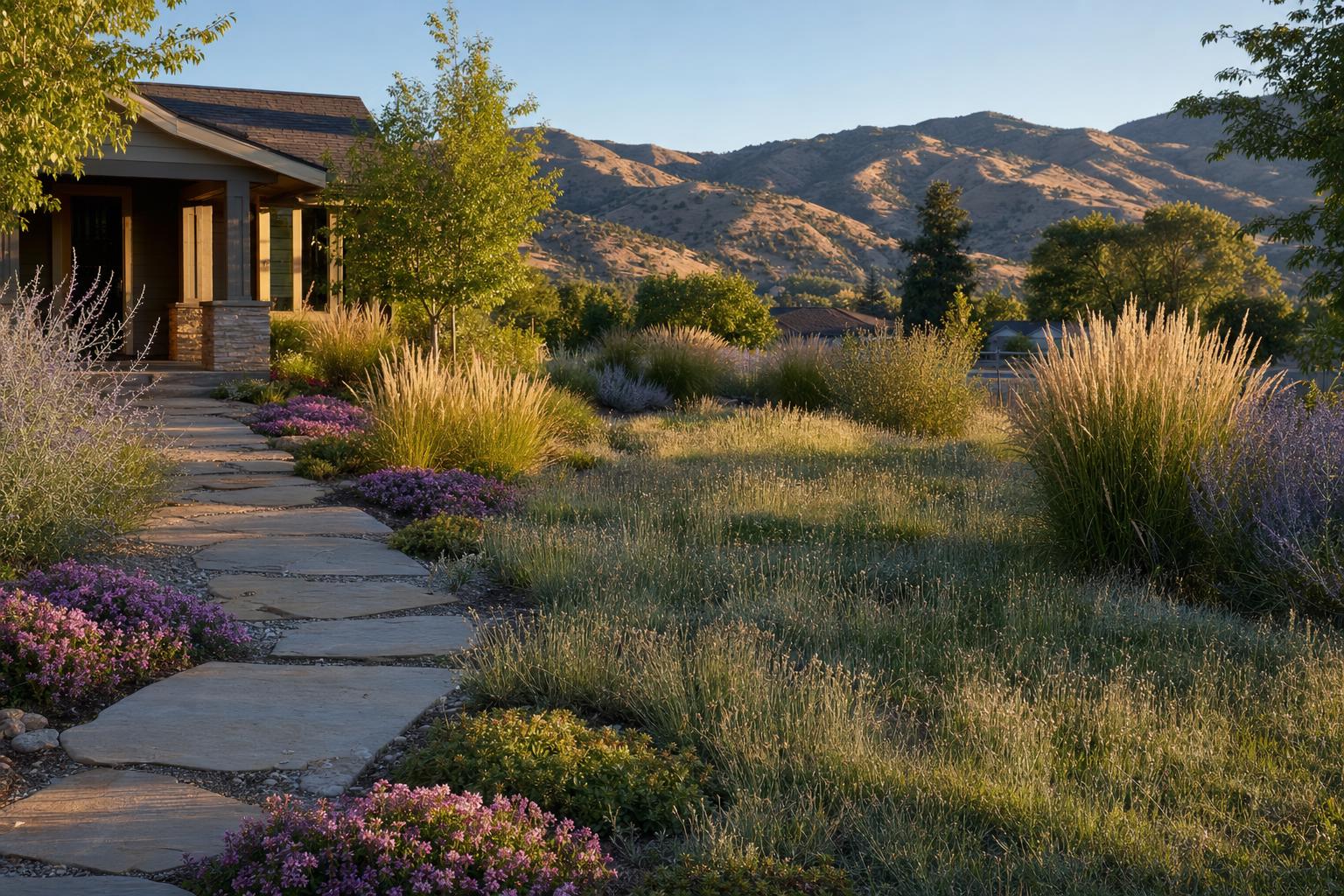
The good news is that a lawn alternative does not have to look like a gravel pit. A well-designed low-water yard can be lush, green, walkable, and full of life. A real Boise example: one North End homeowner replaced their entire south-facing Kentucky bluegrass front lawn with a mix of desert penstemon, creeping thyme, blue grama grass, and salvia — the yard now blooms from late February through November and draws pollinators all summer, on a fraction of the water the old lawn demanded.
Why replace your lawn?
Before diving into alternatives, it helps to understand what is actually wrong with a conventional lawn in the Treasure Valley:
- Water use. Kentucky bluegrass needs roughly 1–1.5 inches of water per week through July and August — about 25 inches over the growing season, more than double what falls from the sky. On a 1,000 sq ft lawn, that is over 15,000 gallons per summer.
- Mowing. Bluegrass grows aggressively from May through September, requiring weekly mowing to stay healthy. A smaller or slow-growing alternative can cut mowing to once a month — or eliminate it entirely.
- Fertilizer and chemicals. Conventional lawns are typically fed synthetic nitrogen four times a year and treated for weeds and grubs. Alternatives like native grasses and clover need little to no fertilizer, and many are naturally pest-resistant.
- July stress. Even with faithful watering, bluegrass struggles during the weeks of 95°F+ heat that define a Treasure Valley summer. Patches go dormant, fungal diseases flare, and the lawn looks tired by August.
- HOA and curb appeal pressure. Many Treasure Valley subdivisions still expect a green lawn in front. The good news: several alternatives below are green, walkable, and neat enough to satisfy most HOAs while using 50–80% less water.
Local insight: Even reducing lawn area by 30% — converting just the park strip, side yard, and one hot corner — can cut outdoor water use by 40–50%. You do not have to go all-in to make a difference. Start with the least-used, hardest-to-keep-green parts of your yard.
The six best lawn alternatives for the Treasure Valley
Every alternative below has been vetted for Treasure Valley conditions: USDA Hardiness Zone 6b/7a, alkaline soils (pH 7.5–8.5), 11 inches of annual precipitation, and summer highs regularly exceeding 95°F. They are ordered from most lawn-like to most meadow-like, so you can choose how far from a traditional lawn you want to go.
1. Buffalo grass (Bouteloua dactyloides)
Buffalo grass is a native North American warm-season prairie grass that thrives in the high-desert West. It forms a soft, dense, blue-green turf that you can walk and sit on, survives on 50–70% less water than Kentucky bluegrass, and needs mowing only once every 3–4 weeks — or not at all, if you like the natural 4–6 inch meadow look.
- Cold hardiness: Zone 5–9. Handles Boise winters without issue, going dormant and tan-colored from November through April.
- Soil: Prefers clay loam but tolerates sandy and alkaline soils. Does not like shade.
- Water: 0.5 inches per week once established. Can go 2–3 weeks without water in summer and simply go dormant, then green up when water returns.
- Planting: Seed in late May–June (warm-season grass, needs soil temps above 60°F). Sod is rare locally but available by special order from regional growers.
- Best for: Full-sun front yards, south-facing lots, and homeowners who want a real walkable lawn that just uses far less water.
- Drawback: Brown and dormant from roughly November to May. If you need year-round green, this is not your grass.
2. Blue grama grass (Bouteloua gracilis)
Blue grama is a companion prairie native that handles the Treasure Valley's cold winters and alkaline soils even better than buffalo grass. Its signature look is the eyelash-shaped seed heads that appear in mid-summer and catch the light beautifully. It can be mowed short for a turf look or left natural at 6–10 inches for a soft meadow.
- Cold hardiness: Zone 3–9. One of the most cold-hardy native grasses available — it grows wild as far north as Alberta.
- Water: Survives on 7 inches of annual rainfall. In the Treasure Valley, it needs supplemental water only during the hottest weeks of July and August.
- Soil: Extremely adaptable — clay, sand, rocky, alkaline. Tolerates poor soils better than almost any other lawn grass.
- Planting: Seed in May–June. The cultivar 'Blonde Ambition' is widely available as plugs and is a favorite in Boise water-wise gardens.
- Best for: Meadow-style front yards, park strips, and homeowners who want to never mow at all. The seed heads provide winter interest and bird food.
- Drawback: Not a tight, carpet-like turf. If you want a putting-green look, blue grama is not it.
3. Microclover and Dutch white clover (Trifolium repens)
Clover is not a grass, but it is one of the easiest and cheapest lawn alternatives available — and it stays green through the winter in the Treasure Valley. Microclover is a smaller-leafed variety bred specifically for lawns; Dutch white clover is the traditional pasture version. Both fix nitrogen from the air, meaning they fertilize themselves and any grass they are mixed with.
- Cold hardiness: Zone 3–10. Stays green well into December in Boise and often holds some color through mild winters.
- Water: Needs about 50% less water than bluegrass. Deep taproots (up to 3 feet) find moisture that grass roots never reach.
- Mowing: Optional. Mow every 3–4 weeks for a neat 3–4 inch lawn, or skip mowing entirely for a 6–8 inch flowering meadow.
- Planting: Seed in early spring (April–May) or early fall (September). Sow at 1–2 lbs per 1,000 sq ft. Germinates in 7–14 days.
- Best for: Homeowners who want a green, soft, walkable surface year-round with minimal mowing and zero fertilizer. Also excellent as a mix-in with fescue for an "eco-lawn."
- Drawback: Attracts bees when flowering (a benefit for pollinators, but a concern for barefoot kids). Not as durable as grass for heavy sports play. Can spread into adjacent beds if not edged.
4. Creeping thyme (Thymus serpyllum)
Creeping thyme is a low-growing herb that forms a dense, fragrant mat of green foliage covered in pink-purple flowers in mid-summer. It tolerates foot traffic, stays evergreen in mild Treasure Valley winters, and thrives in the hot, dry conditions that stress bluegrass. It does not need mowing at all.
- Cold hardiness: Zone 4–9. Reliable in all Treasure Valley microclimates.
- Water: Very low — once established, needs deep watering only every 2–3 weeks in peak summer.
- Soil: Requires well-drained soil. In heavy Treasure Valley clay, amend with compost and gritty sand, or plant on low berms to improve drainage.
- Planting: Plugs or starts planted in spring or early fall. Space 6–8 inches apart; full coverage in one growing season. Seed is slow and unreliable — buy plugs.
- Best for: Small front yards, park strips, between stepping stones, and as an accent in a mixed alternative-lawn design.
- Drawback: Not durable enough for heavy traffic or play areas. Best for visual and occasional-walking areas. Needs well-drained soil — will rot in poorly drained clay.
5. Fine fescue blends (Creeping red, Chewings, hard, sheep fescue)
Fine fescues are the backbone of "no-mow" and "eco-lawn" seed mixes sold across the northern US. They are cool-season grasses that stay green through Boise winters, tolerate partial shade, and grow so slowly that you can mow just twice a year — or never. A fine fescue lawn has a soft, wispy, natural look rather than a manicured carpet.
- Cold hardiness: Zone 3–7. Excellent for the Treasure Valley and higher-elevation areas like Idaho City or Cascade.
- Water: 40–60% less than Kentucky bluegrass. Goes dormant in extreme heat but recovers when temperatures drop.
- Soil: Tolerates poor, sandy, and acidic soils better than bluegrass. Does not like heavy wet clay — amend if needed.
- Planting: Seed in September or April. Sow at 4–5 lbs per 1,000 sq ft. Germinates in 10–14 days.
- Best for: Shady yards under mature trees, large low-use areas, and homeowners who never want to mow. The "no-mow" look is intentional — a gentle, undulating meadow of 6–12 inch blades.
- Drawback: Not a high-traffic surface. Can look unkempt to neighbors who expect a manicured lawn. Goes tan and dormant during the worst of July heat without supplemental water.
6. Ornamental grass and perennial meadow
For the most dramatic transformation, skip turf entirely and replace your lawn with a designed meadow of ornamental grasses and drought-tolerant perennials. This is what the Boise homeowner mentioned at the top of this article did — a front yard of penstemon, salvia, blue grama, agastache, and creeping groundcovers that blooms for nine months of the year on a fraction of the water.
- Best plants for the Treasure Valley: Karl Foerster feather reed grass (Calamagrostis × acutiflora), Blue oat grass (Helictotrichon sempervirens), Little bluestem (Schizachyrium scoparium), Blonde Ambition blue grama (Bouteloua gracilis), Russian sage (Salvia yangii), Mojave sage (Salvia pachyphylla), Blanket flower (Gaillardia aristata), Penstemon species, Creeping goldenaster (Heterotheca jonesii), Turkish speedwell (Veronica liwanensis).
- Water: Drip-irrigated at 50–70% less than lawn once established. Many of these plants survive on our natural 11 inches after the first year.
- Best for: Front yards, park strips, and anyone who wants maximum pollinator habitat and visual interest. This is a landscape, not a lawn — it changes color and texture through the seasons.
- Drawback: Not walkable. You will need a path or patio. Highest up-front cost and design effort. May require HOA approval if your neighborhood has turf mandates.
Comparison at a glance
| Alternative | Water vs. bluegrass | Mowing | Winter color | Walkable | Best for |
|---|---|---|---|---|---|
| Buffalo grass | −50 to −70% | Monthly (or none) | Dormant (tan) | Yes, moderate | Full-sun front lawn replacement |
| Blue grama grass | −60 to −80% | None (or monthly) | Dormant (tan) | Light traffic | Meadow, park strip, low-use areas |
| Microclover | −40 to −50% | Every 3–4 weeks | Green (mild winters) | Yes, moderate | Year-round green with low care |
| Creeping thyme | −60 to −75% | None | Evergreen (mild) | Light traffic | Park strips, accent areas, paths |
| Fine fescue blend | −40 to −60% | Twice a year (or none) | Green | Light traffic | Shady yards, no-mow aesthetic |
| Ornamental meadow | −50 to −80% | Cut back once in spring | Varies by plant | No (needs paths) | Pollinator habitat, full front-yard conversion |
| Kentucky bluegrass (baseline) | — | Weekly | Green (with water) | Yes, high | High-use play lawns |
How to remove an existing lawn
Before you can plant an alternative, you need to get rid of the old grass. Three methods work well in the Treasure Valley, each with trade-offs:
Solarization (best for summer)
Clear plastic sheeting laid over the mown, watered lawn from June through August uses the sun's heat to kill grass, weeds, and seeds down to 4–6 inches. In Boise's summer sun, soil temperatures under the plastic can reach 140°F. By fall, the dead sod breaks down and adds organic matter. Cost: $0.05–0.10 per sq ft for UV-stable plastic. Time: 6–8 weeks. Best for full-sun areas.
Sheet mulching (best for fall)
Layer cardboard (overlapping by 6 inches) over the mown lawn, then 4–6 inches of arbor mulch on top. The grass dies and decomposes under the cardboard, and you plant directly through the mulch the following spring. Cost: $0.25–0.50 per sq ft for cardboard and mulch. Time: 3–4 months to kill grass. Builds soil as it works.
Sod cutter (fastest)
Rent a gas-powered sod cutter ($60–$90/day from local rental yards), strip the grass in 12-inch strips, flip the sod grass-side down to compost in place, or haul it to a green-waste drop-off. Leaves bare soil ready to amend and plant immediately. Cost: $0.10–0.15 per sq ft plus disposal fees. Time: 1 day for a typical front yard. Best when you need to plant right away.
Don't use glyphosate. Roundup and other glyphosate herbicides will kill your lawn, but they also bind to soil and can harm the new plantings you put in next. Solarization and sheet mulching are slower but healthier for your soil and the beneficial microbes that your new alternative lawn will depend on.
Soil preparation
Treasure Valley soils are typically alkaline (pH 7.5–8.5), ranging from silty loam in Boise and Garden City to heavier clay in Meridian and Nampa, with sandier soils in parts of Eagle and Star. Before planting any lawn alternative, do the following:
- Test your soil. Pick up a free or low-cost soil test kit from the Ada Soil & Water Conservation District or the Canyon Soil Conservation District. Send the sample to a lab (University of Idaho Extension offers affordable testing) to learn your pH, organic matter percentage, and nutrient levels.
- Add compost. Spread 2–3 inches of compost over the area and till it in to a depth of 6–8 inches. This improves water retention in sandy soils and drainage in clay, and feeds the soil biology that makes any alternative lawn thrive.
- Check drainage. For creeping thyme and ornamental grasses, drainage is critical. If water pools after rain or irrigation, build low berms (6–12 inches high) using a mix of native soil, compost, and a gritty soil amendment. Clay berms with drainage-loving plants on top is a tried-and-true Treasure Valley approach.
- Install drip irrigation. If you are converting from sprinklers to drip for a meadow or ground cover, cap the old pop-up heads and run 1/2-inch drip tubing with inline emitters across the bed. See our Treasure Valley Irrigation Guide for full drip system design.
Where to buy seed and plants locally
Native and alternative-lawn grasses are not always stocked at big-box garden centers. These Treasure Valley and regional sources carry the species above:
| Source | What they carry | Notes |
|---|---|---|
| Victory Greens (Boise) | Sod (bluegrass/fescue blends), some native grass seed, ornamental grasses | Treasure Valley's primary retail sod supplier. Daily fresh cuts. |
| McKellip Sod Farm (Meridian) | Conventional and drought-tolerant sod | Family-owned, 25+ years serving SW Idaho. Wholesale and retail. |
| Edwards Greenhouse (Boise) | Creeping thyme plugs, ornamental grasses, perennials | Best local source for ground cover starts and regionally adapted perennials. |
| High Country Gardens (online) | Drought-tolerant plugs, native grass seed, pre-planned waterwise gardens | Based in New Mexico; ships to Idaho. The source for 'Blonde Ambition' blue grama and many penstemon varieties proven in Boise. |
| Outsidepride (online, Oregon) | Microclover seed, buffalo grass seed, alternative lawn mixes | Pacific Northwest seed company with cold-hardy varieties suited to Idaho. |
| Idaho Botanical Garden (Boise) | Demonstration beds, plant sales, education | See mature water-wise plants and natives in a Boise setting before you buy. |
What does it cost?
Costs for lawn replacement vary widely depending on whether you do the work yourself, what you plant, and how large the area is. The ranges below reflect Treasure Valley market conditions for a typical 800–1,200 sq ft front yard, as of 2026:
| Project type | Approximate cost | What's involved |
|---|---|---|
| Buffalo grass from seed (DIY) | $0.15–0.25 per sq ft | Seed, soil prep, removal of old lawn |
| Microclover lawn (DIY) | $0.10–0.20 per sq ft | Clover seed at 1–2 lbs/1,000 sq ft, soil prep |
| Creeping thyme from plugs (DIY) | $1.50–3.00 per sq ft | Plugs at $0.50–$1 each, spaced 6–8 inches apart |
| Fine fescue no-mow lawn (DIY) | $0.08–0.15 per sq ft | Seed mix, soil prep |
| Ornamental meadow (DIY) | $2–5 per sq ft | Plants, drip irrigation, mulch, soil amendments |
| Full professional conversion | $5–12 per sq ft | Lawn removal, design, soil prep, plants, drip irrigation, mulch, installation |
| Sod cutter rental | $60–$90 per day | Equipment rental for fast lawn removal |
The savings show up over time. A 1,000 sq ft lawn converted to a low-water alternative can save 8,000–12,000 gallons of water per summer, plus the cost of weekly mowing, fertilizer, and weed treatments. At current Boise water rates, that is $200–$400 per year in water alone.
Planting calendar for the Treasure Valley
April–May
Seed microclover and fine fescue blends while temperatures are cool and spring moisture is reliable. Plant creeping thyme plugs. Start solarization on lawns you plan to replace by mid-summer.
May–June
Seed warm-season grasses (buffalo grass, blue grama) once soil temperatures reach 60°F — usually late May in the Treasure Valley. Install drip irrigation before planting.
July–August
Solarization under clear plastic kills old lawn and weed seeds. Do not seed during this period — it is too hot and dry for establishment. Water new plantings deeply once a week.
September–October
The best planting window of the year. Cooler temperatures and natural moisture help roots establish before winter. Seed cool-season grasses and clover. Plant all plugs and potted perennials. Sheet mulch over lawns for spring conversion.
November–March
Most alternatives are dormant or evergreen. Do not walk on dormant buffalo grass — it is fragile when not actively growing. Plan your spring project, order seed and plugs early, and sketch your design.
March–April
Cut back ornamental grasses and perennials to 2–3 inches before new growth begins. Refresh mulch to 2–3 inches. Check drip emitters and flush lines before turning the system on for the season.
Common mistakes to avoid
- Planting warm-season grasses in fall. Buffalo grass and blue grama seeded in October will not germinate before frost. Wait until late May or June — the soil needs to be warm.
- Skipping soil prep. Even drought-tolerant plants need decent soil to establish. Compost and till before planting — you will not get another easy chance to amend the whole area.
- Underwatering during establishment. All of these alternatives are low-water once established, but they need regular water for the first growing season. Drip every 2–3 days for plugs, every 4–5 days for seed, until roots are deep.
- Planting creeping thyme in heavy clay without amending. Thyme demands drainage. In native Treasure Valley clay, it will rot in winter. Build a berm or amend heavily.
- Expecting winter green from warm-season grasses. Buffalo grass and blue grama are brown from November to May. If year-round green matters, choose clover or a fine fescue instead.
- Not checking your HOA. Some Treasure Valley HOAs still require a minimum percentage of turf grass in front yards. Check your CC&Rs before converting, or focus your alternative lawn on the back yard first.
Getting started
If you are not ready to replace your entire lawn, start with one section. The easiest, highest-impact move in the Treasure Valley is converting your park strip — that hot, narrow, hard-to-water strip between the sidewalk and the street. It is the hardest part of a lawn to keep green, it is rarely walked on, and it is visible to every neighbor who walks by. Replace it with creeping thyme, blue grama, or a small ornamental meadow and you will save water, cut mowing time, and create a curb-appeal feature that looks intentional and designed.
The best time to start is September. The cooler weather and fall moisture give new plantings the best chance to establish roots before the stress of a Treasure Valley summer. Order seed and plugs in August, prep the soil in September, and plant before the first hard frost — typically mid-October in Boise, though it can come as early as late September in outlying areas like Kuna and Star.
For help designing a full alternative-lawn conversion, see our Landscapers of the Treasure Valley directory — several of the listed companies specialize in water-wise and xeriscape conversions.