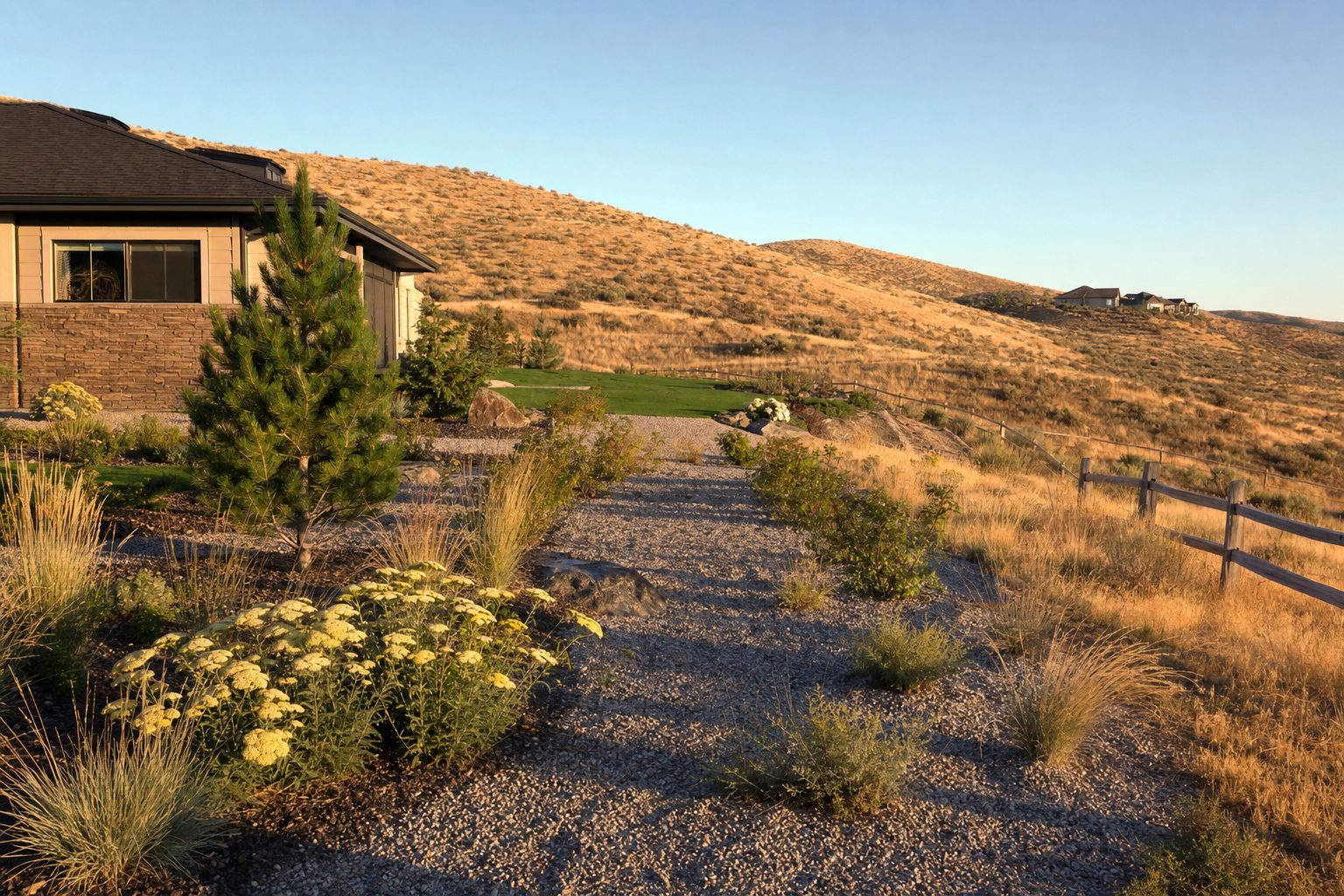
The Boise Foothills, the sagebrush-covered benches above Eagle, and the dry grasslands ringing Nampa and Kuna all sit in Idaho's wildland-urban interface — the zone where homes meet fire-adapted ecosystems. Each summer, wildfires burn across these landscapes. The right landscaping choices can make the difference between a home that survives an ember storm and one that doesn't.
Why Firewise landscaping matters here
The Treasure Valley's wildfire season runs from late June through September, peaking in August when fuels are driest. The Boise National Forest and BLM lands bordering the valley produce embers that travel a mile or more on wind currents — meaning a fire burning on a ridgeline above the Foothills can ignite homes miles away in the valley floor.
Idaho Firewise, a non-profit partnership of the BLM, Idaho Department of Lands, the Idaho Fire Chiefs Association, and the University of Idaho Extension, defines defensible space as the area around a structure designed and maintained to reduce fire danger. Their recommendation: a minimum of 100 feet of defensible space on flat ground, expanding to 200 feet or more on sloped sites — which includes much of the Boise Foothills and the benches above Eagle.
The ember reality: Research from the National Fire Protection Association (NFPA) shows that most homes lost to wildfire don't burn from the fire front — they ignite from embers landing on flammable material near the home. A single juniper shrub planted against a wood-sided house can catch an ember, torch, and spread fire to the structure. Firewise landscaping is about controlling those fuels, not about stopping a wall of flame.
The three defensible space zones
Idaho Firewise divides defensible space into three concentric zones. What you plant — and what you remove — in each zone determines how vulnerable your home is to ignition.
Zone 1: The immediate zone (0–5 feet from the home)
This is the most critical zone. The first five feet from your home's exterior should be non-combustible. Nothing flammable should be here — no shrubs, no wood mulch, no leaf litter, no pine needles.
- Ground cover: Use gravel, decomposed granite, or pavers instead of bark mulch. Gravel mulch in this zone is the single most effective Firewise upgrade you can make.
- Plants: If you must plant here, use only short, high-moisture plants — flowering annuals or succulent perennials hardy to USDA Zone 6. Avoid anything woody or resinous.
- Clearance: Keep the ground clean. Sweep decks, remove leaf litter from gutters, and clear dead vegetation weekly during fire season.
- Screening: Screen vents, eaves, and deck gaps with 1/8-inch metal mesh to block embers from entering the home or crawlspace.
- No junipers: Junipers (Juniperus spp.) are the most dangerous common landscape plant near homes — their foliage contains volatile oils, they accumulate dead material inside the plant, and they ignite easily from embers. If you have junipers within five feet of your home, remove them.
Cost: Replacing bark mulch with gravel in a 5-foot perimeter around a 2,000 sq ft home costs roughly $300–$600 for materials (3–5 cubic yards of 3/4-inch crushed gravel at $35–$55/yard from local suppliers like Western Stone & Brick in Boise). Removing a mature juniper shrub and replacing with a non-combustible ground cover: $50–$200 per shrub if you hire it out, or just your labor if you do it yourself.
Zone 2: The intermediate zone (5–30 feet)
Zone 2 should be a well-maintained "greenbelt" — lean, clean, and green. This is where your primary landscape lives, but it must be designed and maintained to slow fire spread.
- Plant islands: Plant in small, separated clusters rather than continuous beds. Break up the vegetation with hardscape — patios, stone pathways, gravel paths, or dry river beds. These act as fuel breaks.
- Lawn: Well-watered turf is an effective fuel break. Keep lawns mowed to 4 inches. A green, irrigated lawn will not carry a ground fire.
- Trees: Trees in this zone should be in small clusters only. Plan for the mature canopy to be no closer than 10 feet to the structure. Prune branches up to 6–10 feet from the ground (or one-third the height of the tree for shorter trees) to eliminate "ladder fuels" that carry ground fire into the canopy.
- Shrub spacing: Space shrubs so their mature spread doesn't touch — a minimum of 2–3 times the shrub's mature height between clusters.
- Water features: Ponds, dry creek beds, and water features serve double duty as landscape amenities and fire breaks.
Zone 3: The extended zone (30–100 feet and beyond)
Zone 3 transitions from your managed landscape to the natural vegetation beyond. If your property line ends before 100 feet — common on Foothills lots — work with neighbors to create overlapping defensible spaces.
- Remove dangerous fuels: Remove highly flammable species like sagebrush and rabbitbrush that grow within 30 feet of structures, and replace with fire-resistant alternatives.
- Tree thinning: Trees 30–60 feet from the home should have at least 12 feet between canopy tops. Trees 60–100 feet away need at least 6 feet of canopy separation.
- Firewood and propane: Store firewood and propane tanks on gravel or concrete pads at least 30 feet from structures. Do not stack firewood on a deck or against the house.
- Cheatgrass control: Cheatgrass (Bromus tectorum) is the most dangerous invasive fuel in the Treasure Valley. It greens up early, dries out by June, and burns hotter and faster than native bunchgrasses. Control it with early-season mowing (before seed set, typically April–May) and replace with native bunchgrasses like bluebunch wheatgrass (Pseudoroegneria spicata) and Idaho fescue (Festuca idahoensis).
Fire-resistant plants for the Treasure Valley
No plant is fireproof — all plants will burn under extreme conditions. But some plants are significantly more resistant to ignition because they have high moisture content, low volatile oil content, open growth habits (less fuel continuity), and minimal dead material accumulation. The following plants have been tested by Idaho Firewise and the University of Idaho Extension and are well-suited to Treasure Valley growing conditions (USDA Zone 6, alkaline soils, 12 inches of annual precipitation).
| Plant | Type | Fire resistance | Water needs | Best zone |
|---|---|---|---|---|
| Yarrow (Achillea millefolium) | Perennial | High | Low | 2–3 |
| Sulfur buckwheat (Eriogonum umbellatum) | Perennial | High | Very low | 2–3 |
| Bluebunch wheatgrass (Pseudoroegneria spicata) | Native bunchgrass | High | Very low | 3 |
| Idaho fescue (Festuca idahoensis) | Native bunchgrass | High | Low | 3 |
| Coneflower (Echinacea purpurea) | Perennial | High | Low–medium | 2 |
| Stonecrop sedum (Sedum spp.) | Succulent | Very high | Very low | 1–2 |
| Blanket flower (Gaillardia aristata) | Perennial | High | Low | 2–3 |
| Penstemon (Penstemon digitalis) | Perennial | High | Low | 2–3 |
| Lavender cotton (Santolina chamaecyparissus) | Subshrub | Medium | Very low | 2 (keep pruned) |
Plants to avoid near the home: Juniper (Juniperus spp.), arborvitae (Thuja spp.), Russian sage (Perovskia atriplicifolia), rosemary, pine trees (especially Scotch and ponderosa), sagebrush (Artemisia tridentata), rabbitbrush (Ericameria nauseosa), and ornamental grasses that form dense clumps (like maiden grass, Miscanthus sinensis). These all contain volatile oils, accumulate dead material, or dry out and become highly flammable. Keep them at least 30 feet from any structure.
Where to buy fire-resistant plants locally
The following Treasure Valley nurseries carry native and fire-resistant plant species suitable for Firewise landscapes:
- Edwards Greenhouse & Nursery (Boise, State Street) — native perennials, grasses, and xeriscape plants; staff knowledgeable about fire-resistant species.
- Idaho Botanical Garden plant sales (Boise, Old Penitentiary Road) — spring and fall native plant sales; excellent source for locally-grown Idaho natives like sulfur buckwheat, yarrow, and bunchgrasses.
- FarWest Landscape & Nursery (Boise, Chinden Boulevard) — broad selection of drought-tolerant perennials and ornamental grasses suitable for Zone 2 plantings.
- Zamzows (multiple Treasure Valley locations) — carries sedums, coneflowers, and low-water perennials; convenient for smaller Firewise projects.
- Terra Nursery (Meridian, Linder Road) — native and adapted plants with knowledgeable staff; good for bunchgrass selections.
Seasonal Firewise maintenance calendar
Firewise landscaping is not a one-time project — it requires ongoing maintenance to stay effective. A well-designed Firewise landscape becomes dangerous when maintenance lapses. Use this seasonal calendar for the Treasure Valley (adapted from Idaho Firewise and University of Idaho Extension guidelines):
March–April
Mow cheatgrass before it sets seed (April–May). Rake and remove leaf litter, pine needles, and dead vegetation from all zones. Clean gutters. Inspect screens on vents and eaves.
May–June
Prune tree branches up to 6–10 feet. Remove dead wood from shrubs. Check irrigation system — a well-watered Zone 2 is your best fuel break. Begin weekly deadheading of perennials.
July–August
Peak fire season. Mow lawns to 4 inches and keep them green. Remove any dead or dying plants immediately. Keep the 5-foot Zone 1 clear of all debris. Store firewood at least 30 feet from the house.
September–October
As fire season tapers, assess what worked and what didn't. Remove any plants that struggled or died. Plan replacement plantings for spring. Clean leaf litter as it falls. Check that gravel mulch in Zone 1 hasn't accumulated organic debris.
November–February
Dormant season. Prune deciduous trees and shrubs while structure is visible. Remove junipers and other dangerous plants near the home while growth is dormant. Plan new hardscape paths or fuel breaks for installation in spring.
The cheatgrass problem — and how to fix it
Cheatgrass (Bromus tectorum) is the most significant wildfire fuel in the Treasure Valley. This invasive annual grass germinates in fall, grows through winter, and dries out by early June — a full two months before native bunchgrasses. A cheatgrass-invaded hillside burns in July; a native bunchgrass hillside doesn't burn until September, if at all.
The problem is worst in the Boise Foothills, the Open Space reserves above Boise and the Ridge to Rivers trail system, and the sagebrush-steppe around Kuna, Nampa, and south of the Boise River. Cheatgrass also outcompetes native plants, creating a feedback loop: fire promotes cheatgrass, and cheatgrass promotes fire.
How to control cheatgrass on your property:
- Mow early: Mow cheatgrass to 2–3 inches in April–May, before it produces seed heads. This depletes the root reserves and prevents seed set. Mowing after seed set (June) is useless — the seeds are already on the ground.
- Rake and remove: After mowing, rake up the cut material. Cheatgrass thatch itself is highly flammable and must be removed, not left in place.
- Sheet mulch (optional): For large areas, lay cardboard over the mowed cheatgrass, then cover with 3–4 inches of arborist wood chip mulch. This suppresses the seed bank for one growing season while you establish replacement plants.
- Plant natives: Seed or transplant native bunchgrasses (bluebunch wheatgrass at 1 lb per 1,000 sq ft, Idaho fescue at 0.5 lb per 1,000 sq ft) in October–November. Native bunchgrasses germinate in cool soils and will outcompete cheatgrass seedlings the following spring. Seed is available from conservation districts — the Ada Soil & Water Conservation District sells native seed mixes in fall.
- Repeat: Cheatgrass seed bank persists for 2–3 years. Expect to mow and reseed for at least two seasons before natives establish.
Firewise on a slope: extra considerations for Foothills homes
Homes on slopes need more defensible space and more careful design. Fire moves uphill — a fire on a 30% slope spreads twice as fast as the same fire on flat ground. On the Boise Foothills, where many homes sit on 15–40% slopes, defensible space should extend 200 feet or more downslope from the structure.
- Retaining walls: Terraced retaining walls slow fire spread by breaking up continuous slopes. Use them as fuel breaks between planted zones. See our retaining walls guide for construction details.
- Roads and paths: A gravel or paved access road or path along the contour of a slope serves as both access and a fuel break.
- No continuous fuel beds: On a slope, a continuous hedge or tree line becomes a fuse. Break plantings into islands with 10-foot gaps of hardscape or low ground cover between them.
- Downslope fuel reduction is critical: Fire intensity below the home is what threatens it. Prioritize clearing and thinning the 100 feet downslope of the structure.
Firewise doesn't mean ugly
The most common misconception about Firewise landscaping is that it means replacing your yard with gravel. That's not true. A Firewise landscape can be lush, colorful, and beautiful — it's just designed and maintained with fire behavior in mind.
Think of it as strategic landscaping: keep the 5 feet nearest the home lean and non-combustible, build a lush greenbelt in Zone 2 with well-spaced plant islands and hardscape breaks, and gradually thin the wildland vegetation in Zone 3. Within those zones, you can grow yarrow, coneflowers, blanket flowers, sedums, penstemon, and native bunchgrasses — all of which are beautiful, drought-tolerant, pollinator-friendly, and fire-resistant.
Many of the same principles that make a landscape water-wise also make it fire-wise. Deep-rooted native plants stay greener longer, require less irrigation, and accumulate less dead fuel. The xeriscaping principles that reduce water use also reduce fire risk — a coincidence that makes Firewise landscaping a natural fit for the Treasure Valley.
Where to learn more: The Idaho Firewise website offers detailed guides on defensible space, fire-resistant plant materials, and landscape maintenance. The University of Idaho Extension publishes Firewise planting guides for Idaho counties. KTVB's "You Can Grow It" series has featured Firewise landscaping from a Boise demonstration garden. The Boise Fire Department offers free Wildfire Home Ignition Zone assessments for Foothills residents.