Browse all six Treasure Valley city guides →
Meridian is Idaho's second-largest city and one of the fastest-growing in the nation. Its population reached 142,988 in the Census Bureau's July 1, 2025 estimate — up 21.4% from the April 1, 2020 estimates base — transforming former farmland into a grid of master-planned communities, amenity-rich subdivisions, and busy commercial corridors. For homeowners, that means landscaping in Meridian comes with a distinct set of opportunities and constraints: newer construction lots, pressurized irrigation in most subdivisions, HOA design guidelines, and soils shaped by decades of agriculture.
This guide covers Meridian's climate and growing season, soil types, the Nampa & Meridian Irrigation District's pressurized urban system, landscaping strategies by neighborhood, recommended plants for Meridian yards, cost expectations, and local resources for getting projects done.
Meridian's climate and growing season
Meridian sits at approximately 2,605 feet elevation on the flat valley floor of the western Snake River Plain. The 2023 USDA Plant Hardiness Zone Map places Meridian in Zone 7a (0°F to 5°F average minimum), the same zone as Boise. The nearest NOAA climate station is the Boise Air Terminal, roughly 10 miles east, which provides the frost data most garden references use for Meridian.
Key climate facts for Meridian:
- Average last spring frost: April 30 (30% probability, 1991–2020 NOAA normals)
- Average first fall frost: October 14
- Growing season: ~166 days
- Annual precipitation: ~11–12 inches, mostly November through May
- July average high: 93°F; record highs exceeding 110°F
- January average low: 24°F
- Elevation: ~2,605 feet
- USDA Zone: 7a (0°F to 5°F average minimum)
Meridian's flat terrain means fewer microclimates than Boise's foothills neighborhoods. Wind exposure can be significant in newer subdivisions where trees haven't yet matured — strong afternoon winds from the southwest are common in summer, which increases evapotranspiration and stresses new plantings. Plan for windbreaks and faster-establishing species in exposed south- and west-facing lots.
Soil types in Meridian
Meridian's soils are shaped by its location on the Boise River floodplain and its agricultural history. Most of the city sits on alluvial deposits — silty to sandy loams laid down by ancient river channels and millennia of flood irrigation farming. Here is what you will encounter:
- North Meridian (Paramount, Bridgetower, Spurwing area): Sandy loam over a clay sublayer, typically 18–36 inches below the surface. Good surface drainage but the clay layer can create a perched water table in wet years. Core aeration and organic amendment improve both drainage and water retention.
- Central/Downtown Meridian (older homes along Main, Pine, Meridian Road): Silty loam with decades of accumulated organic matter from lawns and gardens. Generally well-drained, good fertility, and easier to work than newer-construction compacted soils.
- South Meridian (Century Farm, Tuscany, Sky Mesa): Sandy to silty loam, often compacted by construction equipment. Newer subdivisions typically have a thin layer of topsoil spread over compacted subsoil — plan to amend heavily with compost before planting.
- East Meridian (near the Boise River corridor): Variable alluvial soils with pockets of heavier clay and sandy deposits. Some areas near irrigation canals have higher water tables.
All Meridian soils trend alkaline (pH 7.5–8.5), consistent with the Snake River Plain. Acid-loving plants (blueberries, rhododendrons, azaleas) need raised beds with acidified soil. Most native and adapted plants thrive in these alkaline conditions.
Pressurized irrigation: Meridian's landscape advantage
One of Meridian's biggest landscaping advantages is its pressurized irrigation system, operated by the Nampa & Meridian Irrigation District (NMID). Unlike many Boise neighborhoods where irrigation access varies by street, most Meridian subdivisions built since the 1990s include pressurized urban irrigation — a separate water supply for landscape watering that costs a fraction of potable water.
How Meridian's pressurized irrigation works:
- Water is diverted from the Boise River through the Ridenbaugh Canal and other NMID canal systems, then pressurized and delivered to subdivisions via underground mains.
- The system operates from approximately April 15 through the first week of October each year.
- Pressurized irrigation water is delivered at 40–60 psi — enough to run standard sprinkler systems without a pump.
- The approximate cost is $90 per year per quarter-acre lot — far cheaper than irrigating with potable water.
- NMID maintains the main lines and delivery valve; homeowners maintain their own sprinkler systems from the valve onward.
- Home sprinkler systems should be designed for 5–7 gallons per minute per watering station.
- The water is filtered to 1/16 inch; no secondary filters should be needed.
If you are buying a home or planning a landscape project in Meridian, verify your irrigation access. Most subdivisions built after 1993 have pressurized irrigation by ordinance, but some older pockets near downtown do not. Contact the Nampa & Meridian Irrigation District at (208) 466-7861 or check their district lookup tool to confirm your water rights and system connection.
Outside the irrigation season (October–April), you will need to use potable water for any landscape watering — typically only needed for new plantings and winter-established evergreens during dry spells.
Neighborhood landscaping guide
Meridian's rapid growth has produced distinct submarkets, each with different lot sizes, HOA rules, soil conditions, and landscape opportunities. Here is how to approach the major areas:
North Meridian (Paramount, Bridgetower, Spurwing)
The amenity-rich master-planned territory north of McMillan Road. Communities like Paramount, Bridgetower, and the Spurwing complex feature pools, clubhouses, parks, and on-site schools. Lots are typically 0.15–0.25 acres with full HOA coverage and architectural guidelines that dictate fence styles, paint colors, and sometimes plant palettes.
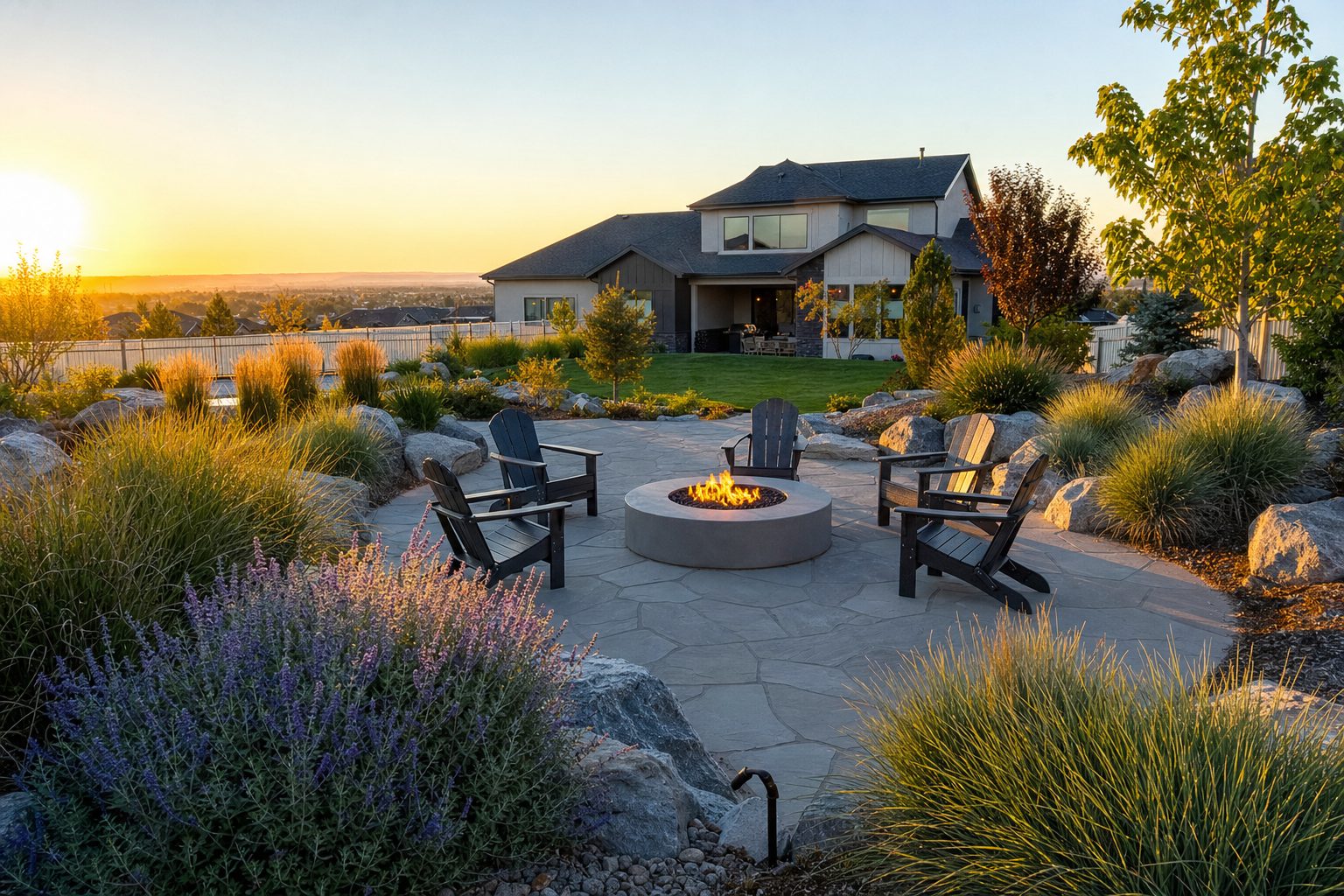
- Design approach: Polished, cohesive front yards that meet HOA standards; private backyard oases with patios, fire features, and raised beds. The Spurwing community centers on a private golf course — homes there lean toward upscale, resort-style landscaping.
- Challenges: HOA design review processes can limit plant choices and hardscape materials. Smaller lots require efficient space planning. Newer trees provide little shade for the first 5–10 years.
- Opportunities: Pressurized irrigation keeps watering costs low. Sandy loam soils respond well to amendment. Proximity to the Linder Road corridor makes plant sourcing easy.
- Plant picks: Karl Foerster feather reed grass for vertical accent, Russian Sage for summer color, Autumn Blaze Maple for fast shade, Knock Out roses for continuous bloom (HOA-friendly), lavender for drought-tolerant fragrance.
South Meridian (Century Farm, Tuscany, Sky Mesa)
The active-growth area south of I-84. Communities like Century Farm (anchored by the Treasure Valley Family YMCA), Tuscany, and Sky Mesa offer newer construction with amenity packages. Lots are similar in size to north Meridian but at more accessible price points. The Linder Road corridor is the primary north-south artery.
- Design approach: Builder-grade front yards can be upgraded with xeriscape conversions, layered shrub borders, and statement trees. Backyards are a blank canvas — ideal for outdoor living zones with patios, pergolas, and vegetable gardens.
- Challenges: Construction-compacted soils need deep tilling and compost amendment. Infrastructure (schools, roads, retail) is still catching up to growth. Wind exposure is high in areas without mature tree canopies.
- Opportunities: Newer lots often start with a clean slate — no mature trees to work around, no inherited landscape to remove. Pressurized irrigation is standard. Larger community amenities (pools, paths, parks) complement private yard design.
- Plant picks: Serviceberry for multi-season interest, Little Leaf Linden for street-tree shade, Catmint for low-water borders, Blanket Flower for perennial color, creeping thyme for lawn alternatives in park strips.
Central/Downtown Meridian (Main Street, Pine, Meridian Road)
The older core of Meridian, with pre-2000 housing stock, wider lots, and proximity to The Village shopping center, Roaring Springs water park, and Meridian's downtown corridor. Many properties here sit outside HOA boundaries, giving homeowners more flexibility on fences, outbuildings, RV parking, and landscape style.
- Design approach: Established neighborhoods with mature trees and wider lots allow for layered landscapes — shade trees, understory shrubs, perennial borders, and lawn. No HOA constraints mean more freedom for vegetable gardens, greenhouse structures, and creative hardscape.
- Challenges: Older irrigation systems may need upgrading. Some properties have compacted soils from decades of use. Tree root competition in yards with mature maples and elms limits what grows beneath.
- Opportunities: Silty loam soils with good organic content. Mature trees provide instant shade and privacy. No HOA means full creative control. Proximity to downtown Meridian's growing restaurant and retail scene.
- Plant picks: Bigleaf Hydrangea for shade borders, Hosta varieties for deep shade, daylilies for sun borders, columnar junipers for privacy screens, Kentucky bluegrass or tall fescue for lawns (irrigation-dependent).
East Meridian (Near Boise River corridor)
Properties along the eastern edge of Meridian, closer to the Boise River and the transition to Eagle and West Boise. A mix of established homes, rural-residential lots, and newer infill. Soils are more variable here, with alluvial deposits and pockets of heavier clay.
- Design approach: Transitional landscapes that blend suburban polish with rural spaciousness. Room for larger specimen trees, edible landscaping, and native plant corridors that connect to the river greenbelt system.
- Challenges: Variable soils — test before planting. Some pockets have high water tables near canal corridors. Deer pressure increases near open-space corridors.
- Opportunities: Larger lots, established trees in some areas, and proximity to both Meridian and Boise amenities. Good irrigation access in most subdivisions.
- Plant picks: Ponderosa Pine for native character, Serviceberry for wildlife, Russian Sage for deer-resistant color, ornamental bunchgrasses for movement and texture.
Recommended plants for Meridian yards
Meridian's Zone 7a climate, alkaline soils, and low annual precipitation favor plants adapted to high-desert conditions. The pressurized irrigation system makes moderate-water landscapes affordable, but drought-tolerant choices reduce maintenance and future-proof against potential water restrictions. Here are reliable performers for Meridian:
| Plant | Latin name | Type | Sun | Water | Notes |
|---|---|---|---|---|---|
| Autumn Blaze Maple | Acer × freemanii | Tree | Full sun | Moderate | Fast-growing shade tree; reliable fall color; popular in new subdivisions |
| Little Leaf Linden | Tilia cordata | Tree | Full sun | Moderate | Excellent street tree; dense canopy; fragrant summer flowers |
| Serviceberry | Amelanchier alnifolia | Tree/shrub | Full sun to part shade | Low–moderate | Idaho native; white spring flowers; edible berries; fall color |
| Russian Sage | Perovskia atriplicifolia | Shrub | Full sun | Low | Silver foliage, lavender blooms July–September; Meridian staple |
| Rocky Mountain Juniper | Juniperus scopulorum | Shrub | Full sun | Very low | Native; steel-blue foliage; extremely drought-hardy; good for screening |
| Karl Foerster Grass | Calamagrostis × acutiflora | Grass | Full sun to part shade | Low–moderate | Vertical accent; golden plumes all winter; sterile (non-invasive) |
| Blue Fescue | Festuca glauca | Grass | Full sun | Low | Compact blue mounds; excellent for borders and mass plantings |
| Blanket Flower | Gaillardia aristata | Perennial | Full sun | Low | Native; red-orange daisy blooms May–September |
| Penstemon | Penstemon spp. | Perennial | Full sun | Low | Native; many varieties; hummingbird magnet |
| Lavender | Lavandula angustifolia | Perennial | Full sun | Low | Loves alkaline soil and dry heat; needs excellent drainage |
| Catmint | Nepeta × faassenii | Perennial | Full sun | Low | Blue-purple flowers all summer; deer-resistant; low maintenance |
| Creeping Thyme | Thymus serpyllum | Groundcover | Full sun | Low | Lawn alternative for park strips; tolerates foot traffic; blooms pink |
For a full plant list with bloom times and detailed growing notes, see our Native Plants for Treasure Valley Yards guide. For lawn replacement ideas, see our Lawn Alternatives for the Treasure Valley article.
Meridian landscaping costs
Meridian landscape project costs are in line with Treasure Valley averages. Newer-construction lots often need more soil preparation (compaction relief, compost amendment) than established neighborhoods, which adds to base costs. Here are realistic ranges:
- Front yard xeriscape conversion (builder-grade to water-wise): $3,500–$12,000 depending on size, plant selection, and hardscape elements (boulders, gravel, pathways).
- Paver patio (300 sq ft): $3,600–$7,500 installed, including base preparation.
- Retaining wall (50 linear feet, 3 feet tall): $4,000–$8,000 for segmental block.
- Fire pit (gas, stone surround): $3,000–$7,000 installed.
- Sprinkler system connection to pressurized irrigation (quarter-acre lot): $2,500–$5,000 — less than potable systems because no pump is needed.
- Sod installation: $1.50–$2.50 per square foot (sod + prep + installation).
- Full front yard landscape design + installation: $8,000–$25,000+ depending on scope.
For detailed pricing across all project types, see our Treasure Valley Landscaping Cost Guide.
Local resources for Meridian landscaping
- Victory Garden Nursery — Meridian's local garden center at 120 E Victory Rd. Plants, trees, garden supplies, and a coffee bar. A convenient in-city plant source. victorygardensidaho.com
- Franz Witte Garden Center — Full-service nursery and landscape company north of Meridian on State Street. Wide selection of trees, shrubs, grasses, and edibles, many grown on-site. franzwitte.com
- Arbor Farms Nursery — Local nursery serving the Meridian area with trees, shrubs, and perennials suited to Treasure Valley conditions.
- FarWest Landscape — 7-acre garden center on State Street in Northwest Boise, 15 minutes from Meridian. The region's largest local plant and landscape supply source. farwestlandscape.net · (208) 853-4057
- Nampa & Meridian Irrigation District — Contact for irrigation water rights, system connection, pressure issues, and season dates. nmid.org · (208) 466-7861 (office) · (208) 466-0663 (maintenance)
- Ada Soil & Water Conservation District — Free soil testing guidance and conservation resources for Ada County residents, including Meridian. adaswcd.org
- City of Meridian Parks & Recreation — Julius M. Kleiner Memorial Park (58 acres) is Meridian's largest regional park and a good place to see mature landscape plantings that thrive in local conditions. meridiancity.org
Meridian landscape contractors
These established landscape companies serve Meridian and the surrounding west Treasure Valley. Each has a verifiable local reputation, real Meridian-area projects, and the credentials to back their work. The directory below is curated — not paid placement.
A Beautiful View Lawn & Landscaping
Meridian-based, family-operated landscape and ground maintenance company serving the greater Boise area. Design, installation, lawn care, sprinkler service, and seasonal cleanups. BBB A+ accredited — a reliable choice for ongoing maintenance relationships and full yard renovations in Meridian subdivisions.
abeautifulviewlandscaping.com →Chamberlain & Sons Landscaping
Family-owned landscape company based in Meridian, specializing in landscape design and construction for new and existing homes across Meridian, Eagle, Star, Kuna, and the Treasure Valley. Fully licensed and insured. A strong fit for new-build yard installs — sprinkler systems, sod, hardscape, and planting.
landscapingboise.com →ProVision Landscape
Full-service Meridian landscape company on East Lanark Street. Landscape design, sprinkler installation and repair, sod, paver patios, retaining walls, and ongoing maintenance. Well-reviewed on Yelp with a reputation for responsive communication and clean workmanship.
pvlidaho.com →Alderwood Landscaping
Full-service design-build firm serving Meridian, Eagle, and the greater Boise area. Known for elevated, resort-quality landscape design and construction. Strong fit for master-planned communities and higher-end Meridian estates where cohesive, architectural landscape finishes matter.
alderwoodlandscaping.com →Schaefer Butte Landscaping & Patios
Landscape and hardscape design-build contractor serving Star, Meridian, Eagle, and surrounding areas. Specializes in landscape construction, paver patios, irrigation systems, and sod installation. A good fit for west-valley homeowners wanting a dedicated, hands-on contractor with a portfolio of local projects.
schaeferbutte.com →Hawkeye Landscape & Conservation Group
Family-owned Meridian landscape company offering weekly mowing, sprinkler blowouts, irrigation work, landscape remodeling, and conservation services. Locally rooted — the owners are Meridian natives with a reputation for dependable, community-oriented service across west-valley neighborhoods.
hawkeye-landscape.com →This is a curated directory, not a paid listing. Inclusion is based on established local reputation, verifiable credentials, and service to Meridian-area communities. Know a Meridian landscaper we should add? Tell us →
For guidance on evaluating bids, checking licenses, and asking the right questions, see our Choosing a Landscape Contractor guide. For project pricing across all of Meridian and the Treasure Valley, see our Cost Guide.
When to plant in Meridian
March–April
Plant bare-root trees and shrubs while dormant. Direct sow cool-season crops. Start tomato and pepper seeds indoors. Prune fruit trees and dormant deciduous shrubs before bud break. Pressurized irrigation typically starts April 15.
May
Safe to plant most perennials, trees, and shrubs after May 15. Wait until late May for tender annuals and warm-season vegetables. Harden off seedlings before transplanting. Irrigation water is flowing — set timers for early morning watering.
June–July
Heat-loving plants go in the ground. Install or adjust drip irrigation. Mulch beds deeply (2–3 inches) to conserve moisture. Avoid planting new trees during the hottest weeks — wait for cooler fall weather. Windbreak new plantings in exposed south Meridian subdivisions.
August–September
Best time to plant trees and shrubs in Meridian. Soil is warm, air temperatures moderate, and fall rains begin. Plants establish root systems before winter dormancy. Seed new lawns in early September while irrigation water is still available.
October
Last call for tree and shrub planting. Plant spring-blooming bulbs (tulips, daffodils, alliums). Irrigation shuts down the first week of October — winterize sprinkler systems before first hard freeze. Apply winter mulch to tender perennials.
November–February
Dormant pruning season for deciduous trees. Protect young trees from sunscorch with trunk wrap — especially important in exposed new subdivisions. Plan next year's projects. Avoid walking on frozen lawns. Hand-water new evergreens during dry winter spells (no irrigation water available).