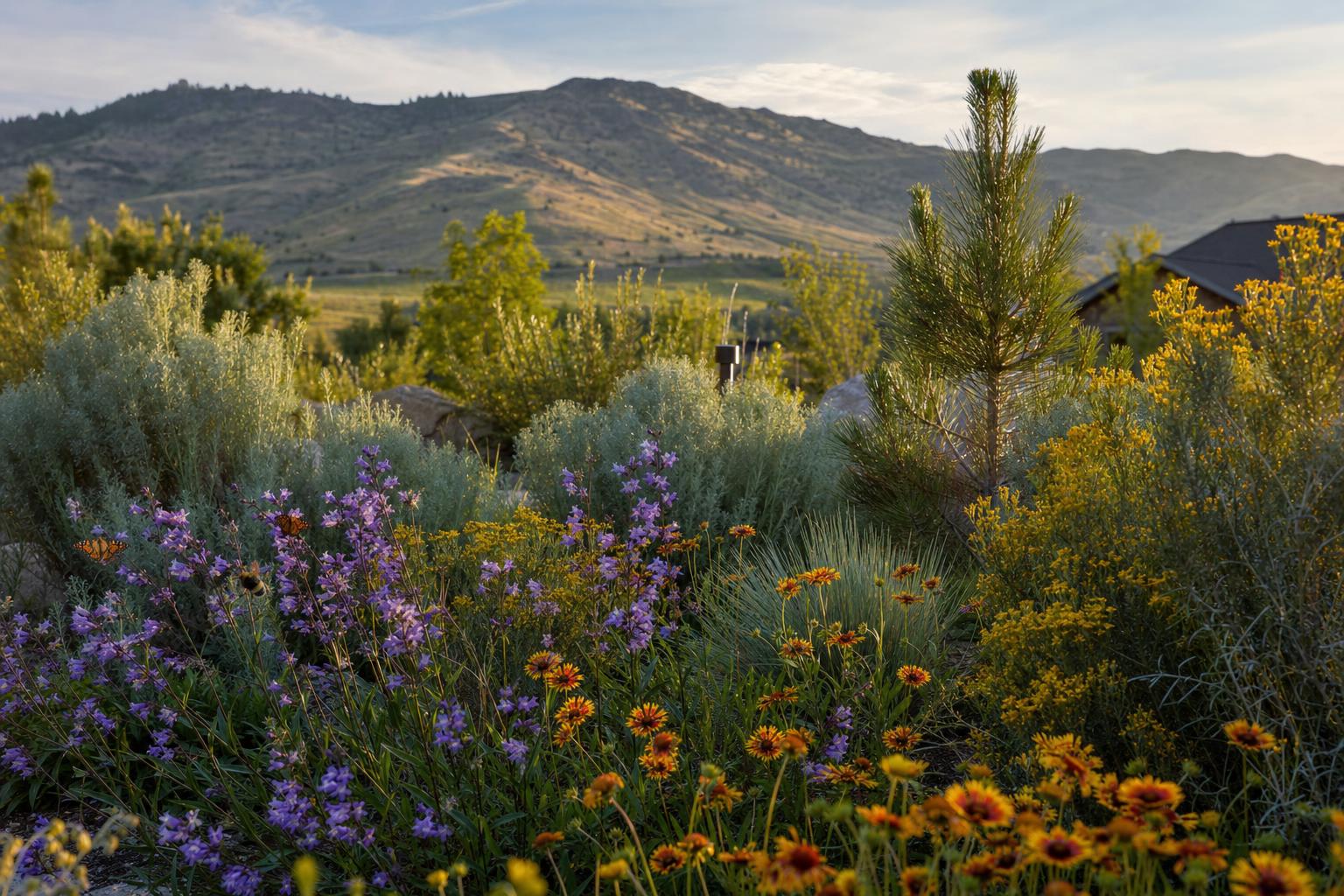
Native and climate-adapted plants help Treasure Valley yards become more resilient, lower-maintenance, and more supportive of pollinators. The goal is not to make every landscape look wild — it is to use plants that fit our high-desert climate and still create structure, color, and curb appeal.
The Treasure Valley sits at roughly 2,500 feet elevation in a semi-arid high-desert climate. We receive about 11 inches of precipitation annually, mostly between November and May. Summers are hot and dry with highs regularly above 95°F. Winters are relatively mild but can dip below zero during Arctic intrusions. Soils tend to be alkaline (pH 7.5–8.5) and range from silty loam to sandy-clay loam. Plants that thrive here are built for drought, alkaline soil, intense sun, and wide temperature swings.
Why choose natives?
Native plants are uniquely adapted to Idaho's arid conditions, alkaline soils, and harsh seasonal swings. Once established, they typically get the water they need from rainfall alone. They resist local pests and diseases, require fewer chemicals, and support local pollinators and wildlife — including hummingbirds, native bees, butterflies, and songbirds. For the homeowner, that means less watering, less fertilizing, and less fussing.
You don't have to go fully native. Even incorporating 30–40% natives into a traditional landscape reduces water use and maintenance while supporting biodiversity. The key is choosing the right plant for the right place.
Trees
| Tree | Sun | Water | Mature size | Why it works |
|---|---|---|---|---|
| Ponderosa Pine Pinus ponderosa | Full sun | Low | 60–100 ft | Deep roots, orange bark, drought champion. Iconic Idaho evergreen. |
| Western Hackberry Celtis reticulata | Full sun | Low | 20–30 ft | Tough shade tree with corky bark and bird-attracting berries. |
| Quaking Aspen Populus tremuloides | Sun/part shade | Medium | 20–50 ft | Iconic fluttering leaves, golden fall color. Best in groups with consistent moisture. |
| Rocky Mountain Juniper Juniperus scopulorum | Full sun | Low | 15–25 ft | Dense evergreen, blue-gray foliage, berry-like cones. Excellent screen or accent. |
| Serviceberry Amelanchier alnifolia | Sun/part shade | Low–Med | 10–20 ft | White spring flowers, edible berries, golden fall color. Multi-season star. |
Shrubs
| Shrub | Sun | Water | Mature size | Why it works |
|---|---|---|---|---|
| Russian Sage Perovskia atriplicifolia | Full sun | Low | 3–4 ft | Airy silver foliage, lavender-blue blooms all summer. Hummingbird magnet. |
| Blue Star Juniper Juniperus squamata | Full sun | Low | 2–3 ft | Silvery-blue evergreen, thrives in dry soils. Excellent groundcover texture. |
| Rabbitbrush Ericameria nauseosa | Full sun | Very low | 3–5 ft | Bright yellow fall flowers, silver foliage, extreme drought tolerance. Late pollinator food. |
| Antelope Bitterbrush Purshia tridentata | Full sun | Very low | 3–8 ft | Native to dry western slopes. Rose family. Supports wildlife. Thrives on little water. |
| Amber Jubilee Ninebark Physocarpus opulifolius | Sun/part shade | Low–Med | 5–7 ft | Orange-gold-green foliage, white blooms. Cold-hardy and drought-tolerant. |
| Snowberry Symphoricarpos alba | Sun/shade | Low–Med | 3–6 ft | White berries persist into winter. Wildlife food. Adaptable to shade. |
| Red Osier Dogwood Cornus sericea | Sun/part shade | Medium | 6–9 ft | Red winter stems, white spring flowers, fall fruit. Best in moist spots. |
| Woods' Rose Rosa woodsii | Full sun | Low | 3–6 ft | Wild rose with pink blooms and rose hips for birds. Superb adaptability. |
Ornamental Grasses
| Grass | Sun | Water | Mature size | Why it works |
|---|---|---|---|---|
| Karl Foerster Feather Reed Grass Calamagrostis acutiflora | Full sun | Low–Med | 4–5 ft | Tall, graceful, golden plumes. Drought-tolerant once established. Vertical accent. |
| Bluebunch Wheatgrass Pseudoroegneria spicata | Full sun | Very low | 2–4 ft | Most drought-resistant native bunchgrass. Roots reach 6+ feet deep. Supports wildlife. |
| Basin Wildrye Leymus cinereus | Full sun | Low | 3–5 ft | Tall native bunchgrass with blue-green foliage. Excellent for arid-zone texture. |
Perennials
| Perennial | Sun | Water | Bloom | Why it works |
|---|---|---|---|---|
| Blanket Flower Gaillardia aristata | Full sun | Low | Summer–Fall | Cheerful red-and-yellow daisy blooms all summer. Loves dry, hot spots. |
| Rocky Mountain Penstemon Penstemon strictus | Full sun | Low | Late Spring–Summer | Spikes of purple-blue flowers. Hummingbird favorite. Idaho native. |
| Yarrow Achillea millefolium | Full sun | Low | Summer | Ferny foliage, clusters of white-to-pink blooms. Loves dry, rocky soils. |
| Red Hot Poker Kniphofia uvaria | Full sun | Low–Med | Summer | Torch-like red-orange-yellow flowers. Attracts hummingbirds. Loves heat. |
| Lavender Lavandula angustifolia | Full sun | Low | Summer | Fragrant, silver foliage, purple blooms. Needs well-drained soil. Perfect in arid zones. |
| Catmint Nepeta faassenii | Full sun | Low | Spring–Fall | Long-blooming purple flowers, fragrant foliage. Drought-tolerant groundcover. |
| Showy Milkweed Asclepias speciosa | Full sun | Low–Med | Summer | Large pink blooms. Monarch butterfly host plant. Idaho native. |
| Arrowleaf Balsamroot Balsamorhiza sagittata | Full sun | Very low | Spring | Bright yellow sunflower-like blooms. Iconic Boise Foothills plant. |
Groundcovers
Groundcovers fill the gaps between larger plants, suppress weeds, and reduce the bare mulch that blows around in Treasure Valley winds. The best options here are low-water, sun-loving, and tough enough to survive our temperature swings without coddling.
| Groundcover | Sun | Water | Mature size | Why it works |
|---|---|---|---|---|
| Kinnikinnick / Bearberry Arctostaphylos uva-ursi | Sun/part shade | Low | 6–12 in tall, 3–6 ft spread | Evergreen glossy leaves, white-pink bell flowers, red berries. Replaces lawn on slopes and under trees. |
| Creeping Thyme Thymus serpyllum | Full sun | Low | 2–4 in tall, 12–18 in spread | Walkable, fragrant, pink-purple summer blooms. Tolerates light foot traffic between flagstone. |
| Silver Buffaloberry (low forms) Shepherdia argentea | Full sun | Very low | 6–12 ft (use dwarf selections as groundcover) | Silver foliage, nitrogen-fixing, edible berries. Extremely drought-hardy native of the Intermountain West. |
| Penstemon 'Pike's Peak Purple' Penstemon x mexicali | Full sun | Low | 8–12 in tall, 12 in spread | Low carpet of magenta flowers all summer. Better behaved than some native penstemons for small beds. |
| Woolly Yarrow Achillea tomentosa | Full sun | Low | 6–10 in tall, 12–18 in spread | Ferny silver-green mat, bright yellow flat blooms. Handles poor, dry soil and reflected heat. |
Design tip: Layer your plantings. Use trees for structure and shade, shrubs for mid-height mass and texture, grasses for movement and winter interest, and perennials for color bursts. A typical bed might include a Ponderosa Pine as a focal point, a cluster of Russian Sage and Blue Star Juniper for mid-height, Karl Foerster grass for vertical accents, and Blanket Flower and Penstemon for foreground color.
Three ready-to-plant design combinations
Not sure where to start? These three planting combinations are built from the tables above and tuned to common Treasure Valley yard situations. Each one works in Zone 6b–7a with alkaline soil and minimal summer water after the first year.
1. The Curb-Appeal Front Bed (full sun, 8 × 4 ft)
- Backbone: one Serviceberry (Amelanchier alnifolia) for spring bloom, summer berries, and golden fall color.
- Mid-layer: three Russian Sage (Perovskia atriplicifolia) planted in a loose triangle for summer-long lavender haze.
- Foreground: five Blanket Flower (Gaillardia aristata) and three Catmint (Nepeta faassenii) alternating along the front edge for continuous color June–September.
- Result: four seasons of interest, roughly 5–7 gallons of water per week in year one, tapering to rainfall-only by year three.
2. The Pollinator Border (full sun, 12 × 3 ft strip)
- Tall backdrop: three Karl Foerster Feather Reed Grass (Calamagrostis acutiflora) for vertical structure and winter interest.
- Bloom core: Showy Milkweed (Asclepias speciosa) for monarchs, Rocky Mountain Penstemon (Penstemon strictus) for hummingbirds, and Red Hot Poker (Kniphofia uvaria) for late-summer color.
- Edge: creeping thyme between stepping stones so every step releases fragrance and feeds bees.
- Result: a pollinator highway from May through frost — expect hummingbirds, native bumblebees, and monarchs once the milkweed matures.
3. The Dry Hot Corner (full sun, reflected heat, 6 × 6 ft)
- Anchor: one Rocky Mountain Juniper (Juniperus scopulorum) for year-round evergreen structure.
- Mass: five Rabbitbrush (Ericameria nauseosa) for late-September yellow bloom when everything else has finished.
- Ground: Kinnikinnick (Arctostaphylos uva-ursi) spreading underneath, plus Bluebunch Wheatgrass (Pseudoroegneria spicata) for texture.
- Result: the toughest spot in the yard — against a west-facing wall or beside a driveway — handled with zero supplemental water after establishment.
Invasive plants to avoid in the Treasure Valley
Some plants sold at big-box stores are invasive in Idaho and can escape into wildlands, crowd out natives, and create expensive removal problems. Idaho law designates 71 noxious weeds statewide, and Ada County lists six "Most Wanted" weeds already naturalized here. Even plants that are not legally noxious can be aggressive self-seeders in our climate. Before you buy, check this list — and if a plant is flagged, choose a native alternative instead.
| Avoid | Why it's a problem | Native alternative |
|---|---|---|
| Scotch Broom Cytisus scoparius | Idaho prohibited genus. Aggressive seed spread, crowds out natives, fire hazard. | Russian Sage or Woods' Rose |
| Dyer's Woad Isatis tinctoria | Ada County EDRR weed. Forms dense monocultures on rangeland and roadsides. | Arrowleaf Balsamroot |
| Purple Loosestrife Lythrum salicaria | Invades wetlands and irrigation ditches throughout the Treasure Valley. | Red Osier Dogwood (for moist sites) |
| Puncturevine Tribulus terrestris | Ada County "Most Wanted." Spiny seed heads puncture bike tires and injure pets. Thrives in dry bare soil. | Creeping Thyme (between pavers) |
| Canada Thistle Cirsium arvense | Ada County "Most Wanted." Creeping roots make it nearly impossible to eradicate once established. | Native thistles are rare in nurseries — use Yarrow for similar texture. |
| Rush Skeletonweed Chondrilla juncea | Ada County "Most Wanted." Airborne seeds colonize disturbed rangeland across the valley. | Bluebunch Wheatgrass for dry open areas. |
| Myrtle Spurge Euphorbia myrsinites | Popular in xeriscapes but listed noxious in several western states; self-seeds aggressively. Sap is a skin irritant. | Sedum 'Autumn Joy' or Woolly Yarrow |
| Butterfly Bush Buddleja davidii | Not legally noxious in Idaho but a watch-list self-seeder in riparian areas. Sterile cultivars ('Lo & Behold', 'Pugster') are safer. | Showy Milkweed for monarchs, Rabbitbrush for late bloom. |
If you spot a noxious weed: Ada County Noxious Weed Control (208) 577-4646 can help with identification and removal guidance. Report early-detection species like Dyer's Woad, Bohemian Knotweed, or Purple Loosestrife the same season you find them — rapid response is required by Idaho law and is far cheaper than letting a patch establish.
Where to find native plants in the Treasure Valley
Big-box garden centers carry a limited native selection. For the best variety and locally grown stock, shop the independent nurseries and sales below. Many native plants sell out by late May, so call ahead or shop early in the season.
- Edwards Greenhouse & Flowershop — 4106 Sand Creek St, Boise. Family-owned since 1930. Open year-round. Carries a rotating selection of drought-tolerant perennials and shrubs suited to the valley. (208) 342-7548.
- Idaho Botanical Garden Plant Sale — annual spring sale with roughly 300 curated varieties selected for Idaho landscapes, including natives and water-wise plants. Members get early access.
- Idaho Native Plant Society — Pahove Chapter Sale — held each spring (typically late April) at the MK Nature Center in Boise. The most reliable source of true Idaho natives, grown by chapter members. Sells out fast — arrive early.
- Idaho Land & Conservation native species nurseries list — the Idaho Land Collaborative maintains a directory of nurseries across the state that sell native and xeric species, including several in the Boise area.
- Ada Soil & Water Conservation District — publishes free water-wise gardening resources and locally specific plant lists for Treasure Valley homeowners. A good starting point before you shop.
The Idaho Botanical Garden's Lewis and Clark Native Plant Garden is the best place in the valley to see mature natives in a landscape setting before you buy — bring a notebook and photograph plants that catch your eye, then ask nursery staff for those species by name.
Planting tips for success
- Plant in fall or early spring — September–October or April–May. Cooler temperatures and natural moisture help roots establish before summer stress.
- Water deeply at planting — even drought-tolerant plants need regular water for their first growing season. Taper off in year two.
- Use the finger test — stick your finger 2 inches into the soil. If it's moist, skip watering. If it's dry, water deeply.
- Mulch with bark — 2–3 inches around plants (not against the crown) to retain moisture and regulate soil temperature.
- Don't amend soil for true natives — many natives prefer our alkaline, lean soils. Over-amending can make them grow weak and leggy.
- Provide wind protection — Treasure Valley afternoon winds can desiccate young plants. Temporary windbreaks or strategic placement help establishment.