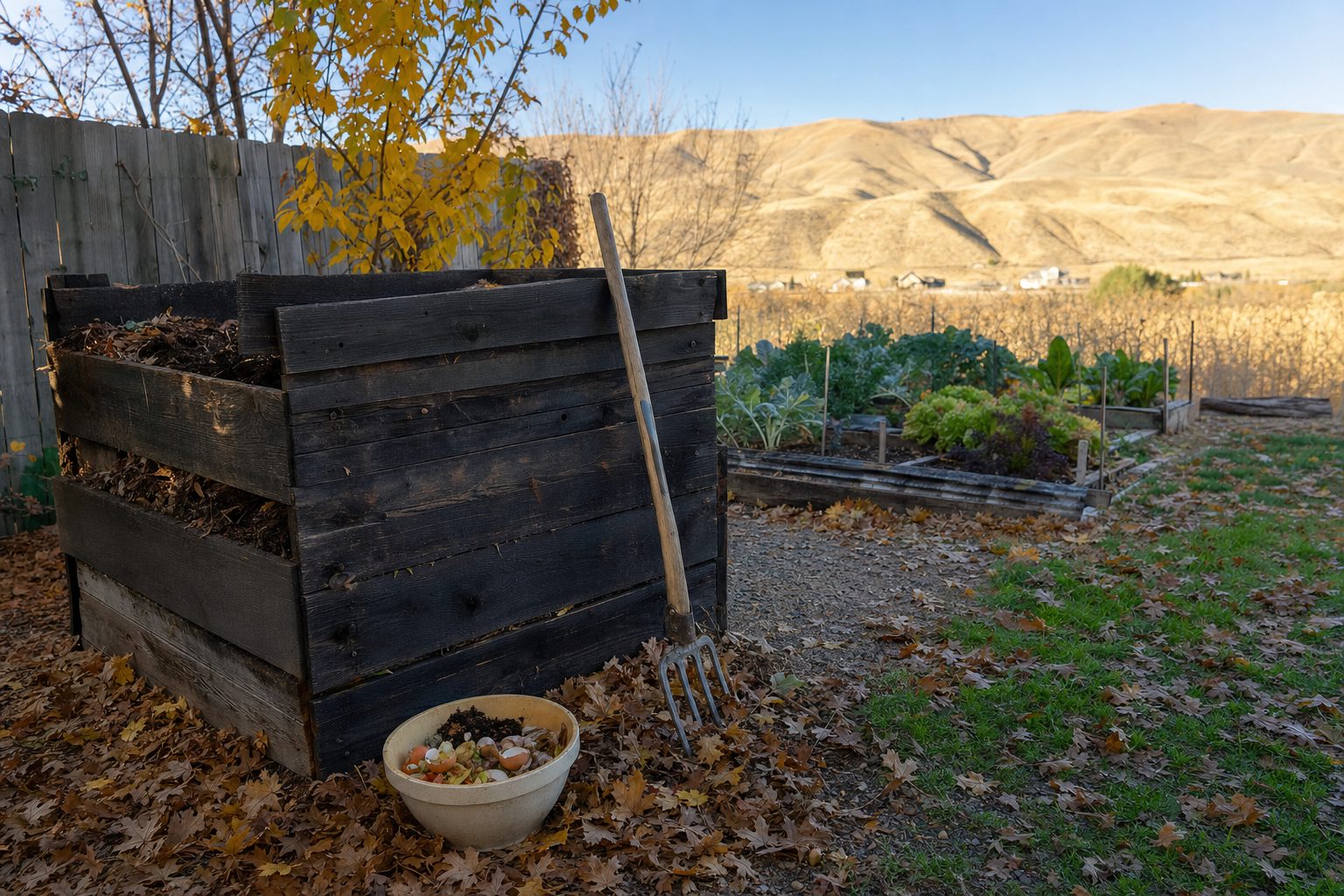
Compost is the single most valuable soil amendment a Treasure Valley gardener can make — and you can produce it yourself for free from materials you're already throwing away. In a valley where soils are alkaline, low in organic matter, and often compacted, compost is the slow-release fix that improves everything: drainage in clay, water-holding in sand, microbial life in sterile subsoil, and nutrient availability where high pH locks up iron and manganese.
This guide covers how to build a backyard compost system that actually works in Idaho's high-desert climate, where the rules are different from what you'll read in books written for the Pacific Northwest or the East Coast. We'll cover bin types, the carbon-to-nitrogen ratio, what to compost (and what to leave out), troubleshooting common Treasure Valley composting problems, how to use your finished compost, and where to get compost locally if you don't want to make your own.
Why composting matters in the Treasure Valley
The Treasure Valley receives only 12–14 inches of precipitation per year in Boise, and even less in Nampa and Caldwell to the west. That's a high-desert climate, and it shapes everything about how compost behaves here. In humid climates, compost piles stay moist naturally and decompose quickly. Here, the combination of low humidity, intense summer sun, and drying winds means a compost pile left unattended will desiccate into a dry, inert pile of brown material that never breaks down.
But the same dry climate is also why compost is so valuable here. Our native soils typically contain less than 2% organic matter — compared to 5–8% in forested regions. Every handful of compost you add is rebuilding the organic matter that was never there (or was stripped during construction). The University of Idaho Extension recommends incorporating 2–3 inches of compost into garden beds each season to maintain productive soil in our climate, and that much compost costs $30–$50 per cubic yard if purchased — but costs nothing if you make it from your own yard and kitchen waste.
Boise's citywide Curb It compost program, which serves 97% of participating households, composts over a third of all collected residential waste each year. The finished compost is STA-certified through the US Composting Council and available free to Boise residents (2 cubic yards per household per year). That program proves the scale is possible — but backyard composting gives you control over the quality and means you don't have to drive across town to pick it up.
How composting works: the basics
Composting is controlled decomposition. Microorganisms — bacteria, fungi, actinomycetes — break down organic material into a dark, crumbly, earthy-smelling substance called humus. The process requires four things in balance:
- Carbon — the energy source. "Brown" materials: dried leaves, straw, wood chips, shredded paper, cardboard, pine needles.
- Nitrogen — the protein source for microbial growth. "Green" materials: grass clippings, kitchen scraps, coffee grounds, garden trimmings, manure.
- Water — microbes need moisture. The pile should feel like a wrung-out sponge: damp but not dripping.
- Oxygen — the microbes doing the work are aerobic. Without air, the pile goes anaerobic and starts to smell.
The ideal carbon-to-nitrogen (C:N) ratio for a compost pile is roughly 30:1 by volume. In practice, this means roughly three parts brown material to one part green material. Too much carbon and the pile decomposes slowly; too much nitrogen and it goes anaerobic, producing ammonia and a rotten-egg smell.
Choosing a compost bin for Idaho's climate
The right bin for the Treasure Valley needs to address our specific challenges: dry air that desiccates open piles, cold winters that slow decomposition to a near-stop, and occasional wildlife (raccoons in Boise's North End, deer in the Foothills, dogs in rural areas of Kuna and Star) that will investigate anything that smells like food.
| Bin type | Cost | Best for | Dry-climate pros & cons |
|---|---|---|---|
| Enclosed tumbler | $100–$250 | Small yards, fast results, easy turning | Sealed drum retains moisture well — excellent for dry climate. Batch composting only (fill, tumble, wait). Can't add material continuously. |
| Stationary plastic bin | $40–$100 | Beginners, continuous feed | Lid retains some moisture. Solid sides block wind. Slow decomposition (6–12 months). Hard to turn. |
| Wooden slat bin (DIY) | $30–$60 in lumber | Large yards, serious composters | Slats allow some airflow but lose moisture faster than enclosed bins. Easy to turn with a fork. Can build a second bay for batch processing. |
| Wire mesh bin | $15–$30 | Leaf composting, rural properties | Cheapest option. Loses moisture rapidly — needs frequent watering in summer. Best for fall leaves (abundant, free) rather than food scraps. |
| Open pile (no bin) | $0 | Large properties, leaf piles | Free but loses moisture fastest. Will not work for food scraps (wildlife). Only practical for leaves, grass, and garden trimmings on rural lots in Kuna, Star, or rural Caldwell. |
| Vermicomposting bin | $50–$150 | Indoor/winter composting, apartment dwellers | Red wigglers (Eisenia fetida) process kitchen scraps fast. Must be kept in a garage or shed — worms die below 40°F and above 85°F. Excellent for Meridian and Nampa homeowners who want year-round composting without a outdoor pile. |
The Treasure Valley moisture problem
In nearly every other part of the country, composting advice focuses on aeration — keeping the pile from getting too wet and going anaerobic. Here, the opposite is true: your pile will dry out. An unmanaged pile in July will have moisture content below 20% (the threshold for microbial activity is 40–60%). The single most important maintenance task for Treasure Valley compost is adding water. Check moisture weekly during summer — dig 12 inches in and squeeze a handful. If no water comes out, the pile is too dry. If it drips, it's too wet. Aim for a damp-sponge feel.
What to compost (and what not to)
Do compost — "browns" (carbon)
- Dried leaves (oak, maple, ash, elm — all common Treasure Valley street trees)
- Straw and hay (not hay with weed seeds)
- Wood chips and shredded bark (from local arborists — many deliver free)
- Shredded cardboard and brown paper (no glossy/colored print)
- Newspaper (shredded, black ink only)
- Pine needles (acidic — use in moderation, but fine in a mixed pile)
- Sawdust (in thin layers — it compacts and can go anaerobic if too thick)
- Dried garden trimmings (sunflower stalks, corn stalks, bean vines)
Do compost — "greens" (nitrogen)
- Fruit and vegetable scraps (all — including citrus, which breaks down fine despite the myth)
- Coffee grounds and filters (high in nitrogen — Starbucks on Milwaukee St. in Boise gives away grounds for free through their Grounds for Your Garden program)
- Tea bags (remove any plastic mesh bags — paper bags and loose leaf only)
- Grass clippings (fresh — but mix in thin layers to prevent matting and odor)
- Garden trimmings (green, non-diseased plant material)
- Eggshells (crushed — add calcium, slow to decompose)
- Horse, cow, chicken, and rabbit manure (herbivore only — age 6 months before using finished compost on food crops)
- Hair and fur (breaks down slowly but adds nitrogen)
Do NOT compost
- Meat, bones, fish, and dairy — attract wildlife, create odor, and break down slowly. (Note: Boise's municipal Curb It program does accept these in curbside carts because the facility reaches industrial composting temperatures — your backyard bin will not.)
- Pet waste (dog and cat feces) — can carry pathogens and parasites. Never add to compost that will be used on food crops.
- Diseased plants — home compost piles rarely reach the 131°F+ needed to kill plant pathogens. Bag and trash diseased material, especially if you suspect blight, powdery mildew, or curly top virus (common on Treasure Valley tomatoes).
- Weeds with seeds — unless your pile consistently reaches 140°F+ (hot composting), weed seeds will survive and spread when you use the compost. Bindweed (Convolvulus arvensis), one of the Treasure Valley's worst weeds, is especially persistent.
- Treated wood — pressure-treated lumber, painted wood, and plywood contain preservatives that persist in compost.
- Charcoal ash and coal ash — contain heavy metals and sulfur. Wood ash from untreated wood is acceptable in small amounts (it adds potassium and raises pH, which is already high here — so use sparingly if at all).
- Compostable bioplastics — "compostable" plates, cups, and bags require industrial composting temperatures (140°F+) to break down. They will not decompose in a backyard bin. Boise's Curb It program does not accept them either.
- Glossy or colored paper — the inks and coatings can contain heavy metals. Stick with black-ink newspaper and plain brown cardboard.
Building your pile: the layer method
The most reliable approach for a beginner is the "lasagna" or layer method. Start with a 4×4 foot bin (or a 3×3 foot section of a tumbler) and build alternating layers:
- Base layer (4–6 inches) — coarse brown material: twigs, wood chips, or thick stems. This creates airflow at the bottom and prevents the pile from becoming a wet, anaerobic mass.
- Green layer (2–3 inches) — kitchen scraps, grass clippings, coffee grounds. Water lightly if dry.
- Brown layer (4–6 inches) — dried leaves, straw, shredded paper. This is your carbon reservoir.
- Thin soil layer (½ inch) — a sprinkling of garden soil or finished compost adds the starter microbes. Don't use potting mix — it's sterile. Native Treasure Valley soil works fine.
- Repeat — alternate green and brown layers until the bin is full. Always top with a brown layer to deter flies and wildlife.
The pile should be at least 3 feet wide and 3 feet tall for the core to heat up — smaller piles don't generate enough microbial mass to reach the 120–140°F range that signals active decomposition. A pile built correctly will be warm to the touch within 24–48 hours and will reach peak temperature in 3–5 days.
Hot vs. cold composting
Hot composting — the pile reaches 120–160°F and finishes in 6–8 weeks. Requires turning every 5–7 days, consistent moisture, and a good C:N ratio. Kills weed seeds and most plant pathogens. Best if you need compost fast and are willing to manage the pile actively.
Cold composting — the pile never heats up much and takes 6–18 months. Requires no turning (though turning speeds it up). Does not kill weed seeds or pathogens. Best for lazy composters — just keep adding material and wait. In the Treasure Valley's cold winters, cold composting all but stops from November through March.
For most Treasure Valley homeowners, cold composting is the practical default. You add kitchen scraps and yard waste as you generate them, keep the pile damp, and harvest finished compost from the bottom once or twice a year. Hot composting is worth the effort if you have a large garden and want to produce significant volume, or if you need to kill weed seeds in material you're composting.
The Treasure Valley seasonal composting calendar
March – April
Spring awakening. Turn the pile for the first time since fall. Add water if dry — the freeze-thaw cycle of Idaho winters actually helps break down material physically even when microbial activity stops. Start adding green material as lawn mowing and garden cleanup begin.
May – June
Peak composting season. Warm temperatures mean fast decomposition (2–4 weeks for a hot pile). Grass clippings are abundant — mix with browns immediately to prevent the classic "slimy green mass" problem. Check moisture weekly; our dry springs can desiccate a pile in days.
July – August
Harvest finished compost from the bottom of the pile for fall garden prep. The pile needs frequent watering in our hottest, driest months — water deeply every 5–7 days. Cover with a tarp or lid to retain moisture. Decomposition slows but doesn't stop if moisture is maintained.
September – October
The golden season for composting in the Treasure Valley. Autumn leaves are the single best free carbon source available — stockpile them in a separate bin or in bags for year-round use. Mix the fall leaf surplus with end-of-season garden waste. Build a new hot pile now and it can finish before the ground freezes.
November – February
Decomposition essentially stops when the pile freezes. Don't worry — it will resume in spring. Keep adding kitchen scraps to the top; they'll freeze and then break down rapidly when temperatures rise. Insulate the bin with a layer of straw or leaves to keep the core active longer into the season.
Year-round
Keep a container on your kitchen counter for daily scraps. A simple lidded bucket works; a stainless steel pail with a charcoal filter ($25–$40) controls odor. Empty into the outdoor bin every 2–3 days. In summer, bury fresh scraps 6 inches deep in the pile to prevent fruit flies.
Troubleshooting common problems
The pile smells like rotten eggs or ammonia
Cause: Too much nitrogen (greens) and not enough air. The pile has gone anaerobic.
Fix: Turn the pile thoroughly and add a generous layer of brown material (dried leaves, straw, shredded paper). If the pile is soaking wet, add dry browns to absorb moisture. Don't add greens until the smell subsides.
The pile isn't breaking down
Cause: Most commonly in the Treasure Valley — the pile is too dry. Other causes: too much carbon (all browns, no greens), the pile is too small, or it's winter.
Fix: Check moisture first. Dig in 12 inches, grab a handful, and squeeze — if it crumbles with no moisture, water the pile deeply and turn it. If the pile is dry but well-mixed, water it and cover with a lid or tarp. If it's all browns, add fresh greens or coffee grounds. If the pile is smaller than 3×3 feet, add more material to build mass.
The pile attracts flies and fruit flies
Cause: Kitchen scraps exposed on the surface.
Fix: Always cover fresh green material with a layer of brown (leaves, straw, soil). Bury food scraps at least 6 inches deep. In summer, keep a bucket of "cover material" (sawdust, shredded leaves, or soil) next to the bin to throw on top every time you add scraps.
Animals are getting into the bin
Cause: Food scraps accessible to raccoons, dogs, or rodents. Most common in established neighborhoods (Boise's North End, East End, and Bench areas have active raccoon populations).
Fix: Use an enclosed bin with a secure lid (tumbler or solid plastic bin). Bury all food scraps deep in the pile. Never add meat, dairy, or oils. If rodents are a persistent problem, line the bottom of the bin with ½-inch hardware cloth to prevent burrowing.
The pile is matted and wet
Cause: Too many grass clippings in a single layer. Grass mats into a wet, anaerobic mass that smells and decomposes poorly.
Fix: Always mix grass clippings with an equal or greater volume of brown material immediately when adding them. Spread clippings thin — never dump a bag in as a single layer. Turn the pile to break up the mat and add dry browns.
Using your finished compost
Compost is "finished" when it's dark, crumbly, and earthy-smelling, and you can no longer identify the original materials (except perhaps the occasional eggshell or woody twig). This takes 2–6 months for a hot pile and 6–18 months for a cold pile.
Garden beds — the annual amendment
Spread 2–3 inches of compost over vegetable and flower beds each spring or fall and incorporate it into the top 8–12 inches of soil. This is the University of Idaho Extension's standard recommendation for maintaining productive garden soil in the Treasure Valley. One cubic yard of compost covers 162 square feet at 2 inches deep.
New tree and shrub planting
Mix compost with native soil at a ratio of 1 part compost to 3 parts native soil for backfill. Do not fill the planting hole with pure compost — this creates a "bathtub" effect in caliche soils where the hole fills with water and drowns the roots. Top-dress with 2–3 inches of compost as mulch around the drip line.
Lawn top-dressing
After core aeration in spring or fall, spread ¼ inch of compost across the lawn and rake it into the aeration holes. This delivers organic matter and microbes directly to the root zone. A cubic yard of compost top-dresses about 1,300 square feet of lawn at ¼ inch.
Mulch around trees and shrubs
Apply 2–3 inches of compost as mulch in a ring around trees and shrubs, extending to the drip line. Keep compost 2–3 inches away from the trunk to prevent rot. Compost mulch suppresses weeds, conserves moisture, and slowly feeds the tree as it breaks down. Reapply annually.
Compost tea (optional)
For gardeners who want to give plants a fast nutrient boost, compost tea is made by steeping finished compost in water for 24–48 hours (1 part compost to 5 parts water, aerated with a small pump). The resulting liquid can be applied as a foliar spray or soil drench. It's not a substitute for solid compost but can provide a quick microbial and nutrient boost for stressed plants.
Where to get compost locally if you don't make your own
If you don't want to compost at home — or can't produce enough for your needs — several local sources offer finished compost in the Treasure Valley:
- City of Boise Compost Program — Free finished compost for Boise residents (2 cubic yards per household per year). STA-certified, regularly tested for pathogens and metals. Pickup at the Joplin Road site, open daily 9 AM – 7 PM. cityofboise.org
- Boise Compost (Drummand, Inc.) — Commercial compost facility serving the broader Treasure Valley. Sells bulk compost by the cubic yard and bagged product. drbcompost.com
- Ground Keeper, Inc. — Local landscape supply with compost, topsoil blends, and mulch. Delivery available in Boise and Meridian. groundkeeperinc.com
- Eden's Garden Supply — Organic compost, soil amendments, and worm castings. 5300 W. State St., Boise. edensgardensupply.com
- The Home & Garden Store — Bagged compost, soil test kits, and expert advice on Treasure Valley soils. 4828 N. Cole Rd., Boise. thehomeandgardenstore.com
- Local arborists — Many tree service companies (Mountain West Arborists, Action Tree Service, Zollman Tree Service) will deliver a truckload of wood chips for free or cheap. These are excellent brown material for composting or can be used directly as mulch.
Free coffee grounds — Boise's hidden compost resource
Starbucks stores across Boise participate in the "Grounds for Your Garden" program, offering free spent coffee grounds to anyone who asks. Coffee grounds are nitrogen-rich (C:N ratio of about 20:1) and make an excellent compost activator. The Starbucks on Milwaukee St. (near BSU), on Fairview Ave. in Meridian, and on Caldwell Blvd. in Nampa all participate. Bring a bucket or container — they'll fill it for free. The grounds are typically available in the afternoon after the morning rush.
How much compost do you need?
Compost is sold by the cubic yard (27 cubic feet). Here's a quick reference for common Treasure Valley landscaping projects:
| Project | Depth | Coverage per cu yd | Typical cost (bulk) |
|---|---|---|---|
| Garden bed amendment | 2 inches | 162 sq ft | $30–$50/cu yd |
| Lawn top-dressing | ¼ inch | 1,300 sq ft | $30–$50/cu yd |
| New lawn (pre-planting incorporation) | 1 inch | 324 sq ft | $30–$50/cu yd |
| Mulch ring around trees | 3 inches | 108 sq ft | $30–$50/cu yd |
For a typical 1,000 square foot yard needing a 2-inch top-dress, you'll need about 6 cubic yards of compost — roughly $180–$300. The same amount costs nothing if you produce it from your own yard waste over 2–3 seasons.
Composting and the Treasure Valley's water future
Every inch of compost added to soil increases its water-holding capacity by approximately 1 quart per cubic foot. In a valley where irrigation water is allocated and drought years are becoming more common, building soil organic matter through composting is one of the most effective things a homeowner can do to reduce water consumption. The Boise Public Works Department, which manages the Curb It compost program, notes that composting preserves landfill space and reduces greenhouse gas emissions — but the water-saving benefit of returning that compost to local soils may be even more significant in our arid climate.
A lawn growing in soil with 5% organic matter needs roughly 30% less irrigation water than the same lawn in soil with 1% organic matter. Over a growing season (May–October, roughly 180 days of irrigation), that can mean 30,000+ gallons saved on a quarter-acre lot. Composting is not just a waste-reduction strategy in the Treasure Valley — it's a water strategy.