Treasure Valley Irrigation Guide
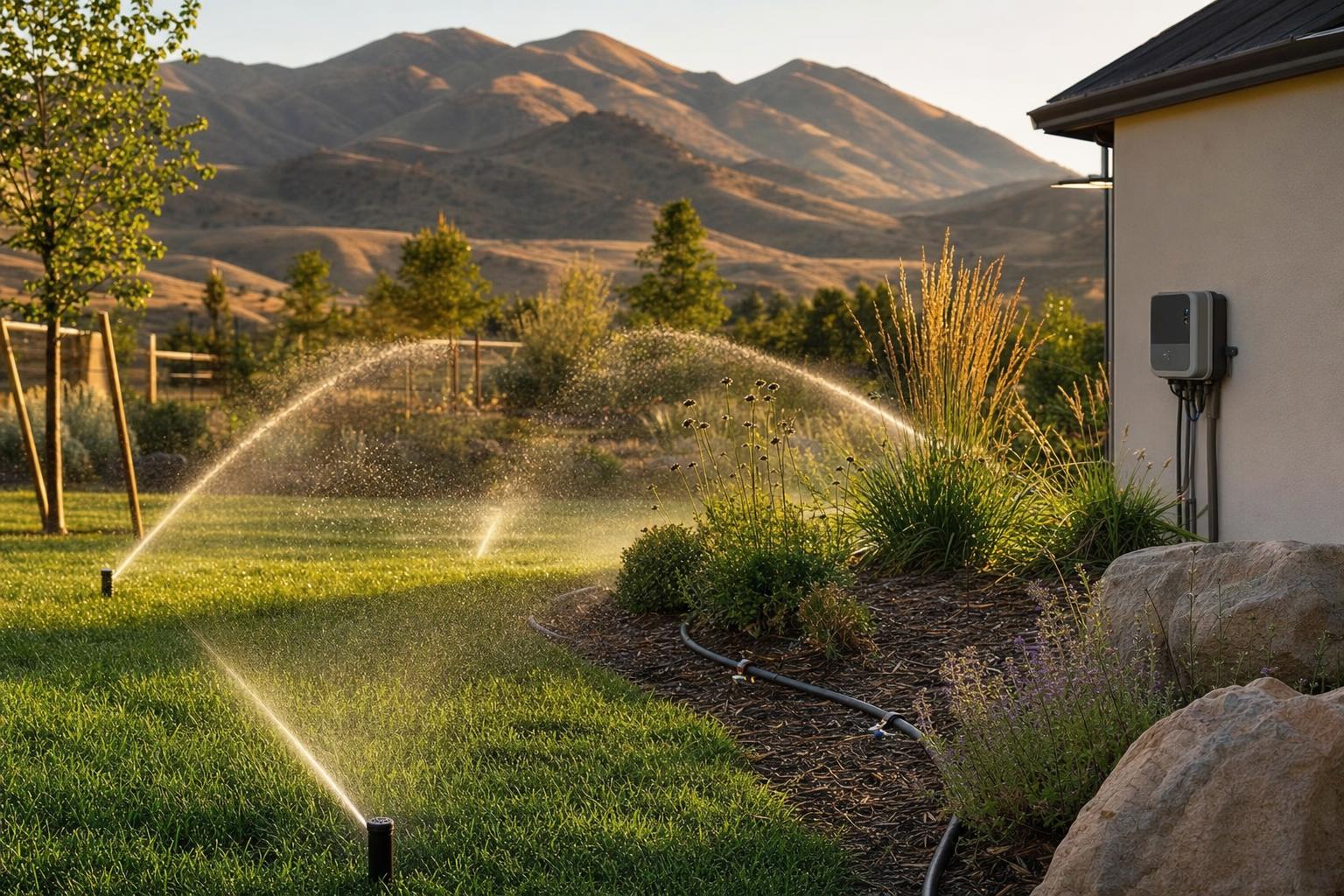
In the Treasure Valley's high-desert climate, irrigation is not optional — most lawns and gardens need supplemental water from May through October. This guide covers everything from understanding the valley's unique pressure irrigation systems to choosing a smart controller, designing sprinkler zones, running drip lines, and winterizing before the first hard freeze.
The Treasure Valley receives only about 11 inches of precipitation annually, most of it between November and May. From June through September, rainfall is scarce — Boise averages less than half an inch in July and August combined. That means every homeowner who wants a green lawn, productive vegetable garden, or healthy landscape needs a reliable irrigation strategy. Whether you are starting from scratch on a new lot in Meridian or upgrading a decades-old system in Boise's North End, the principles below apply.
Understanding Treasure Valley water sources
One of the most confusing aspects of landscaping in the Treasure Valley is that your water source depends on where you live. There are three main scenarios:
Pressure irrigation (irrigation district water)
Many subdivisions built in the last 25 years — across Boise, Meridian, Nampa, and Eagle — are served by a pressurized urban irrigation system (PUIS). This is a separate water system from your drinking water, fed by irrigation canals that draw from the Boise River. The water is pressurized to 40–60 psi by district pump stations and delivered to your property through a dedicated irrigation meter or valve.
Key facts about pressure irrigation:
- Season: Water is typically available from mid-April through the first week of October, depending on your irrigation district and annual water supply.
- Cost: Approximately $90 per year for a quarter-acre lot through the Nampa & Meridian Irrigation District (NMID) — far cheaper than irrigating with city water.
- Watering schedules: Most districts assign watering days based on your address (even-numbered days for even addresses, odd-numbered days for odd addresses). Some subdivisions use zone-based schedules. Check with your district for specifics.
- Filtering: Water is filtered to 1/16 inch. Use sprinkler components that accommodate 1/16-inch particles; secondary filters are usually unnecessary.
- Flow limits: Home sprinkler systems on pressure irrigation should be designed not to exceed 5–7 gallons per minute per watering station (zone).
Major irrigation districts in the Treasure Valley include:
| District | Phone | Service area |
|---|---|---|
| Nampa & Meridian Irrigation District (NMID) | (208) 466-7861 | Nampa, Meridian, parts of Boise |
| Boise Project Board of Control | (208) 344-1141 | Boise, Eagle |
| Settlers Irrigation District | (208) 344-2471 | Boise (older neighborhoods) |
| New York Irrigation District | (208) 378-1023 | Boise East End, parts of Boise |
| Boise/Kuna Irrigation | (208) 922-5608 | Kuna area |
| Black Canyon Irrigation District | (208) 459-4141 | Caldwell, Emmett area |
| Caldwell Irrigation Lateral District | (208) 454-3477 | Caldwell |
Know your water source before you build: If your home has pressure irrigation, connect your sprinkler system to it — it costs a fraction of city water for irrigation. If you are on city water only (common in older Boise neighborhoods like the North End, East End, and some Bench areas), your sprinkler system ties into your domestic water line with a backflow prevention device. The City of Boise requires backflow testing annually for systems connected to potable water.
City water (domestic)
Older neighborhoods and some newer infill lots use city (potable) water for irrigation. This is more expensive per gallon but available year-round. A backflow prevention device is required by code to keep irrigation water from contaminating your drinking water supply. In Boise, Veolia Water and Capitol Water Company operate the domestic water systems; testing of backflow assemblies is required annually.
Well water
Rural properties in Kuna, Star, and unincorporated Ada/Canyon County may have private wells. Well water is free (after drilling and pump costs) but varies in pressure and quality. High mineral content can clog drip emitters — install a filter with at least 150 mesh (100 micron) filtration. Pressure tanks typically deliver 30–50 psi, which is adequate for most sprinkler systems.
Sprinkler system design basics
A well-designed underground sprinkler system is the backbone of a healthy Treasure Valley landscape. Here is what you need to know whether you are planning a new installation or evaluating an existing system.
Zones: matching heads to heads
The single most important principle in sprinkler design is matching precipitation rates within each zone. A zone is a group of sprinkler heads that turn on and off together, controlled by a single valve. Never mix head types in the same zone — rotors (which cover large areas slowly) and spray heads (which cover small areas quickly) deliver water at very different rates. If you mix them, some areas get too much water and others get too little.
| Head type | Best for | Coverage | Run time for 1 inch |
|---|---|---|---|
| Rotary nozzles (MP Rotators) | Lawns 15–30 ft wide | 0.4 in/hr | ~150 minutes (in 2–3 cycles) |
| Pop-up spray heads | Small lawns, tight strips | 1.5 in/hr | ~40 minutes (split into 2 cycles) |
| Rotor heads (gear-driven) | Large lawns 30–50+ ft | 0.5 in/hr | ~120 minutes (in 2–3 cycles) |
| Drip emitters | Shrubs, trees, perennials, vegetables | 0.5–2.0 gal/hr per emitter | 30–90 minutes, 1–3× per week |
How many zones do you need?
Zone count depends on your water source's flow rate and the size of your landscape. A typical Treasure Valley residential lot (8,000–12,000 sq ft) runs 5–8 zones:
- Front lawn: 1–2 zones (rotary nozzles or rotors)
- Back lawn: 1–2 zones
- Side strips or parkway: 1 zone (small spray heads)
- Planting beds: 1–2 drip zones
- Vegetable garden: 1 drip zone (separate from ornamentals)
If you have pressure irrigation, your flow rate is limited to 5–7 gallons per minute per zone. That means each zone can support about 6–8 rotary nozzles or 4–6 spray heads. Designers typically plan for 6–10 zones on larger lots to ensure adequate coverage without exceeding flow capacity.
Cost of a new sprinkler system
| Project | Cost range | Notes |
|---|---|---|
| New system (full yard, typical lot) | $3,500–$8,000 | 5–8 zones for 8,000–12,000 sq ft |
| Per-zone cost | $500–$1,340 per zone | Includes heads, valves, pipe, controller wiring |
| Pressure irrigation hookup | $500–$1,500 | Trenching from district valve to sprinkler manifold; includes backflow prevention |
| Smart controller upgrade | $200–$600 | Rachio 3 ($200), Hunter Hydrawise ($350+), installed |
| Drip irrigation (beds) | $200–$800 | Tubing, emitters, filter, pressure regulator |
| Sprinkler blowout (annual) | $75–$150 | Compressed air winterization in October |
| System repair & tune-up | $150–$500 | Broken heads, valve replacement, coverage adjustment |
Pressure irrigation saves money: If your subdivision has pressure irrigation, connecting to it can cut your irrigation water costs by 80–90% compared to city water. The annual assessment is roughly $90 for a quarter-acre lot versus $200–$600 per summer in city water charges for the same irrigation volume. Check with your irrigation district for hookup requirements.
Drip irrigation for planting beds
Drip irrigation is the most water-efficient way to water shrubs, trees, perennials, and vegetable gardens. Instead of spraying water into the air (where much of it evaporates in our dry summer air), drip delivers water directly to the root zone — typically saving 50–70% compared to spray heads.
Components of a drip system
- Filter: Essential even on pressure irrigation. A 150-mesh (100-micron) screen filter prevents emitter clogging. Clean monthly during the irrigation season.
- Pressure regulator: Drip systems operate at 20–30 psi. Most home water sources run 40–60 psi. A pressure regulator ($15–$30) prevents blowouts and misting.
- Mainline tubing: 1/2-inch polyethylene tubing carries water throughout the bed. Bury 2–3 inches or lay on top under mulch.
- Emitter tubing: 1/4-inch tubing with pre-installed emitters every 6, 9, or 12 inches — ideal for dense perennial beds and ground covers.
- Individual emitters: Button or inline emitters (0.5, 1, or 2 gal/hr) placed at each plant for shrubs and trees. Use 2–4 emitters per tree, 1–2 per shrub.
Designing drip for Treasure Valley beds
For a typical foundation planting bed along the front of a house:
- Run 1/2-inch mainline along the bed, 1 foot from the foundation.
- Branch off with 1/4-inch emitter tubing to each shrub, or use inline emitter tubing to cover densely planted perennials.
- For trees, place 2–4 emitters in a ring around the root ball, 12–18 inches from the trunk. Move emitters outward each year as the tree grows.
- For vegetable gardens, use 1/4-inch emitter tubing (0.5 gal/hr every 12 inches) snaked between rows. Place under mulch or slightly buried.
Run times: Drip runs longer than spray — typically 30–90 minutes, 1–3 times per week depending on plant type and weather. Trees and shrubs prefer deep, infrequent watering (once every 1–2 weeks once established). Perennials and vegetables usually need 2–3 sessions per week during peak summer heat.
Smart controllers: watering with data, not guesses
Traditional sprinkler controllers run on fixed schedules — 15 minutes per zone, three days a week, all season. Smart controllers adjust watering automatically based on local weather data, soil type, plant type, and sun exposure. In the Treasure Valley, where summer temperatures swing from 75°F in June to 100°F+ in July and August, a smart controller can save 20–40% on water use while keeping your landscape healthier.
Smart controller options for Treasure Valley homeowners
| Controller | Cost (installed) | Key features | Best for |
|---|---|---|---|
| Rachio 3 | $200–$350 | Wi-Fi, Weather Intelligence Plus (hyper-local weather), zone-by-zone customization, app control, Alexa/Google integration | Homeowners wanting ease of use and reliable weather adjustments |
| Hunter Hydrawise | $350–$600 | Wi-Fi, flow monitoring (leak detection), predictive watering with local ET data, professional-grade reliability, on-device controls | Homeowners who want flow monitoring and professional-grade features |
| Rain Bird ESP-Me | $300–$500 | Wi-Fi module add-on, simpler scheduling, robust hardware | Homeowners with existing Rain Bird systems |
| Orbit B-hyve | $100–$200 | Budget-friendly, Wi-Fi weather sensing, app control | Cost-conscious homeowners with smaller systems |
Flow monitoring is worth it: The Hunter Hydrawise controller includes flow sensor integration that can detect leaks and broken heads automatically — shutting down a zone if flow exceeds the expected rate. In the Treasure Valley, where a single broken head can waste thousands of gallons before you notice, this feature pays for itself. If you are installing a new system, ask your contractor about adding a flow sensor.
Setting up your smart controller
Getting the most from a smart controller requires more than plugging it in. For each zone, enter:
- Plant type: Lawn, shrubs, flowers, trees, or vegetables — this sets the crop coefficient.
- Sprinkler type: Rotor, spray, rotary nozzle, or drip — this sets the precipitation rate.
- Soil type: Sandy loam (common on Boise Bench), clay (common in Nampa and Caldwell), or loam — this determines how much water the soil holds and how fast it absorbs.
- Sun exposure: Full sun, part shade, or full shade.
- Slope: Flat, slight, or steep — affects runoff and cycle soaking.
With these inputs entered, the controller calculates how many minutes each zone needs to deliver the right amount of water based on current weather. During a 100°F week in July, it automatically increases run times. When a thunderstorm rolls through, it skips the next cycle. This is dramatically more efficient than guessing with a fixed timer.
Watering schedule for the Treasure Valley
The Treasure Valley's growing season runs from mid-April to mid-October. Your watering needs change dramatically across those six months. Here is a practical month-by-month watering schedule:
| Month | Lawn (per week) | Beds (drip) | Notes |
|---|---|---|---|
| April | 0.5–0.75 inch | 1× per week, 30 min | System startup; monitor for late frost |
| May | 0.75–1 inch | 1–2× per week, 45 min | Gradual ramp-up as temps rise |
| June | 1–1.5 inches | 2× per week, 60 min | Water before 8 AM; check coverage |
| July | 1.5 inches | 2–3× per week, 60–75 min | Peak demand; deep, infrequent sessions |
| August | 1–1.5 inches | 2–3× per week, 60–75 min | Continue deep watering; check for grub damage |
| September | 0.75–1 inch | 1–2× per week, 45 min | Reduce frequency as nights cool |
| October | 0.5 inch (if needed) | 1× per week, 30 min | Winterization by mid-October; blowout before freeze |
Best watering practices
- Water early morning (before 8 AM): Lowest evaporation, least wind interference, and grass blades dry quickly (reducing disease risk). Evening watering is second-best but can promote fungal issues in humid microclimates.
- Cycle and soak: Instead of running one 40-minute cycle, run two 20-minute cycles with a 30-minute gap. This lets water soak into heavy clay soils (common in Nampa and Caldwell) instead of running off into the street.
- Deep and infrequent: Watering deeply 2–3 times per week encourages deeper root growth than daily shallow watering. Deep-rooted grass survives heat waves and drought better.
- Check coverage monthly: Place straight-sided containers (tuna cans work well) around the lawn during a watering cycle. Measure the water depth in each — if they vary by more than 20%, adjust heads or check for clogs.
- Adjust for rain: A rain sensor ($25–$50) shuts off your system automatically when it rains. Smart controllers include this by default. Without one, you are watering in the rain — wasting water and money.
Winterization: the most important 30 minutes of the year
Every sprinkler system in the Treasure Valley must be winterized before the first hard freeze. The first sustained temperatures below 32°F typically arrive between October 10 and October 20. Skip this step and you risk cracked PVC pipes, shattered valve bodies, and expensive repairs in the spring — a single broken underground fitting can cost $300–$800 to locate and repair.
When to winterize
The ideal window for sprinkler blowouts in the Treasure Valley runs from early October through mid-November, with most homeowners scheduling service in mid-to-late October. Local irrigation companies book up quickly — call by mid-September to guarantee a slot before the first freeze.
What a blowout involves
- Shut off the water supply: Close the main irrigation valve (or the district valve if on pressure irrigation).
- Connect the compressor: A professional-grade air compressor (50–100 CFM) connects to the system through a blowout port or the backflow preventer.
- Blow each zone: The technician opens each zone one at a time and forces compressed air through the heads until they blow mostly air, not water. Each zone takes 2–5 minutes.
- Drain the backflow preventer: Open test cocks and drain valves on the backflow assembly to prevent freeze damage.
- Shut down the controller: Set to "off" or "rain mode" to preserve programming while stopping all scheduled watering.
DIY blowout warning: While it is possible to rent an air compressor and blow out your own system, the most common DIY mistake is using a compressor that is too small (under 20 CFM) or running too much pressure (over 80 psi). Small compressors cannot move enough air volume to clear the lines properly, and excessive pressure can damage sprinkler heads and valves. If you do it yourself, rent a towable compressor rated for at least 50 CFM and never exceed 50 psi at the system. For most homeowners, paying $75–$150 for a professional blowout is the safer, cheaper choice.
Common irrigation problems and solutions
| Problem | Likely cause | Solution |
|---|---|---|
| Brown patches in lawn | Broken head, clogged nozzle, or poor coverage | Turn on that zone, walk it, and look for heads not popping up or spraying incorrectly. Replace or clean. |
| Water pooling or running off | Clay soil absorbing slowly, or zone running too long | Split run time into 2–3 shorter cycles with 30-minute gaps (cycle and soak). |
| Low pressure in one zone | Leak in that zone's line, or too many heads for the flow rate | Check for wet spots indicating a leak. If no leak, split the zone into two. |
| System won't turn on | Tripped GFCI, blown fuse in controller, or dead solenoid valve | Check power to controller. Test solenoid resistance (20–60 ohms is normal). Replace valve if outside range. |
| Water bill spikes | Leak in mainline, stuck valve, or controller programming error | Read your meter before and after a 2-hour no-water period. If the dial moves, you have a leak. |
| Drip emitters not flowing | Clogged filter or mineral buildup in emitters | Clean the filter. Flush the line by removing end caps. Replace clogged emitters (they are inexpensive). |
Irrigation upgrades worth the investment
If you have an older system (pre-2010) or a system using spray heads in lawns, these upgrades pay for themselves in water savings within 1–3 seasons:
- Convert spray heads to rotary nozzles (MP Rotators): Rotary nozzles deliver water more slowly (0.4 in/hr vs. 1.5 in/hr for spray heads), reducing runoff on slopes and clay soils. They retrofit into most pop-up bodies for $5–$8 per head. A 20-head system conversion costs $100–$160 in parts and saves 20–30% on water.
- Add a smart controller: Upgrading from a fixed-timer controller to a weather-based smart controller saves 20–40% on water use, typically paying for itself in 1–2 seasons on city water.
- Install a rain sensor: If your controller does not have weather sensing built in, a standalone rain sensor ($25–$50) prevents watering during and after rain.
- Convert beds from spray to drip: If your planting beds are on spray heads, converting to drip reduces water use by 50–70% and keeps water off leaves (reducing disease). Cost is $100–$300 per bed for parts.
- Add a flow sensor: Compatible with Hydrawise controllers, a flow sensor detects leaks and broken heads automatically, shutting off the zone to prevent water waste. Installation costs $200–$400.
Rebate programs: The City of Boise and United Water (Veolia) occasionally offer rebates for smart controllers and irrigation efficiency upgrades. Check with your water provider before purchasing — you may get $50–$100 back on a Rachio or Hydrawise controller. The Idaho Water Resource Board also funds conservation programs through the Treasure Valley Water Supply Project.
Irrigation for xeriscape and native plant gardens
One of the most common misconceptions about xeriscaping in the Treasure Valley is that native and drought-tolerant plants need no irrigation. While established native plants can survive on rainfall alone, they need supplemental water for the first 1–2 growing seasons to develop deep root systems. After establishment, many natives thrive with little or no supplemental irrigation.
For xeriscape beds, drip irrigation is the ideal solution:
- Establishment period (first 2 years): Water 1–2 times per week, 30–60 minutes per session, from May through September.
- Year 3 and beyond: Reduce to once every 2–4 weeks during the hottest months, or turn off entirely if plants are thriving.
- Species matters: Plants like sagebrush (Artemisia tridentata) and rabbitbrush (Ericameria nauseosa) need very little supplemental water after establishment. Others like Russian sage (Perovskia atriplicifolia) and penstemon (Penstemon spp.) benefit from occasional deep watering during the hottest weeks.
See our Boise Xeriscaping Basics guide for a full plant list with water requirements, and our Native Plants for Treasure Valley Yards guide for species-by-species growing notes.
Hiring an irrigation professional vs. DIY
Some irrigation tasks are well within a homeowner's skill set. Others are best left to professionals with the right equipment and knowledge of local codes.
| Task | DIY-friendly? | When to hire |
|---|---|---|
| Drip system for beds | Yes, with a kit | Complex layouts with multiple zones |
| Replacing a broken head | Yes | If the underground fitting is cracked |
| Upgrading to a smart controller | Yes — straightforward wiring | If your wiring is old or unlabeled |
| Spray-to-rotary nozzle conversion | Yes | If heads are deeply buried or spacing is unusual |
| New sprinkler installation | Possible but challenging | Trenching, zone design, and backflow installation require expertise and permits |
| Pressure irrigation hookup | No | Always hire — district requirements, valve specs, and inspection |
| Backflow preventer installation | No | Requires code compliance and annual testing |
| Sprinkler blowout | Risky for DIY | Recommended — proper compressor size and pressure are critical |
For a full list of local irrigation and landscape contractors, see our Landscapers of the Treasure Valley directory. Many of the companies listed offer irrigation installation, repair, and winterization services.
Putting it all together
A well-designed irrigation system is the difference between a landscape that thrives and one that struggles. In the Treasure Valley's high-desert climate — where summer brings weeks of 95°F+ heat and less than half an inch of rain — your watering strategy matters as much as your plant choices. Here is the priority order for anyone building or upgrading a system:
- Know your water source. Pressure irrigation, city water, or well — this determines everything from cost to flow rate to permitting.
- Design zones with matched heads. Never mix rotor and spray heads in the same zone. Plan for 5–8 zones on a typical lot.
- Use drip for everything except lawn. Beds, shrubs, trees, and vegetables all do better with drip — it saves water and reduces disease.
- Install a smart controller. A Rachio or Hydrawise controller with weather sensing pays for itself in 1–2 seasons of water savings.
- Winterize every October. A $75–$150 blowout prevents hundreds of dollars in freeze damage. Book by mid-September.
Start with those five principles and your landscape will be healthier, your water bills lower, and your seasonal maintenance simpler — leaving more time to enjoy the yard you built.